

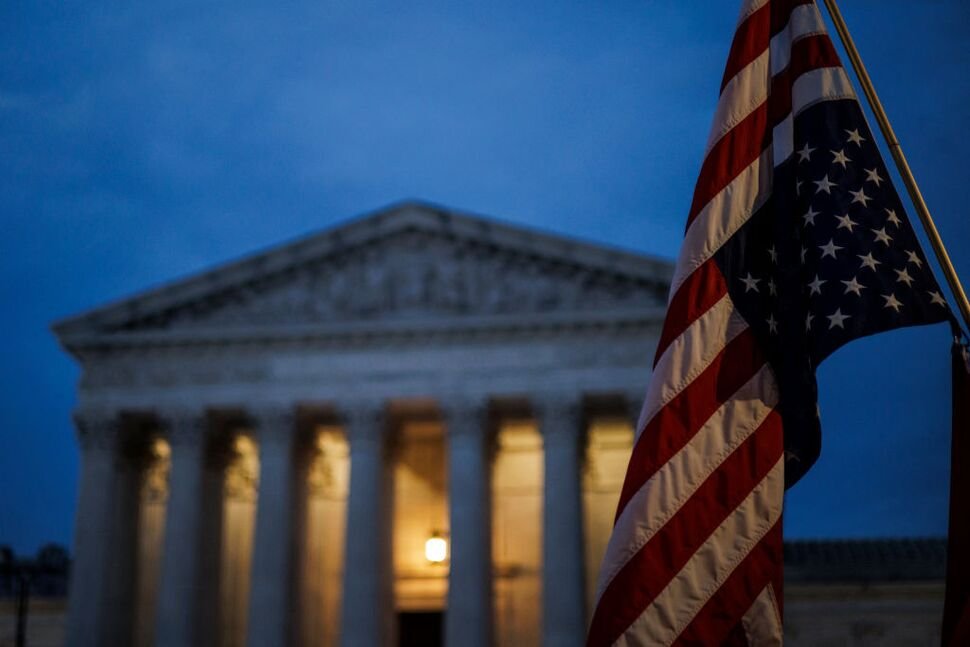
Flying the flag is an expression of free speech protected by the First Amendment, but is unfettered free speech a right that all public officials should exercise?
News that political protest flags have been flown at Supreme Court Justice Samuel Alito’s homes in Virginia and New Jersey raises serious questions about Justice Alito’s impartiality in deciding cases related to these political movements.
Both flags — the upside-down American flag symbolizing the “Stop the Steal” movement, and the Revolutionary-era “Appeal to Heaven” flag adopted in recent years by right-wing Christian nationalists — have been embraced by election deniers who have spread the lie that the 2020 election was stolen from Donald Trump. Both flags were brandished by rioters who stormed the U.S. Capitol on January 6, 2021, attempting to take over Congress and halt the certification of Joe Biden’s electoral victory.
The key issue isn’t whether Alito or his family have constitutionally guaranteed free speech. What keeps me up at night as a political theorist is the role of ethics in a healthy democracy, and what constraints we can reasonably place on public officials who make binding decisions that affect us all.
Nearly 2,500 years ago, in Plato’s foundational work in Western political thought, “The Republic,” the Greek philosopher posed a question that is just as relevant today for the unelected, life-appointed justices of the U.S. Supreme Court: “If certain people were to possess ultimate, non-appealable authority in a society, who should these people be? And how can society prevent the abuse of their power?”
Plato’s answer to the first question is well known: he argued that those with ultimate authority should be the wisest and most virtuous members of society.
His answer to the second question is more complicated and widely misunderstood. Many common interpretations of The Republic conclude that Plato favored absolutist, unconstrained government “to place this power in the hands of the most superior men,” as 20th-century philosopher Karl Popper put it.
This interpretation fails to take into account the strict constraints Plato placed on the wise ruler he envisioned: he even suggested that the ruler of an ideal republic should live on a minimum wage and not have a family, to avoid conflicts of interest or influence that would compromise his impartial judgment.
I am not saying that Supreme Court justices or other high-ranking officials should be forbidden from having private homes or family lives, but Plato correctly reasoned that money and family ties pose dangers to the motivations of public officials, who might be tempted to line their pockets or support causes connected to their families.
Alito said it was his wife, Martha Ann Alito, who raised the upside-down “Stop the Steal” flag but was silent about who raised the other flag. But the spouse of the highest-ranking public official also has an ethical responsibility to refrain from saying or doing anything that might cast reasonable doubt on their spouse’s impartiality.
The same is true of Justice Clarence Thomas, whose wife, Ginnie Thomas, actively supported those seeking to overturn the results of the 2020 election. Given their wives’ support, it is impossible for the people of our democracy to know whether Justices Alito and Thomas will be able to fairly rule on the case currently before the Court regarding the storming of the Capitol and Trump’s claimed immunity from prosecution in his attempt to overturn the results of the 2020 election.
What would Plato say in such a case? Perhaps he would remind us of the danger that family relations pose to the fair use of political power, and, as he does in the Republic, advise us to look for ways to limit those dangers.
There’s an interesting irony in the “Appeal to Heaven” flag that flies over Alito’s New Jersey home. The flag pays tribute to John Locke, the 17th-century English philosopher whose theories were the basis for the Declaration of Independence and the U.S. Constitution. In “Second Treatise of Government,” Locke wrote that if any branch of government seeks to “enslave or destroy” the people, the people’s only remedy is to “appeal to Heaven.” But Locke thought that “appeal to Heaven” could only happen if the people who serve as earthly judges lacked the legitimacy to decide the case.
No one, not even a Supreme Court justice, can judge their own ethical standards. The ethics code the Court adopted in 2023 is unenforceable and riddled with loopholes, allowing it to do just that. Congress must act quickly to act as a check on the Supreme Court and enact a code of ethics that binds justices just as all other federal judges are already bound by it.
Justices Alito and Thomas are free to resign if they, or their families, wish to exercise their freedom of expression in a way that would undermine the impartiality of the highest court in the land. But justices must accept stricter ethical constraints on resignation if they wish to enjoy the honors and privileges of public office.
Melissa Lane He is the Princeton 1943 Professor of Political Science and the author, most recently, of On Government and Office: Plato’s Political Thought (Princeton University Press, 2023).
