

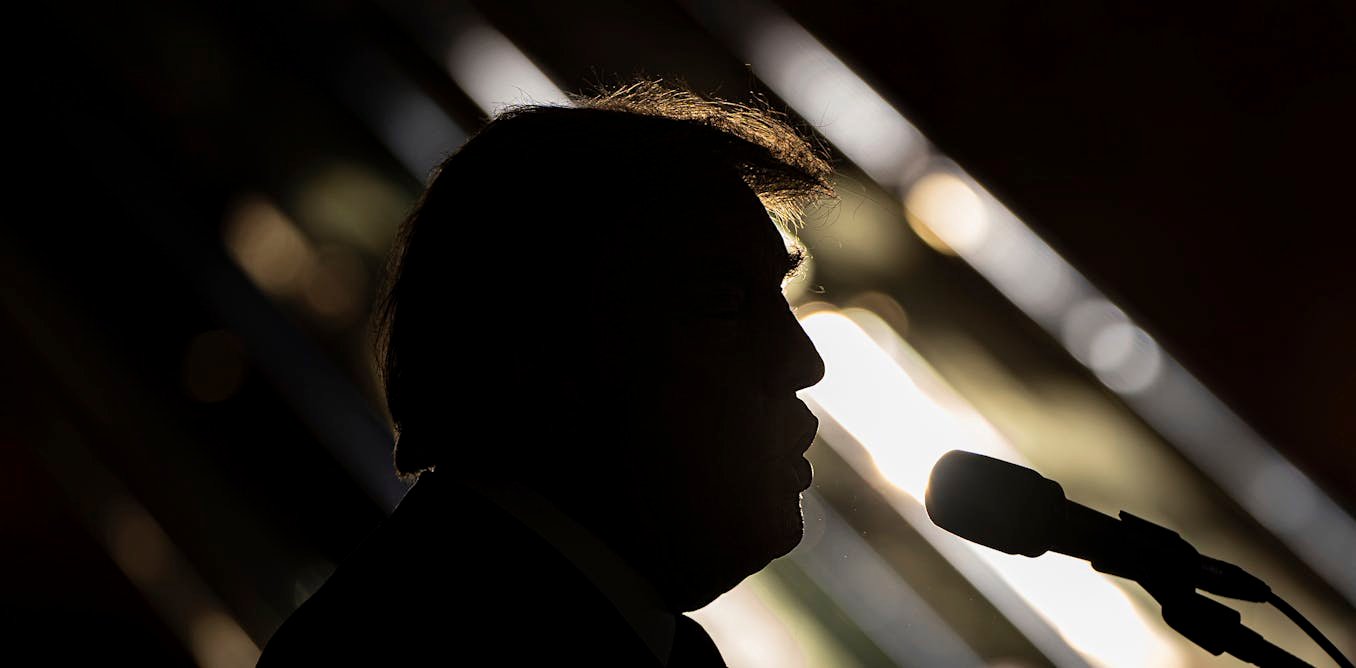
In the week leading up to Friday’s guilty verdict in a Manhattan courtroom, right-wing media focused on Donald Trump’s innocence. The hosts of the popular podcast “Timcast IRL,” which secured an exclusive 17-minute interview with the former president before his speech at the Libertarian National Convention, discussed the case at length.
Guest Kash Patel, a former senior Trump administration official, claimed he had “watched the prosecution’s case disintegrate” after Michael Cohen, Trump’s former lawyer and the star witness in the criminal case against the former president. Host Tim Pool agreed that “nothing has happened,” calling the case “absurd and insane.”
All three presenters and their guests followed the case very closely – they were deeply involved in it – and they were absolutely convinced that the case was fabricated and that only a “rigged system” would find him guilty.
On Friday, a jury found Trump guilty of falsifying business records in connection with the payment of hush money to cover up an affair with a porn star. Trump was found guilty of all 34 felony counts against him, making him the first president in American history to be convicted of a crime.
There is so much unprecedented about Trump. This moment is history-making.
Is America more polarized than ever?
Many Trump supporters like Poole and his friends had expected something like this to happen, and the conviction only strengthened their belief that the system is rigged against Trump and, by extension, against anyone who supports him or any part of his politics.
In the right-wing media world, it’s only A logical conclusion.
Trump has made this argument a popular one in right-wing media for years, and the day after the verdict was handed down, he told his supporters, as he has done so many times before: “If they can do this to me, they can do it to anybody.”
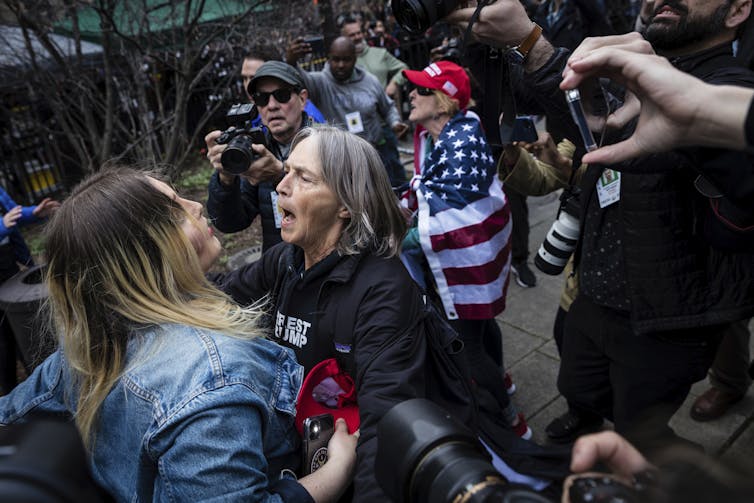
But outside of right-wing media, these comments have been met with a mixture of disbelief and concern, while mainstream media has said they, and the normalization of political violence, pose a serious threat to America’s democratic institutions.
This growing division in American politics, culture and society is often described as “polarization” – two very different political worlds, one right-wing, the other left-wing, becoming more and more separated and extreme from each other.
Stephen Jeremiah/FR171756 AP
But the idea that polarization is getting worse, or even that it is the biggest problem in American politics today, suggests that America once had a golden age of political consensus, and also assumes that there is a political center to which we can always return, and that there is equal amounts of extremism on both sides of the political divide.
This fits into a very Trumpian framework of labelling US President Joe Biden and the Democratic Party as extremists or, in Trump’s words, “socialists” and “Marxists”, which they are nothing like.
The reality of American politics today is not a simple matter of polarization that can somehow be reversed: rather, the apparent divide between the two camps, and their worldviews, is, at least for now, irreconcilable.
This division has a long history. The wildly differing reactions to the criminal convictions are emblematic of a fundamental truth: The United States was never one country. Trump didn’t create this situation, but he’s exploited it better than anyone. He’s already turned criminal convictions into a winning campaign strategy.
Read more: 1968 was a turning point for the U.S. – will 2024 be another one?
The new normal
Those who have unwavering faith in American democracy and the strength of its institutions would argue that this division is not necessarily exhaustive. They might point to polls that have shown fairly consistently that supporters outside of Trump’s core base could be changed by a conviction. This is especially true for Democrats and independents who previously voted for Trump. Biden can win back these voters in the 2020 presidential election and needs to keep them on his side in November.
But that may be changing. Recent polls suggest that the deciding factor for voters may be the prison sentence that results from a conviction, an unlikely outcome. Some polls suggest that a conviction may not matter at all.
Trump is adept at shifting political positions. Voters have known him for a long time, and his ability to avoid responsibility — to defy a “rigged” system — is something many voters admire.
There are many unprecedented aspects of his presidential and political career, and it is entirely possible that Trump could become the first former president to win an election despite or because of multiple criminal convictions.
