

Avirup Roy and Ben Kleiman
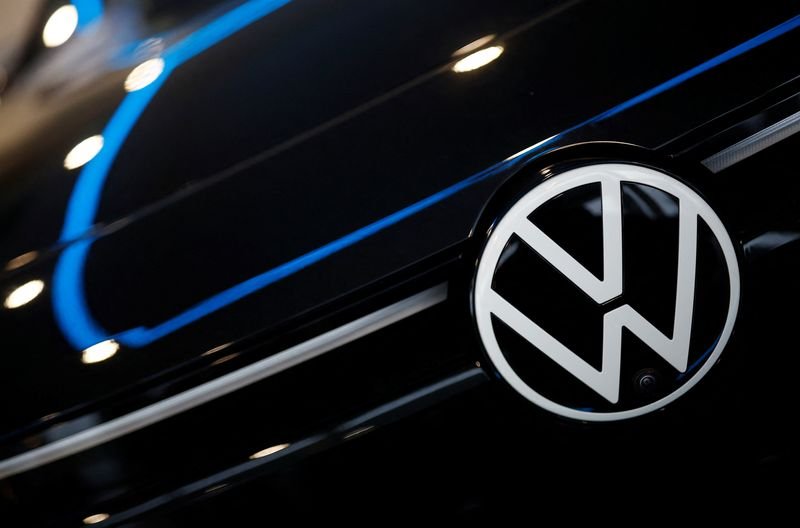
SAN FRANCISCO (Reuters) – German automaker Volkswagen Group will invest up to $5 billion in U.S. electric vehicle maker Rivian as part of a new joint venture to share EV architecture and software, the companies said on Tuesday.
Rivian’s shares surged about 50% in trading after the announcement, and if the rally continues on Wednesday, the company’s market capitalization could rise by nearly $6 billion.
The auto industry is at a critical juncture, with EV startups struggling with sagging demand due to high interest rates and dwindling cash, while traditional automakers struggle to develop battery-powered vehicles and advanced software.
The investment will give Rivian the capital it needs to develop its cheaper, smaller R2 SUV and planned R3 crossover, due for release in early 2026, CEO RJ Scaringe told Reuters. The partnership also allows Rivian to reduce operating costs by leveraging supplies of chips, parts and more, he said.
It would also help Rivian, known for its flagship R1S SUV and R1T pickup truck, become cash-flow positive. The company will license its existing intellectual property to the joint venture, and the R2 will be the first vehicle to use the joint venture’s software, followed by other Volkswagen vehicles including Audi, Porsche, Lamborghini and Bentley.
“Any of these capital injections are huge. Having the backing of the Volkswagen Group really strengthens the company’s story for Europe and ultimately Asia,” said Vitaly Golomb, managing partner at Rivian investor Mavka Capital.
For Volkswagen, analysts and investors see the investment as a move to address the automaker’s software problems. Cariad, the automaker’s software unit founded by former Volkswagen Group CEO Herbert Diess, overshot budgets and missed targets, which contributed to Diess’s departure in September 2022.
Volkswagen will immediately invest $1 billion in Rivian through bonds that will convert into shares on Dec. 1, subject to regulatory approval. Volkswagen will also pay $1 billion when the joint venture is set up, expected in the fourth quarter of this year.
The German automaker also plans to invest $1 billion in each of 2025 and 2026 for a total of $2 billion in equity in Rivian, as well as provide a $1 billion loan in 2026, subject to the startup hitting certain targets.
Cost reduction
Despite losing nearly $40,000 per vehicle it delivers, Rivian remains in a more stable position than other EV startups that have been forced to slash prices and file for bankruptcy, including Fisker, earlier this month.
To stay afloat, Rivian has been working to cut costs while striving to deliver EVs on time, renegotiating contracts with suppliers and making some parts in-house.
The company has overhauled its manufacturing processes and significantly reduced material costs, Scaringe told Reuters last week.
Rivian’s cash and short-term investments fell by about $1.5 billion in the first quarter to just under $8 billion. Before the VW deal, Rivian had said it had enough cash to launch the R2 SUV.
“It definitely needed something to survive after the launch of R2, and this definitely helps extend that reach,” said Sam Fiorani, vice president at research firm AutoForecast Solutions.
Rivian shares have fallen by more than half this year, and traders are betting heavily on the stock falling, with as much as 18% of the stock recently sold short, according to data from S3 Partners.
heritage
Volkswagen said earlier this year that it was sticking to plans to launch 25 electric vehicles across its brands in North America by 2030, even as it acknowledged slowing growth in its electric-vehicle division. The company’s shares have fallen about 3% so far this year.
VW isn’t a big player in the U.S. large SUV and pickup truck segments and failed to break through with its ID4 electric crossover SUV, Mr. Golomb of Mahvka Capital said. But the Rivian partnership gives the company options, he said.
Volkswagen said Tuesday that Rivian’s software will also be used in Scout, the German automaker’s off-road electric brand, which is building a factory in South Carolina to assemble pickup trucks and SUVs that will compete with Rivian, due to open in the second half of 2026.
VW’s Cariad has struggled for years. Analysts say some of the company’s legacy systems are sourced from suppliers, complicating the integration of different parts. Problems at the division have delayed development of key new vehicles, including the Porsche e-Macan and Audi Q6 e-tron.
Volkswagen has unveiled a new software architecture, but cars built using the technology aren’t expected to hit the market until 2028.
Still, VW said Cariad will play a central role in expanding software used across the brand.
(Reporting by Avirup Roy in San Francisco and Ben Klayman in Detroit; Additional reporting by Noel Landewicz in Oakland, California, Christina Ammann in Berlin and Harshita Varghese in Bengaluru; Writing by Sayantani Ghosh; Editing by Rod Nickel, Matthew Lewis and Leslie Adler)
