

-

-
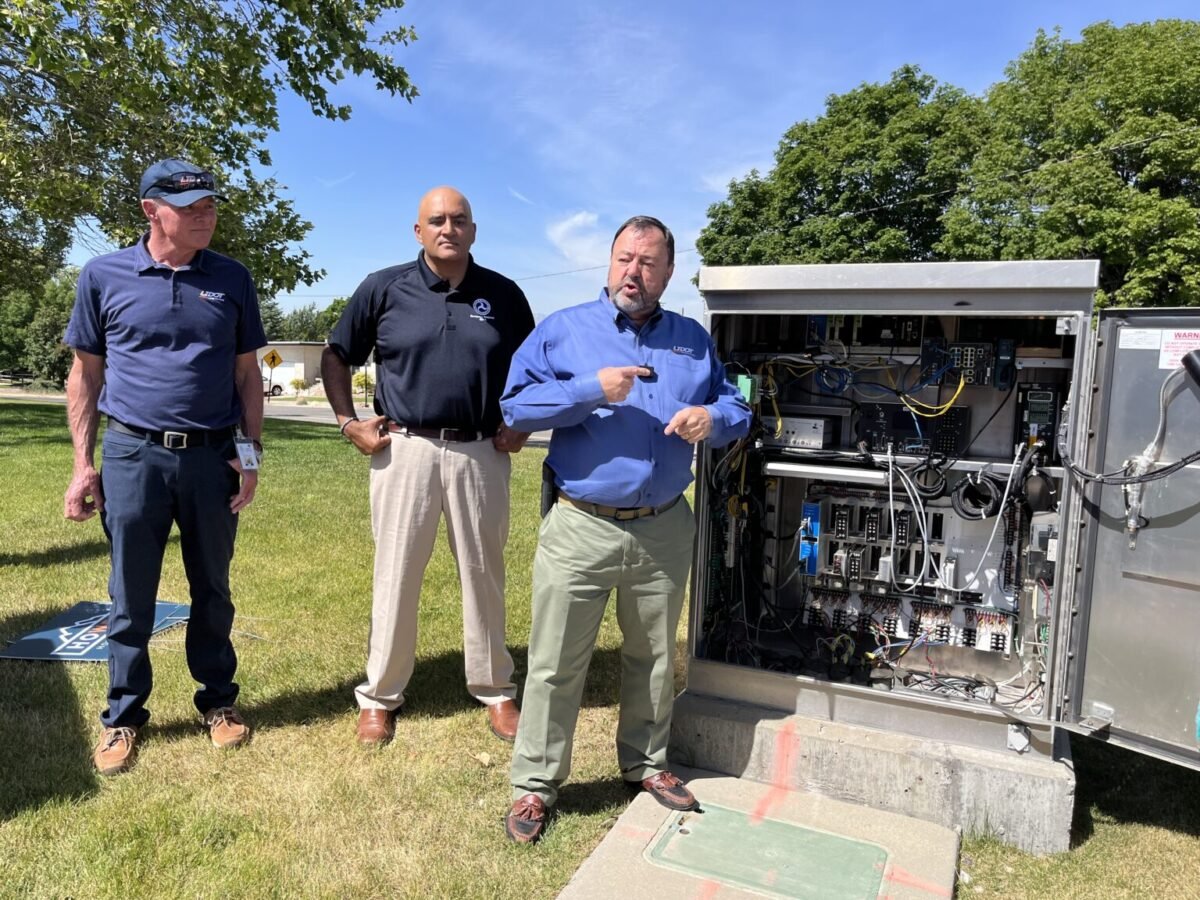
UDOT traffic engineer Blaine Leonard explains how V2X technology works at an intersection in Salt Lake City, Thursday, June 20, 2024, with UDOT Executive Director Carlos Braceras and Federal Highway Administrator Shailene Butt.
-

-
Blaine Leonard, transportation engineer with UDOT, explains how V2X technology works on UTA buses on Thursday, June 20, 2024.

Alixel Cabrera, Utah News-Dispatch
UDOT traffic engineer Blaine Leonard explains how V2X technology works at an intersection in Salt Lake City, Thursday, June 20, 2024, with UDOT Executive Director Carlos Braceras and Federal Highway Administrator Shailene Butt.
What if cars, bikes and buses in Utah could receive messages from the roads to avoid accidents? The state’s infrastructure could predict when a driver might run a red light, turn lights green when emergency vehicles need to get to their destination faster, and bridges could tell cars to slow down to avoid accidents.
It’s technology the Utah Department of Transportation has been working on for years. It’s already installed on Utah Department of Transportation buses and snowplows, and is poised to expand with newly allocated federal funding. Utah will receive $20 million from the Federal Highway Administration from a $60 million funding pool and partner with Wyoming and Colorado on the effort.
“This is a pretty big deal. This is going to change our industry,” UDOT Executive Director Carlos Braceras said at a press conference June 20. “We’re at a point right now where technology and transportation are converging like never before, and I think we’re seeing this major shift happening right now.”
The technology is called “V2X,” an acronym for vehicle-to-everything, and can connect roads, traffic lights and other infrastructure to vehicles. Officials said the hope is that in the future, the system could send a signal if an airbag deploys after a sudden stop on a curve, for example, to stop other vehicles from speeding too close to the scene of a crash.
Federal Highway Administrator Shailen Bhatt, speaking during a visit to Salt Lake City, said technology has transformed a lot of things, but the country will see more than 40,000 traffic deaths in 2023, “because transportation agencies haven’t been brave enough or fast enough to adopt it.”

Alixel Cabrera, Utah News-Dispatch
Blaine Leonard, transportation engineer with UDOT, explains how V2X technology works on UTA buses on Thursday, June 20, 2024.
For example, the system could have sent a message to all vehicles approaching a Baltimore bridge, which collapsed in March after a container ship struck one of its piers, telling them to stop.
Butt announced that federal funding will be allocated to introduce the technology into snowplows, buses and traffic lights.
“There’s been a chicken-and-egg battle on this issue for a long time: Should you have it in the vehicles but no infrastructure, or should you have no vehicles but the infrastructure? With today’s announcement, we want to push that environment further and help automakers realize they need to deploy at scale, because that’s the only way you’re really going to get connectivity,” Bhatt said.
The safety gains could be comparable to the introduction of universal technology such as airbags or mandatory seat belts, Braceras predicted.
Salt Lake City Mayor Erin Mendehall said it’s this safety element she’s most grateful for.
“I think this is a way to use technology that we wouldn’t have even thought of just two years ago. This is a great thing, and it’s a great advantage for the state of Utah and several other states to be at the forefront of this investment with our federal partners,” Mendenhall said at a June 20 press conference.
Utah Transportation Agency buses have been using the technology in recent years; agency Executive Director Jay Fox said at a press conference that the buses are far more advanced than past versions. Ogden has 11 electric buses equipped with V2X technology; the plan is to have the system on UTA’s entire fleet within five years.
“Last year, our buses, across our system, transported 80 million customers, a 15 percent increase from the previous year,” Fox said. “Demand for our service is growing, and customers need to trust that their buses will arrive when they’re scheduled to.”
He added that V2X combined with transit signal priority – a communications technology that allows traffic signals to give delayed buses extra green light time to help them catch up – would help keep buses running on time.
Utah News Dispatch is a nonprofit, nonpartisan news source covering government, policy and the issues that most impact the lives of Utahns.
Newsletter
