

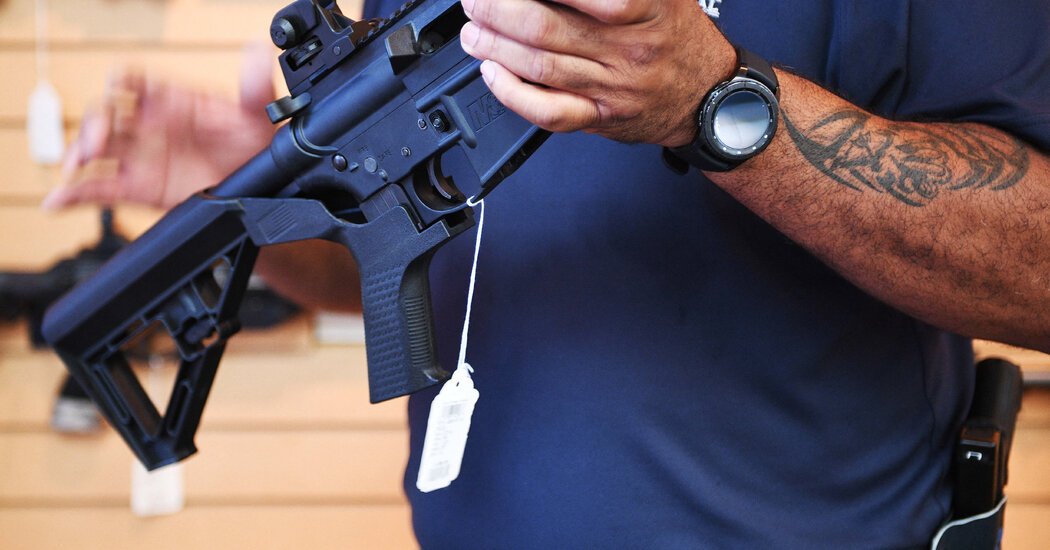
The Supreme Court on Friday struck down a ban on bump stocks, which allow semi-automatic rifles to fire at speeds comparable to those of machine guns, striking down one of the rare gun restrictions enacted by the government in the wake of a mass shooting.
The decision was a 6-3 vote, divided along ideological lines, with Justice Clarence Thomas, writing the majority opinion, saying the Bureau of Alcohol, Tobacco, Firearms and Explosives exceeded its authority when it issued regulations classifying bump stocks as machine guns and banning the devices.
“We hold that a semi-automatic rifle equipped with a bump stock is not a ‘machine gun’ because it cannot fire more than one shot with a ‘single action of the trigger,'” Justice Thomas wrote. His opinion included several diagrams of the firing mechanism and detailed technical descriptions of the firearm’s internal workings to show how bump stocks work.
The Trump administration enacted the ban after a gunman opened fire at a Las Vegas concert in 2017, causing one of the deadliest massacres in modern American history.
The ruling marks a strong rejection of one of the government’s few measures to address gun violence amid stalled legislative efforts in Congress and underscores deep divisions within the Supreme Court as the nation continues to grapple with mass shootings.
The narrowly worded decision is not a challenge to the Second Amendment. Rather, it is one of several cases this term aimed at weakening the power of the executive branch. The Supreme Court has yet to issue many of those decisions, including a challenge to the influential case known as Chevron. But the bump stock decision could signal conservative justices’ support for limiting executive branch power.
Justice Sonia Sotomayor dissented, joined by Justices Elena Kagan and Ketanji Brown Jackson.
Justice Sotomayor wrote the first dissent of her term, a practice she does only in cases of serious disagreement. “The majority is putting machine guns back in civilian hands,” she said.
“If I see a bird that walks like a duck, swims like a duck, and quacks like a duck, I call that bird a duck,” Justice Sotomayor wrote. “A semi-automatic rifle equipped with a bump stock ‘automatically fires multiple shots with a single pull of the trigger, without the need for manual reloading.’ I, like Congress, call it a machine gun, and so I respectfully dissent.”
In the National Firearms Act of 1934, Congress outlawed machine guns, defining them as “weapons that automatically fire, are designed to fire, or are readily reloadable and capable of firing one or more shots with a single pull of the trigger without manual reloading.” This definition was expanded by the Gun Control Act of 1968 to include parts that can be used to convert weapons into machine guns. This category is heavily regulated by the ATF.
Bump stocks allow a gun to slide back and forth freely, harnessing the recoil energy a shooter feels when the gun is fired. Judges appear divided on whether this should count as one or multiple trigger pulls.
Bump stocks were considered legal until the Trump administration implemented the ban. The previous interpretation of the law said that bump stocks increased the gun’s velocity by sliding the stock back and forth to allow for a quicker pull of the trigger, rather than the “single function of the trigger” required for machine guns.
The decision sparked an immediate backlash, with Democrats jumping on the opportunity to blame former President Donald J. Trump and argue that both his actions and his nominations to the Supreme Court were decisive factors in the outcome.
In a statement, President Biden called on Congress to ban the devices. “The American people should not have to live in fear of such massive destruction,” he said.
The bump stock ban was challenged by Texas gun shop owner Michael Cargill and is backed by the New Civil Liberties Union, an advocacy group with financial ties to billionaire Charles Koch, a longtime backer of conservative and libertarian causes. The group primarily targets what it sees as unlawful uses of executive power.
Cargill said he was in bed working on his iPad when he refreshed the Supreme Court’s website and saw the ruling. He was so overwhelmed he fell off the bed. “I was ecstatic,” he said. “For the first time in my life, I was speechless.”
He called the case a broader victory for gun rights, adding that it will make it easier to challenge future attempts by the ATF to regulate firearms.
Justice Thomas said the dissenting justices ignored Congress’ definition of a machine gun.
“Bump stocks cannot turn a semi-automatic rifle into a machine gun, nor can a shooter with lightning-fast trigger pulls do so,” Justice Thomas wrote.
Justice Samuel A. Alito Jr., in a concurring opinion, largely agreed with that assessment, finding that “there is no other way to interpret the statute’s language.”
“The horrific mass shooting in Las Vegas in 2017 did not change the statute’s language or its meaning,” Justice Alito wrote. “There is a simple solution to the difference between treating bump stocks and machine guns differently: Congress can change the statute.”
Justice Sotomayor, in her dissent, disagreed with these interpretations.
“Today, the Court has put bump stocks back into civilian hands,” Justice Sotomayor wrote. “In doing so, the Court has ignored Congress’ definition of ‘machine gun’ and adopted a definition that is inconsistent with the ordinary meaning of the statutory text and unsupported by context or purpose.”
“This is not a difficult case,” she wrote, adding that the majority opinion “focuses on the internal mechanisms that cause a shot to fire, not the human act of the shooter pulling his gun in the first place,” and that its interpretation “requires six diagrams and animations to decipher the meaning of the statutory text.”
The lethality of this device became alarming in October 2017.
That month, 64-year-old high-stakes gambler Stephen Paddock opened fire on the 32nd floor of a Las Vegas hotel at a country music festival, killing 60 people and wounding hundreds, firing more than 1,000 rounds in about 11 minutes. His arsenal included about a dozen AR-15-style rifles equipped with the device.
Political pressure for immediate action began to grow after the Parkland, Florida, school shooting, and President Donald J. Trump, a staunch supporter of the Second Amendment, vowed to ban the devices.
Justice Department officials initially said the executive branch could not ban bump stocks without congressional action, but ultimately reversed course, saying a ban would make possessing or selling them punishable by prison time.
Divided opinions among lower federal courts make it more likely the Supreme Court will rule.
After a federal district judge in Texas ruled against Cargill, he appealed to the U.S. Court of Appeals for the Fifth Circuit. Ultimately, the full bench, one of the most conservative appellate courts in the country, agreed with Cargill, who is split along ideological lines.
“A plain reading of the statute and a close examination of the construction of semi-automatic rifles makes clear that bump stocks are excluded from the technical definition of a ‘machine gun’ in the Gun Control Act and the National Firearms Act,” wrote Judge Jennifer Walker Elrod, an appointee of President George W. Bush.
The three dissenting justices, all Democratic appointees, argued that the majority’s reasoning “legitimized the means of mass murder.”
Adam Liptak Contributed report.
