

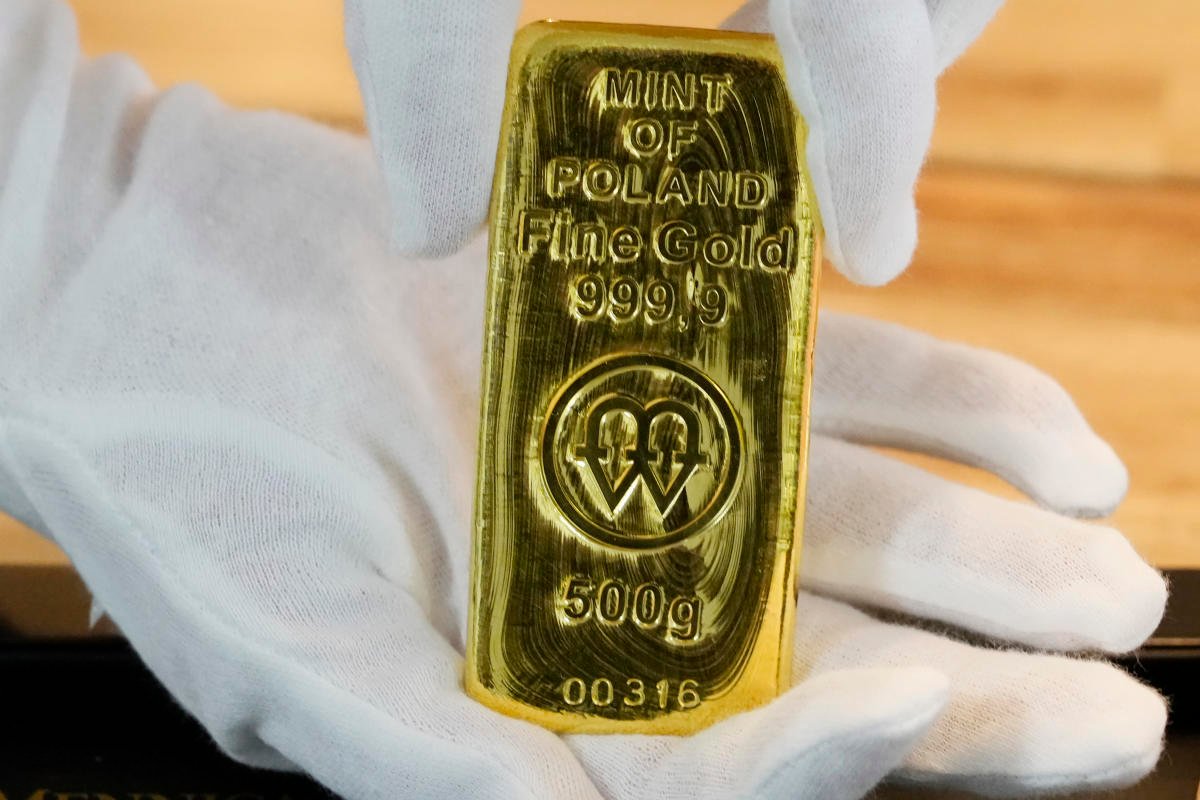
WARSAW, Poland (AP) — Long lines formed outside gold stores in Poland when the coronavirus pandemic began. Then Russia’s full-scale invasion of Ukraine ignited a renewed scramble for the metal in the neighboring country.
Piotr Kozik, manager of a Warsaw shop selling gold bars and coins made by the Polish Mint, remembers that the day Russia invaded, Feb. 24, 2022, was “Fat Thursday,” a day when Poles gorge on paczki, jam-filled doughnuts.
“That day, there was a line longer at our store to buy gold than there was for doughnuts at the bakery,” Kozik said.
Poles were reeling from war across their borders, refugees were fleeing to their country, and for many, money seemed to offer both financial and emotional security.
Those lines have now disappeared, but demand for gold has remained steady as the war rages on into its third year.Adding to the unrest is a migrant crisis on the Polish-Belarusian border that Polish authorities see as a hybrid war waged by Moscow and Minsk.
Radoslaw Paklikowski, a 38-year-old entrepreneur from the western Polish city of Wroclaw, started buying gold and silver coins in 2021 and now has 5% of his assets invested in precious metals.
“Having physical gold is important — not in the sense of having a ton of gold, but having enough gold to help you get across borders or to keep your family safe if something happens,” he said.
NATO membership gives some a sense of security, but many in a region once under Moscow’s control worry that a Russian victory in Ukraine could be more than just an end in itself.
While governments are beefing up their defenses and sending weapons to Ukraine, ordinary people are seeking protection. Some of the wealthy are buying homes in Spain and Italy.
Unlike investments in real estate or fine art, gold, diamonds and silver are easily movable in Poland.
In Poland, the allure of gold is intertwined with the enduring trauma of World War II, which could have guaranteed survival.
Families still tell stories of relatives surviving thanks to gold jewelry and coins that allowed them to buy food and travel to safety across the border during the German and Soviet occupations that killed some six million Polish citizens, including most of Poland’s Jews.
Marta Bassany-Prusik, head of precious metals trading at the Polish Mint, said her customers include Poles remembering such family histories, as well as people of Polish descent who fled the Warsaw Ghetto and are returning to see the land of their ancestors.
“They say they’re only surviving because of gold, because their grandparents had gold bars or gold coins,” she said.
She said the market for investment gold bars and coins had been sluggish for several years before COVID-19, but had skyrocketed due to the pandemic and war “because everyone was scared of what was going on.”
Just as the gold market was beginning to calm down, post-pandemic inflation has caused it to rise again, with inflation in Poland exceeding 18%.
The price of gold, like stocks, can be volatile and investors can lose money by buying high and selling low, and it can also be lost or stolen. Gold, like oil, is priced in dollars on the global market, so currency fluctuations can increase risk for some.
Gold’s continuing allure is a testament to its universal appeal, with its price soaring from about $1,300 per troy ounce (31 grams, the standard unit of measurement for the precious metal) to more than $2,300 in the past decade.
The rise in gold prices is increasingly being driven by demand from individuals and central banks in Asia, according to Michal Teklinski, an expert at Gold Saver, a popular new division of investment gold dealer GoldenMark Group that allows clients to buy physical gold in installments.
Teklinski expects gold prices to continue to rise over the next few years as central banks in China and many emerging markets increase their gold reserves.
Buoyed by rising wealth and distrust in authorities amid a global economic boom, Poland’s physical gold market has been one of the strongest in Europe since 2020, behind Germany, Switzerland and Austria. “After 2020, people started going back to basics,” he said.
The Polish Mint, in operation since 1766, was once a state-owned enterprise but was privatized after the fall of Communism and is now listed on the Warsaw Stock Exchange. The Mint holds the sole right to produce Poland’s circulation coins. It also mints coins for countries around the world, from Paraguay to Ireland, and Luxembourg to Thailand.
The company says its gold comes from mines in Poland and is ethically sourced and produced, respecting human rights and environmental protection.
At the Polish Mint’s store in central Warsaw, surrounded by skyscrapers on the site of the former Warsaw Ghetto, the price of gold is updated on screens throughout the day.
One afternoon, the store’s owner, Marcin Grzesiak, 40, came into the store and ordered three gold coins. He handed over 29,000 Polish zlotys ($7,000) in cash and slipped the coins into his pocket.
Grzesiak, who lives in eastern Poland near the border with Belarus, said he wanted to diversify his investments because he was concerned about the geopolitical situation and the threat that cyber attacks pose to global financial stability.
“We are living in turbulent times,” he said. “I never thought Russia would attack Ukraine. Even my friends from Ukraine never thought Russia would attack them. Anything could happen.”
