

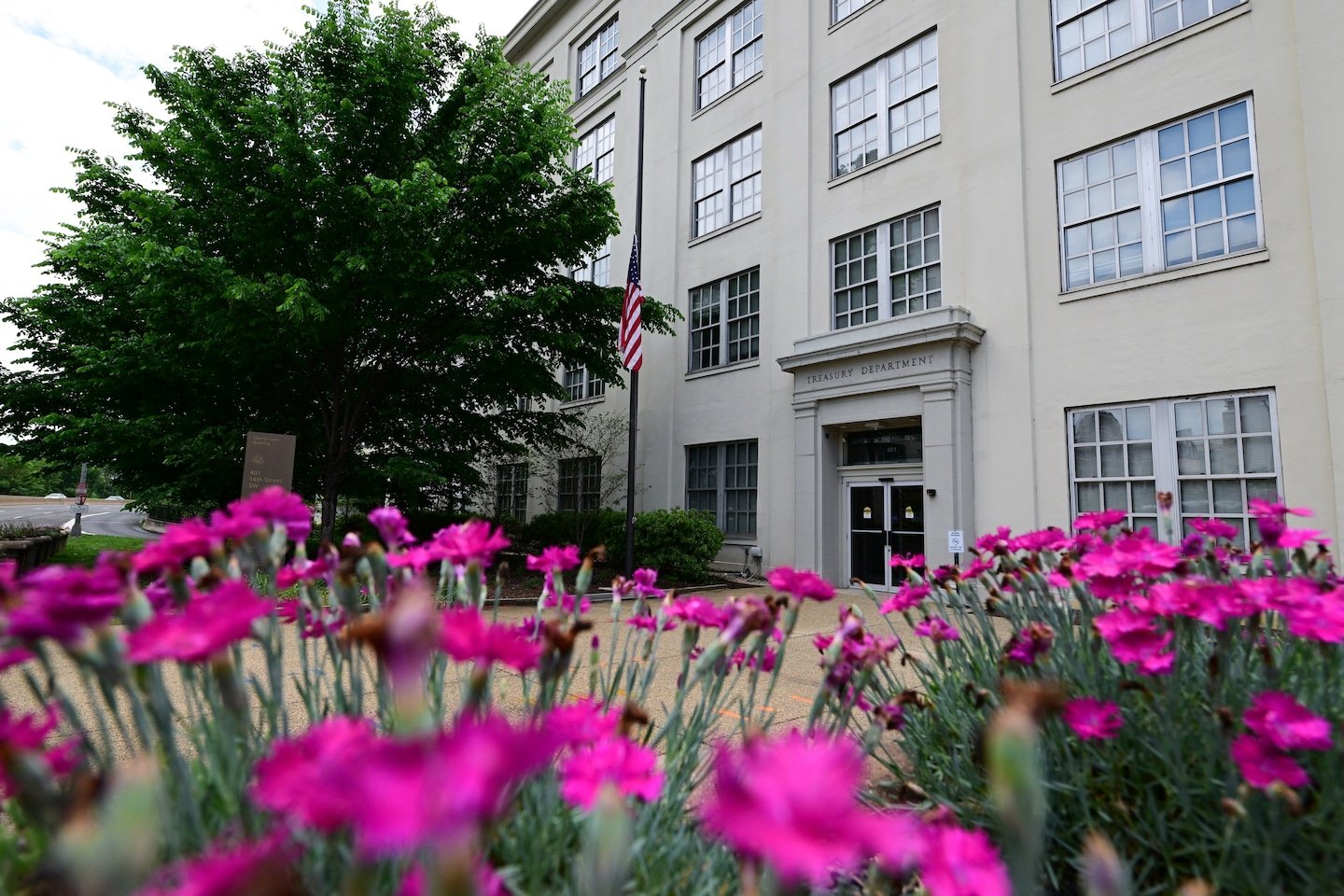
No one knows what will happen next, but if the GSA sells the building, the new owner will likely demolish it to make way for a new structure. That would be not only a disgrace to the views along the Tidal Basin, but also a mistake. To prevent that, we need to designate this important, yet unassuming, relic of the American century as a National Historic Landmark.
Just off the Tidal Basin, at the intersection of SW 14th and D Streets, the Liberty Loan Building was constructed in 1919 as the home of the bond program of the same name that was launched during World War I. According to the GSA, the L-shaped, five-story structure was one of the first reinforced concrete buildings in Washington, and it remains a unique representative of all the tempo that once pulsed with the energy of the nation’s wartime government.
When the United States entered World War I in April 1917, the federal government had 430,000 civilian employees. Within a year, that number had nearly doubled to 844,000, outgrowing the existing Victorian-era government buildings. The only undeveloped area of downtown was the Mall, where thousands of trees were cut down to make way for the Tempos, which sprang up in what was once green space. Huge Tempos housing the Navy and War departments rose along Constitution Avenue, where the Smithsonian National Museum of American History now stands, outgrowing the old State, War and Navy building (now the Eisenhower Executive Office Building) next to the White House.
Once Tempo was built, it quickly became overcrowded: The Liberty Loan Building was meant to house 1,200 workers, but by the time it opened it had to accommodate 1,800, eventually forcing a two-story addition.
After the Armistice, the federal workforce dwindled, but Tempos persisted and grew during World War II. From 700,000 government employees in 1940, the U.S. government grew explosively, and by 1945 nearly 3.4 million employees worked in the new American empire, many of them in the nation’s capital. Dozens more Tempos were built along the Mall and around the city after 1942, connected through reflecting pools. Looking like a comb from above, at least 54 Tempo buildings dotted Washington during the first quarter century of the Cold War.
Washingtonians hated the Tempos. Compared to the monumental neoclassical architecture that dominated the city, they were ugly and utilitarian. By the mid-1960s, the Tempos were outdated and their aging materials made them nearly impossible to keep clean, even as tens of thousands of federal employees toiled away in their cramped offices. In 1964, the Tempos finally began to be removed, and by 1971, only the Liberty Loan Building remained. But while they remained, the Tempos were a symbol of an America that had shed its agricultural roots and become the world’s dominant power.
These offices were also the first to accommodate a more diverse government workforce, a harbinger of broader social change. During World War II, the female workforce rose from 27% to 37% of the total workforce, thousands of women entered government employment, and by 1944 blacks made up almost 12% of federal employees. Washington also welcomed people from small towns, a short distance from farms. Inside the modest exterior, the tempo was high. was America.
There are rules for selling historic federal property, but GSA may try to sell the last Tempo sometime next year. If the government keeps it, the building could become a museum about the federal workforce or house an exhibit about World War I to complement the new World War I memorial in Pershing Park.
If it is sold, its unique history should be recognized and incorporated into its next use: it should be listed on the National Register of Historic Places to prevent the new owner from demolishing and replacing the building. Of the structures on that list, few represent the era of America’s emergence as a global power as the Liberty Loan Building, and few have welcomed such a diverse range of Americans as this last tempo.
From landing soldiers in France to astronauts on the moon, the Tempo was witness to the American Century. Let’s save the last Tempo.
