

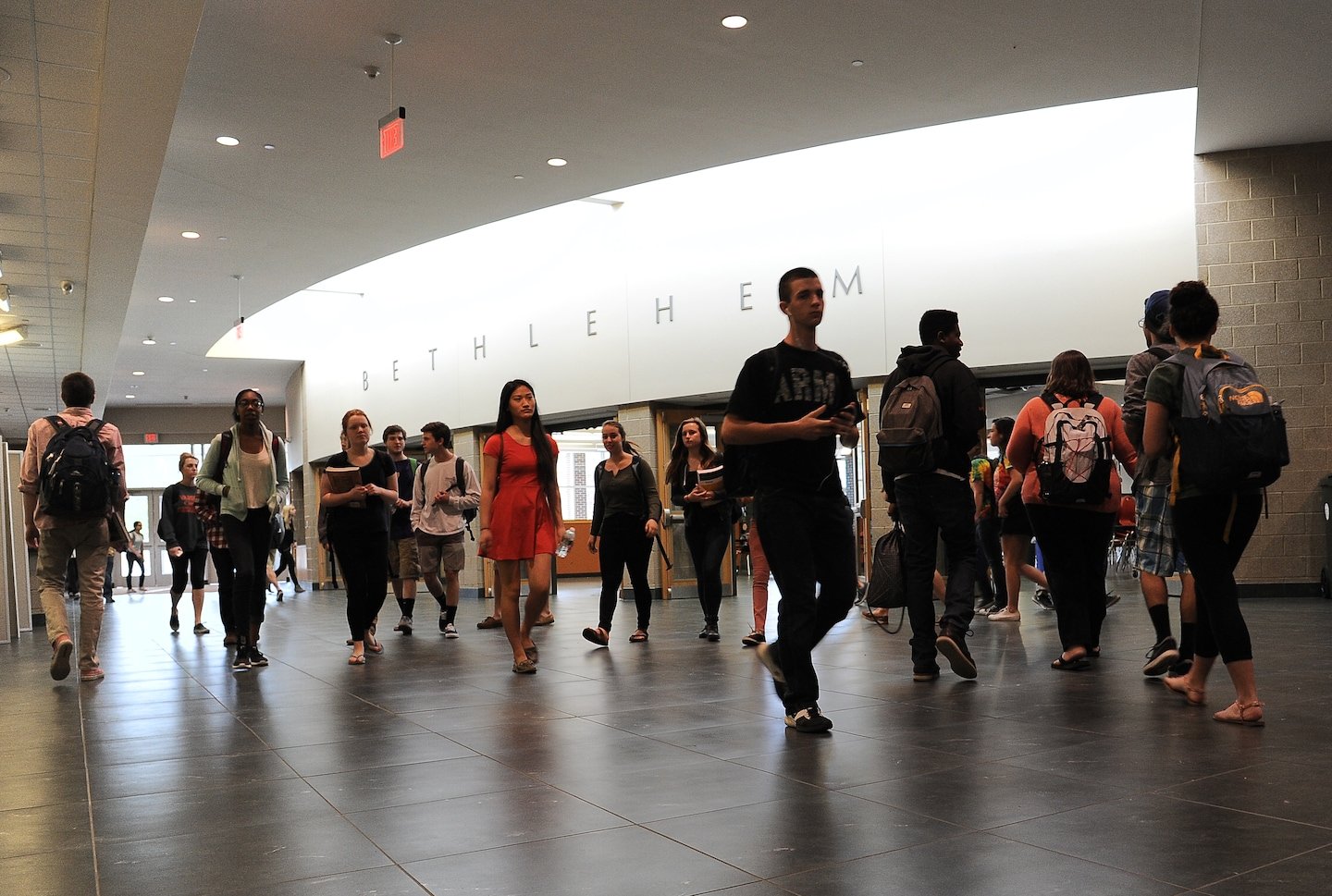
He gestured, as if by some miracle, to the cafeteria in front of us, a throng of chattering students buzzing with the clatter of trays and creaking chairs. It all seemed perfectly normal to me, but maybe that’s because the last time I ate lunch in a high school cafeteria was in the 1980s.
I’m usually wary of complaints that use the past as a benchmark and position the present as a dangerous departure from it. When alarm bells sound about declining marriage rates, or teenagers coming out as nonbinary, or Gen Z leaving religion in droves, I wonder instead how many people got married because they had no other choice, or conformed to strict gender norms despite their discomfort, or stayed in the church despite a feeling of not belonging.
The past, while familiar, was not necessarily better.
So, with some hesitation, I say, “Kids these days are using their phones too much.” A recent Gallup poll found that teens spend an average of about five hours a day on social media alone, excluding gaming and texting. And a Common Sense Media report found that teens, on average, check their phones more than 100 times a day.
Screen time is bad for adolescents’ mental health. Mobile phone use puts social interactions at risk and is a weapon in bullying. Mobile phones are also a distraction. Even when they’re not in use, they’re always in your pocket or backpack, “Hey! Hey! Hey! Look at me!” This makes it hard to concentrate on anything, let alone applied geometry. In fact, studies have shown a correlation between cell phone use and lower grades and test scores.
Schools, and now some states, are increasingly trying to limit cellphone use during class time to limit the damage — Bethlehem was the first to try — but it’s not just the lack of focus in the classroom that’s the problem. Doemer said cellphones are Outside Every argument during school hours was recorded and posted, every insult and taunt shared, gaining momentum as it spread through the app.
So he pushed for a total ban, and the school board voted unanimously in favor. Parents were worried they wouldn’t be able to reach their kids during class or in case of an emergency, but they could still call the office or send emails. Every student has a Chromebook, and every classroom has a phone that can dial 911.
Teachers also resisted, arguing that students should be treated as adults — a common argument: “If we don’t teach self-control and good judgment, we leave students ill-prepared for life.”
But how do we prepare students to contend with technology that is designed to be addictive? Adults can’t resist it either. Doemer likens it to “giving a kid a cigarette and telling him to be responsible.” Even if students want to be responsible, they can’t.
The next day, I visited another suburban Albany high school, Guilderland, where my sons attended. While cell phones aren’t banned at Guilderland, Principal Mike Piscitelli says the school has purchased storage pockets that hang on classroom doors. Teachers make the rules, and the administration backs them up. “People are a little afraid of being the bad guy,” he says.
Those are the teachers, he said. But even knowing that cellphones can cause problems, school districts are wary. Piscitelli has seen the damage that constant access to social media can do to kids and schools. “If there’s a conflict, it never ends,” he says. “It just continues to go on.”
When Piscitelli and I visited the study halls, there was no fighting, but who knows what lurks in the little magic boxes that every student keeps next to (or in place of) their homework. I asked the librarian who oversees the study halls if she’d noticed a change in her 20 years at Guilderland. “Yes, I have,” she said. “Students don’t know how to have a conversation anymore.”
On my way home, I passed a grassy courtyard where three girls were sitting together in the sunshine, looking at their phones. “Students can’t help but gravitate towards their phones,” Piscitelli told me. I couldn’t help but picture three sunflowers pointing to the ground.
Guilderland, like many local schools, is watching Bethlehem’s ban closely. Representatives from Bethlehem visited the Schoharie, N.Y., school district last year and have toured more than 20 schools, seeing bustling lunchrooms, hearing the old-fashioned hustle and bustle between classes and marveling at students walking the hallways with their heads held up.
But are they prepared to be the bad guys?
The question is not whether kids these days are addicted to their phones or whether that addiction is affecting their mental health, their socialization, their community. Of course they are, and it is. The question is whether we use our schools to try to break that addiction, or at least give kids seven hours of recess 180 days a year.
I asked Doemer if anything about the ban’s implementation surprised him. He said he didn’t realize how much of a burden cell phones were. To all studentsSome students said they felt relieved that they didn’t have to respond to posts or text messages during class.
Maybe kids aren’t learning to regulate their cell phone use, but they are learning that sometimes the best way to solve a problem is to let someone else handle it.
