

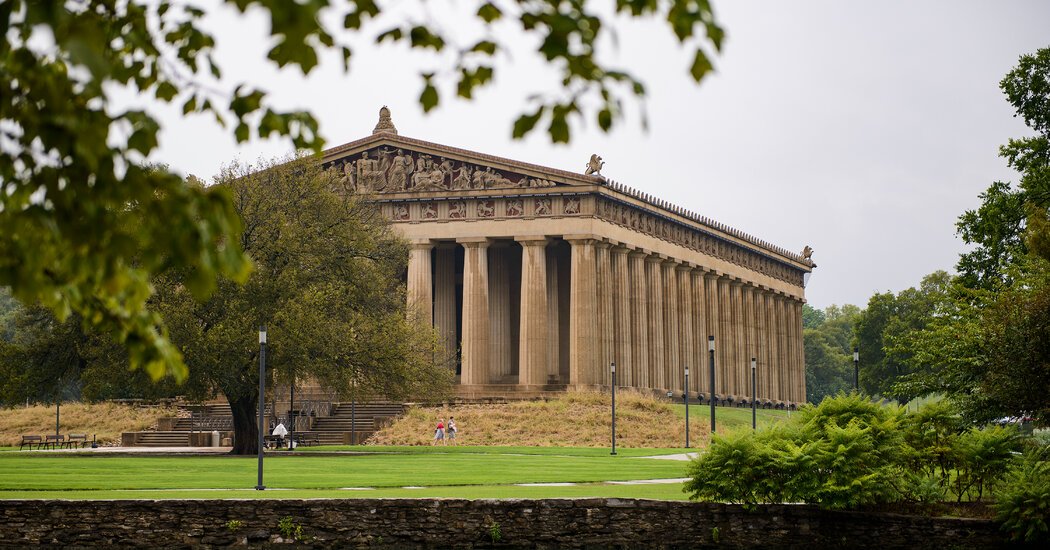
When Nashville Scene held its first annual “You Are So Nashville If” contest in 1989, the winning entry was “I Think Our Parthenon Is Better Because the Other Parthenon Collapsed.”
The winner of Newsweekly’s long-running contest undoubtedly encapsulates the city’s zeitgeist, but I still think of it every time I pass the Parthenon, a contest that acknowledges the building’s breathtaking grandeur while simultaneously tacitly acknowledging the absurdity of having an exact, life-size replica of an ancient Athenian temple in a Nashville city park.
By the mid-19th century, Nashville had become known as the “Athens of the South,” a reference to the city’s unusually high number of universities. The actual Parthenon was built in the 5th century BC as a temple to Athena, the patron goddess of Athens. Our Parthenon was built in 1897 as a temporary exhibition space connected to Tennessee’s Centennial.
Now a museum, it still stands in Centennial Park, surrounded by 132 acres of gardens and other public spaces. Like the original Parthenon, Nashville’s Parthenon says something to the world about how this city sees itself, how it wants to be understood, and the truths it holds most dear.
Following that tradition, officials at the Parthenon in Nashville announced that the museum’s collection of pre-Columbian artifacts would be returned to Mexico. The small, local museum’s decision illustrates the practical, moral and ethical issues that much larger museums, such as the Metropolitan Museum of Art in New York and the British Museum in London, are grappling with as they consider what to do with pieces in their collections that were looted from other cultures.
The 248 Pre-Columbian pieces came to the Parthenon as donations from two private collectors in the 1960s and 1970s, and include tools, musical instruments, ceramic vases, portraits, and animal sculptures (including a very adorable Mexican hairless dog).
Some of the most prominent pieces have been on public display since April 18 in an exhibition entitled “Repatriation and its Consequences.” After the exhibition closes on July 14, the entire collection will be sent to the National Institute of Anthropology and History in Mexico City.
I toured the exhibit with Bonnie Seymour, an assistant curator who joined the museum staff two years ago. The need to address the ethical implications of this collection became apparent to her on her first day in her new job. She recalls that while browsing the art in the museum’s storage, she stopped in front of some pre-Columbian artifacts and thought, “Oh, this is not the place for these artifacts.”
Questions about the belonging of antiquities are often raised when it comes to art collected before the ethical standards held to by collectors today. “Every restitution case is different,” Seymour is careful to point out.
If the piece’s provenance is unclear, if there is no documentation proving its legitimate purchase, if it is beloved by museum visitors, if the decision is politically charged, if the piece has cultural significance well beyond its place of origin, or if the museum is prohibited by local law from returning the piece – all these and other circumstances can make what may seem like a simple question much more complicated.
For these reasons, the British Museum has been grappling with the question of what to do with the set of friezes and life-size statues that have long been known as the Elgin Marbles. The statues were removed from the Parthenon in Athens in the late 18th and early 19th centuries by order of Thomas Bruce, 7th Earl of Elgin, who was Britain’s ambassador to the Ottoman Empire at the time. By that time, the ancient Parthenon had been badly damaged in wars.
As Rebecca Mead detailed in The New Yorker, the ambassador, with tacit permission from Turkish authorities, made off with what are now known as the “Parthenon Sculptures.” In 1816, the ambassador sold the sculptures to the British Museum. Shortly after Greece gained its independence, the British Museum began seeking the return of the Parthenon sculptures, and has been doing so ever since.
In contrast, the issue of repatriating Pre-Columbian artifacts was a much easier decision for Parthenon officials in Nashville. Many of the artifacts were known to have been excavated without permission from Mexican authorities. They were unrelated to the museum’s actual mission; they were not on display and had no sentimental value to Nashville residents. The museum’s ethical obligations to these works of art made by people of other cultures, and to the people who produced their histories, were clear and not complicated by political exigencies.
Parthenon director Lauren Buffard and Metro Parks and Recreation director Monique Houghton Odom were quick to support Seymour’s instinctive reaction: “These artifacts don’t belong here. They belong to the Mexican people and we share our history with them and help illuminate that history.”
But first Seymour had to research the provenance of each piece. The right museum in Mexico had to agree to accept the donation. The Mexican Consulate in Atlanta had to be consulted. The help of Metropolitan Nashville’s legal counsel was needed to clear procedural hurdles. And the Metropolitan Council, Nashville’s legislative body, had to pass an ordinance allowing the Parthenon to decommission its Pre-Columbian collection and move forward with the return. And so the story unfolded in a way that would make every Nashvillian proud.
This bilingual exhibition is not only the final showing of the artifacts before they soon return home, but also a crash course in the complex task of decontaminating and repatriating artifacts along with the cultures that produced them.
Colorful graphics provide historical context for art “collecting” in earlier eras, examples of recent restitution by other museums, and the role of replicas in substituting original works for use in education programs.
The exhibition also includes work by Nashville-based artist Jose Vera Gonzalez, who is originally from the area where these pieces were excavated. His multimedia work visually and viscerally connects contemporary artists to their own cultural history. The exhibition occupies one small gallery, but conveys a world.
Nashville’s Parthenon was restored and rebuilt as a permanent structure in the early 20th century. It was restored again in the 1990s and is now home to a spectacular 42-foot-tall gold-plated statue of Athena, a life-size replica of the statue that was once the centerpiece of the Parthenon in Athens. The original, carved by sculptor Phidias, is lost to history. Our Athena was created by Nashville sculptor Alan Lucia. While many of the original Greek statues that graced the building’s pediment are now lost or damaged, Lucia’s Athena was created after meticulous research. Coming to Nashville is the closest you’ll ever get to seeing the timeless Parthenon of ancient Athens.
Of course, it is not true that our Parthenon is better because the other Parthenon collapsed, but it is a strong, even unlikely, argument for returning works of art to the cultures they created from.There are plenty of ways to learn about the creativity of earlier cultures that don’t involve theft or economic coercion.
By returning the entire Pre-Columbian collection to Mexico, Nashville’s Parthenon curatorial team, with the cooperation of many members of the city’s government, quietly demonstrated an undeniable truth: What doesn’t really belong to you needs to be returned.
