

DudikHe holds a Ph.D. World War II Experiencean educational nonprofit based in San Marcos, where she lives.
There is a road sign in Escondido that reads “Wanek Road,” a story about the World War II sailor for whom the street is named.
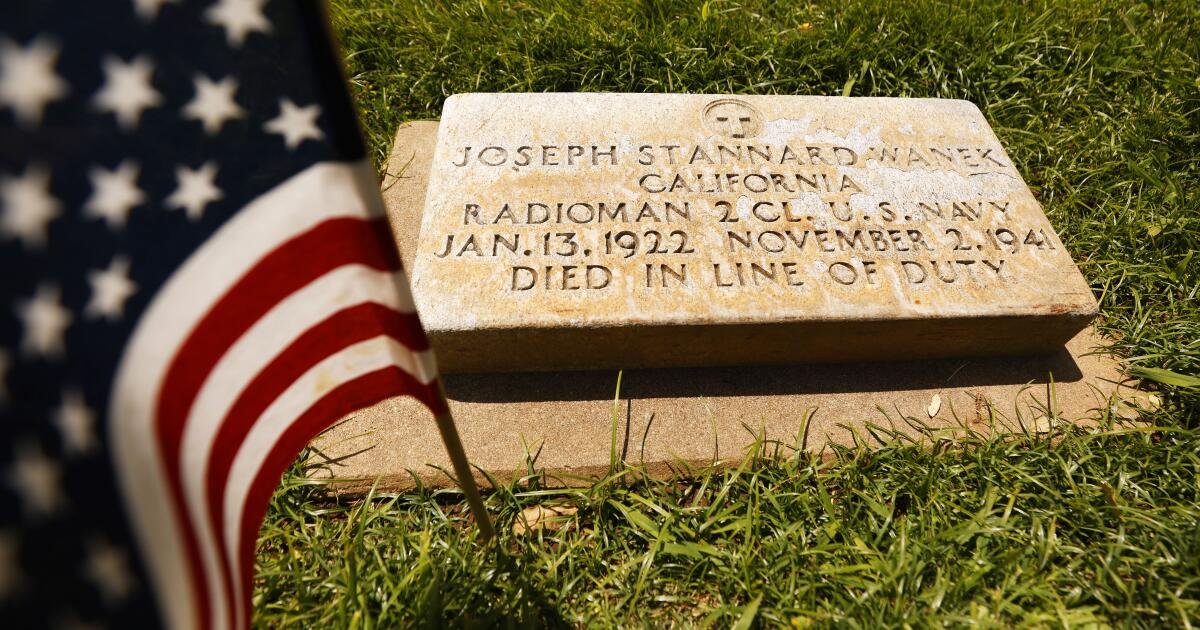
Joe Wanek enlisted in the U.S. Navy on March 10, 1939, six months before World War II broke out in Europe. Born in South Dakota on January 13, 1922, Joe had just turned 17. He and his family were relatively new to Escondido, having moved there in 1935. In South Dakota, Joe’s father, Carl, was a letter carrier for the U.S. Post Office. The Wanek family moved to Escondido when his father was transferred there. Joe was one of five children, three sons and two daughters. All five graduated from Escondido Union High School. Known at school as the “football hero,” Joe graduated in January 1939, six months before the rest of his class. Perhaps Carl Wanek influenced Joe’s decision to join the Navy two months later by telling him his own story of serving as a U.S. sailor during World War I.
After graduating from boot camp in San Diego, Joe trained as a radio operator in the Navy. He was a member of an air patrol squadron assigned to the Atlantic Ocean. In the fall of 1941, Joe’s squadron was stationed at the naval base in Norfolk, Virginia. The planes were probably patrolling the waters of the Atlantic Ocean. In October 1939, Roosevelt had declared that the United States would establish a neutral zone in the Atlantic Ocean to keep German ships away from the American coast. After France surrendered to Germany in June 1940, only Britain could stop Hitler’s domination of the European continent. But Britain desperately needed military aid. The Franklin D. Roosevelt administration did all it could to support Britain, including sending military supplies on merchant ships across the North Atlantic.
By the fall of 1941, the North Atlantic had become a battlefield for the United States, even though the country was officially neutral. As American merchant ships increasingly carried military equipment to Britain, German submarines targeted these ships as they approached the British Isles. President Roosevelt had already ordered the U.S. Navy to patrol the North Atlantic. The Navy also escorted U.S. supply convoys bound for Britain to Iceland. In September 1941, Germany attacked U.S. ships, but no Americans were killed. But a month later, that all changed. On October 17, a German submarine torpedoed the destroyer USS Kearny off the coast of Iceland, killing 11 sailors. In the words of Pulitzer Prize-winning historian David M. Kennedy, they were “the first American casualties in a war that had not yet been declared between the United States and Germany.” Ten days later, on October 27, a torpedo fired by a German submarine hit the munitions magazine of another destroyer, the USS Reuben James, killing approximately 150 crew members.
Just six days later, Joe Wanek’s plane crashed “somewhere over the Atlantic Ocean.” Those were the last four words in a government telegram sent to his parents. Apparently, his squadron was on patrol. Poor weather, mechanical failure, or even a collision between two planes could have caused the plane to crash. His family, who remained in Escondido, never learned the details. The telegram further explained that such information had to be withheld “to protect the lives of other Navy personnel at sea and to ensure the safety of Navy ships.” The Escondido Times-Advocate broke the news of Joe’s death on November 2 in its November 4 edition. In an editorial that day, the paper shared its view that Joe Wanek “may be the first young man in San Diego County to give his life for his country in this apparently inevitable war.”
Joe’s body was transported by Navy escort to his home in Escondido, arriving there on Friday, December 5, 1941. A rosary was held for Joe that evening. His funeral took place the following day, December 6. The U.S. Naval Training Station, San Diego, sent a convoy from the Marines to carry the casket. “Full uniform” members of the local American Legion chapter, to which Joe’s father belonged, attended the religious service at St. Mary’s Catholic Church. The parish priest officiated at the mass. Burial took place in Oak Hill Cemetery, where another service was held with full military honors.
At the graveside, a chaplain from the 2nd Marine Division, stationed at Camp Elliott in San Diego, performed the ceremony. A sailor guard fired a rifle salute over Joe’s grave. A bugler from the Naval Training Station played Taps. The Times Advocate reported on Joe Wanek’s burial the next day, December 7, 1941. That day, the Japanese attacked Pearl Harbor.
