

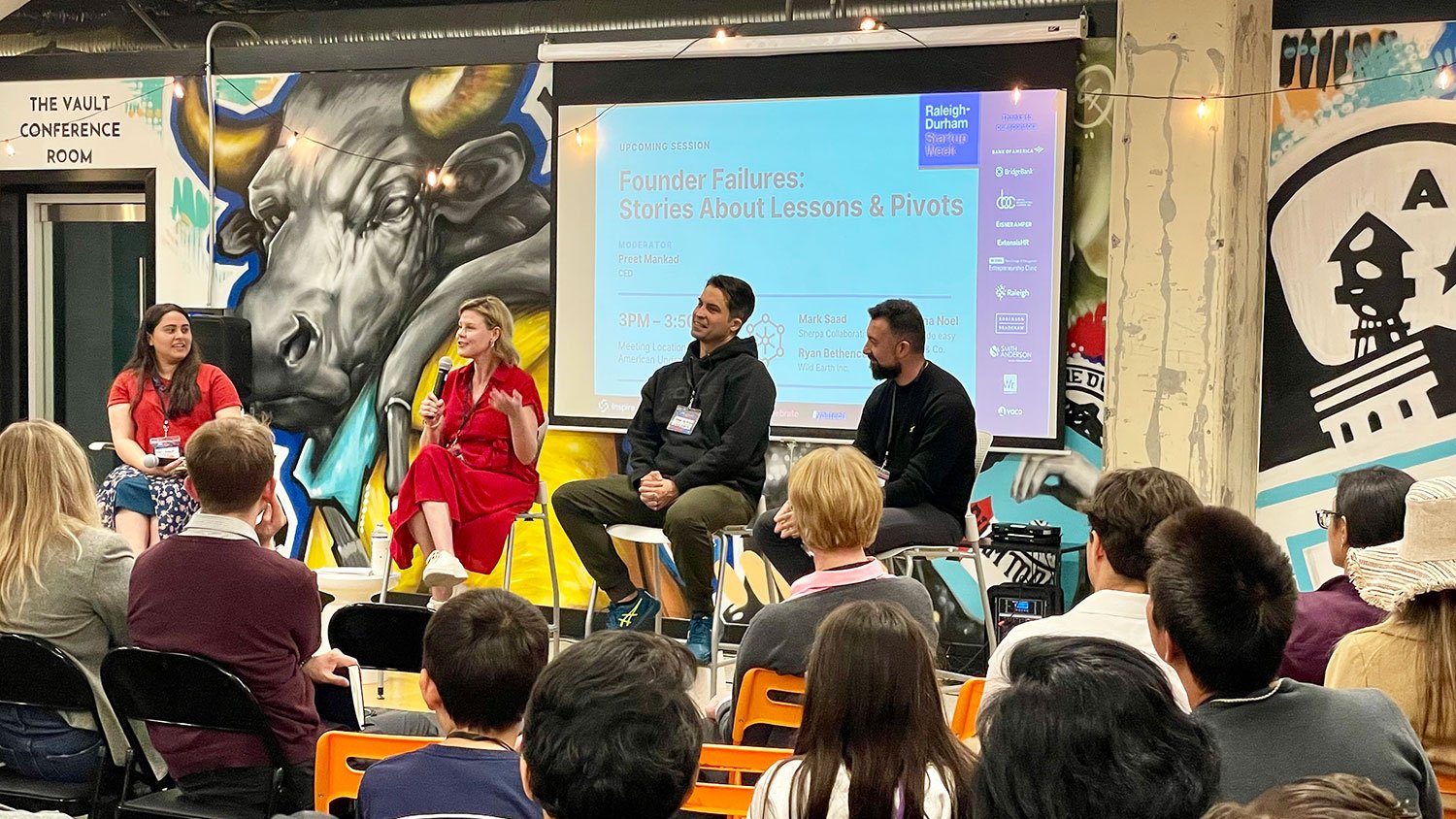
Only successful entrepreneurs talk publicly about their business failures, but what was Poole College graduate Mark Saad’s first memorable failure?
His company tried to sell 65,000 pairs of children’s flip-flops that don’t have backstraps to keep them on kids’ feet, but only sold about 10 percent of them in the first year, Saad said recently as a panelist at the annual Raleigh-Durham Startup Week.
“When you look at successful entrepreneurs, you think they’re always hitting home runs, but that’s not the case. Every entrepreneur experiences setbacks,” Saad says of his experience starting his second company after graduating college. “It’s okay to talk about failure. It’s part of life.”
Startup Week featured discussions on all stages of a startup. The NC State University Entrepreneurship Clinic, based at Poole College, sponsored and co-organized the event, which saw record attendance from established and aspiring entrepreneurs, investors and other business professionals.
“This event really showcases all the great startup and entrepreneurial activity in the area,” said clinic director Haley Huey. “People find a strong sense of community.”
Startup Week featured more than 50 workshops, keynotes and special events focused on three tracks: early idea stage, build mode and rapid growth scale level. “What attendees really get out of it is the actionable advice shared and the network effect. You can’t help but make some great connections,” Huey said.
With plenty of in-person opportunities to explore potential partnerships and mentoring, “there’s nothing better than meeting people in the real world who are genuinely interested in what you’re working on,” she says.
Participation in Startup Week shows that many people are interested.
Since its inception a few years ago, attendance has tripled to 1,600 people from across the U.S. Startup Week, the only such effort in the Triangle region, has expanded to four days.
The Entrepreneurship Clinic, which works with students across the university, plays a key role in Startup Week.
“To me, the emphasis on community partnerships is important,” Huey said. “NC State needs to be in the conversation and be recognized. That’s what drives entrepreneurship in our region.”
Many of the entrepreneurs and potential founders attending the event are alumni or students from Poole and other NC State universities.
Students in Huey’s Entrepreneurship Clinic classes are expanding their professional networks by speaking with Wolfpack alumni and representatives from startups, including this year’s Airbnb and DoorDash.
Students get founder-level access, learning by doing and immersing themselves in startup culture.
“Students get founder-level access, learn by doing, and are immersed in startup culture,” Huey says. “I’ve received a lot of papers from students afterwards talking about how it impacted their career thought process and what a unique opportunity it was.”
Having graduated from Poole College in 2008, Saad capitalised on a unique opportunity in finance and entrepreneurship. The students also received a check for $150,000 from North Carolina State University’s Entrepreneurship Trainee to start their first business.
The startup was acquired by Feelgoodz, the footwear company where Saad was CEO at the time he reversed his miscalculation.
“We learned that it’s important to really understand and talk to your target market before you launch 65,000 units,” he says. “Fortunately, we’ve had more successes than failures.”
He ultimately led Feelgoodz to a 500% growth rate, as Saad noted during a Startup Week panel. He left the company to co-found Sherpa Collaborative, a Raleigh-based business consulting and investment firm. “The best businesses are the ones that are part of their target market and understand their customers’ needs,” he says.
A fundamental reason for Startup Week’s success is that Huie and others who organize and sponsor the event understand the needs of participants.
“We’re creating a ton of access to investors and networks to provide more mentorship to startups,” Huey said. “From really dedicated investors to people who just have an idea they want to bring to fruition, the key is that everyone is equally invested in growing the ecosystem.”
