

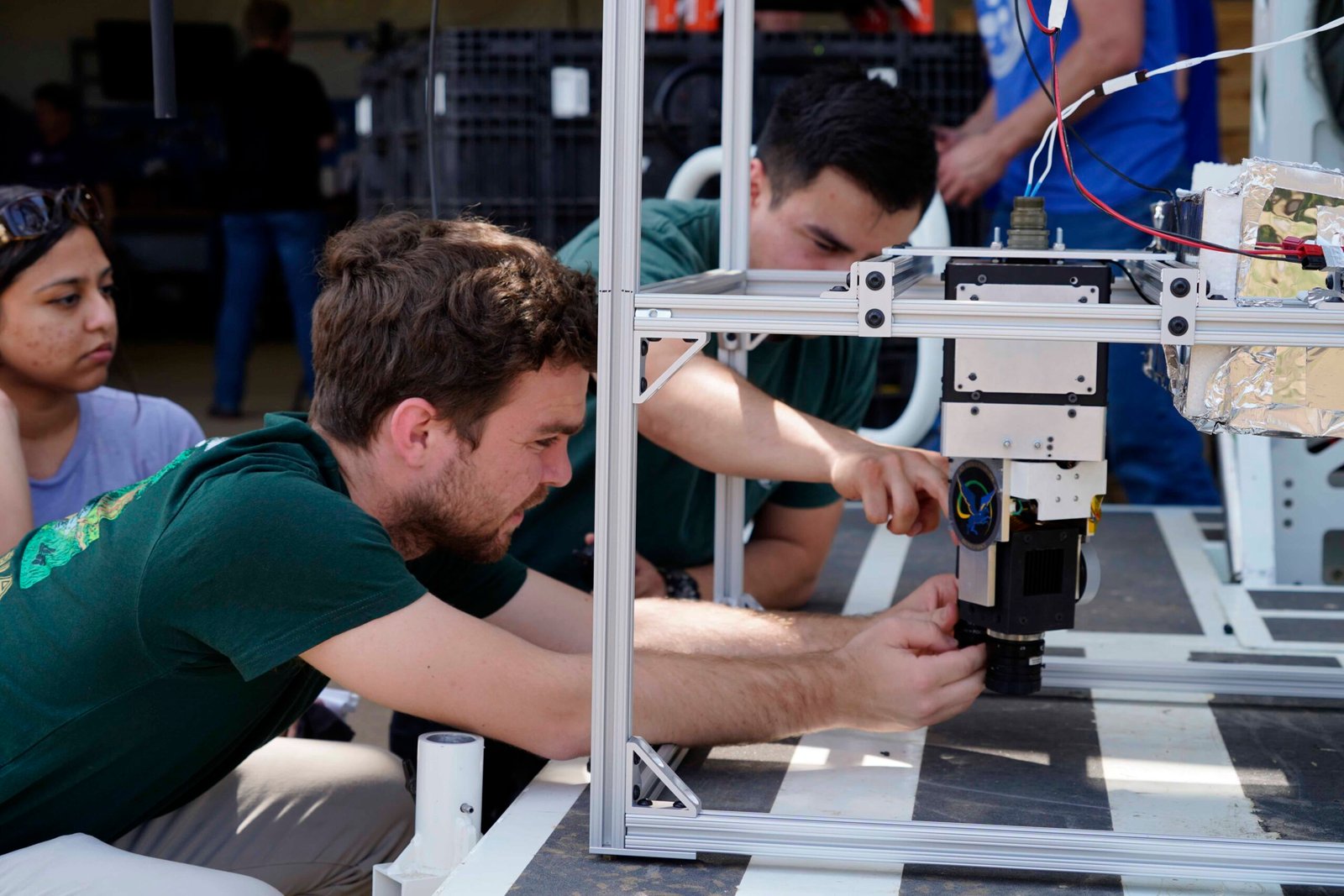
NASA’s open competitions can be transformative for the NASA organization and for the participants. Bronco Space, a cubesat lab at California State Polytechnic University in Pomona, California, has matured more than just space technology as a result of winning funding from NASA’s TechLeap Prize competition. The lab has grown from a shed to a newly constructed lab on campus, expanding its capacity to mature space technology well into the future.
The TechLeap Prize seeks to rapidly identify and develop space technologies through a series of challenges that address specific technology needs of NASA and the nation. In addition to the cash prize, winners will have the opportunity for a suborbital or orbital flight on a commercial flight platform. Bronco Space won $500,000 in the Autonomous Observation Challenge, the first TechLeap Prize launched in 2021. The challenge called for technology for a small spacecraft that can autonomously detect, identify, track and collect data on transient events on and off Earth. The team, made up of both undergraduate and graduate students, developed and launched a wildfire detection system called Bronco Ember, which used a shortwave infrared camera with AI (artificial intelligence) to improve early detection of wildfires.
Zachary Gaines was an undergraduate student when he participated in TechLeap’s first challenge with Bronco Space. He has since graduated and now oversees a lab at California Polytechnic University, Pomona. Gaines says the award gave his team the flexibility to invest in the lab, expanding the university’s technology development and maturation capabilities.
“TechLeap gave us a prize, not a grant, so we were free to invest the money as we wanted,” Gaines says. “If we wanted to have a real-world impact, as we’ve always hoped, we needed a real lab with equipment, and TechLeap gave us the space in Innovation Village, just off campus.”
In 2022, Gaines was also involved in Bronco Space’s second participation in TechLeap as part of the inaugural Night Precision Landing Challenge. The competition called for a sensing system that could detect surface hazards from a height of at least 250 meters and process that data in real time to generate a terrain map suitable for a spacecraft to land safely in darkness. As one of three winners eligible to receive up to $650,000, Bronco Space developed a system that uses a light projector to create an initial geometry map for landing. The system then uses LIDAR (light detection and ranging) and advances in computer vision, machine learning, robotics and computing to generate a map that reconstructs the lunar terrain.
From their experience at TechLeap, Gaines and other team members founded a small business, Pegasus Intelligence and Space, which is now PRISM Intelligence, and participated in another competition, NASA’s Entrepreneur Challenge, which seeks to develop and commercialize lunar payloads and climate science from an entrepreneurial and venture perspective to advance NASA’s scientific exploration goals. Their technology, also called PRISM, is a 3D digital world map that uses AI to make the “twin” world searchable. The competition inspired Gaines and the PRISM team to bridge the gap between available data and consumer end users. PRISM was the winner of the second round of the competition, winning a share of the $1 million prize money as well as exposure to outside funders and investors.
Gaines traces PRISM’s success back to its first TechLeap experience: “If we hadn’t attended TechLeap, the company wouldn’t have been born. TechLeap helped us understand how to develop technology for our industry.”
The company and university continue to secure support from NASA: In December 2023, California Polytechnic State University, Pomona was selected to enter into a two-year, funded cooperative agreement through NASA’s University Small Satellite Technology Partnership.
“When people invest in your idea and continue to support it, it makes you smarter and gives you a better understanding of people’s needs,” Gaines says. “Building technology with the goal of having a real-world impact is really motivating.”
