

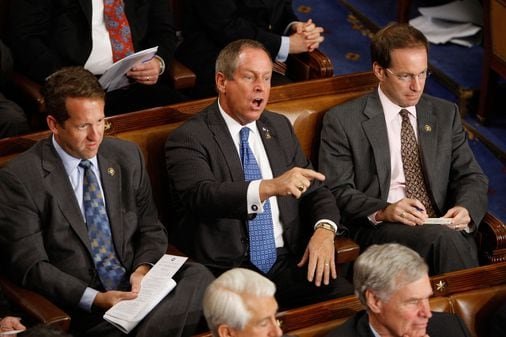
South Carolina Rep. Joe Wilson won the Republican nomination in the state’s June 11 primary, all but ensuring he will retain the seat he has held for more than 20 years in the November general election.
If you don’t live in his state or district, you have little reason to know of Wilson, but his name may evoke certain memories. His unprecedented public denunciation of the president about 15 years ago was not only one of the defining moments of Barack Obama’s presidency, but also helped create this current nastiness in Republican politics.
In September 2009, President Obama visited Capitol Hill to address a joint session of Congress about his landmark Affordable Care Act. As Obama recalled in his memoir, “A Promised Land,” when he repeatedly said that illegal immigrants couldn’t get insurance, Wilson “leaned forward in his seat, pointed at me, his face red, and yelled, ‘You’re a liar!'”
Then-Vice President Joe Biden, who was sitting behind Obama, put his chin to his chest and shook his head. Then-House Speaker Nancy Pelosi’s mouth was open in shock, she glared at the onlookers and looked ready to remove an earring. After a brief silence, Obama continued.
“To my knowledge, nothing like this has ever happened before in a joint session address, at least not in modern times,” Obama wrote. Wilson apologized in a statement but did not contact Obama directly. He also refused to apologize on the House floor, insisting that “one apology is enough.” House Republicans agreed, but House Democrats denounced Wilson in a “resolution of disapproval,” which Republicans protested.
That should have been the end of it.
But Wilson became a Republican darling, raising millions of dollars in donations across the country. The impression was undeniable: A white congressman representing the first state to secede from the Union and where a Confederate traitor first fired a shot in the Civil War was rewarded for openly insulting the nation’s first black president.
“Apparently, for many Republicans, [Wilson] “I was a hero who spoke truth to power, which proved that the Tea Party and its media allies had accomplished more than just their goal of demonizing the health care bill,” Obama wrote. “By demonizing me, they sent a message to every Republican officeholder: When it comes to opposing my Administration, the old rules no longer apply.”
Political opponents became enemies unworthy of basic respect. This marked a turning point for the Republican Party, with repercussions that continue to shake up American politics. What should have been an ugly footnote became a harbinger of the turmoil to come. From Wilson’s tirade against Obama to Georgia Rep. Marjorie Taylor Greene, who donned a MAGA hat and barked and growled like an obedience school dropout during President Biden’s State of the Union address earlier this year, there’s an unbroken stream.
The fact that Wilson was neither alienated nor voted down taught Republicans that aberrant behavior was not only tolerated but welcomed, so long as it aligned with the party’s most divisive instincts and thirst for power.
Of course, no one has benefited from this more than presumptive Republican presidential nominee Donald Trump. After being convicted of 34 felony counts in connection with the hush money trial, Trump used his new felon status as a fundraising tactic. According to the Trump campaign, Trump raised about $53 million in the 24 hours after becoming the first former president to be convicted of a criminal offense.
Trump’s latest fundraising blitz began with the phrase “hand over the guillotine” and suggested that seeing him harmed was the “sick dream” of “every Trump-crazed lunatic.” With the presidential election and global events as a backdrop, Trump’s violent rhetoric aimed at inciting his supporters has barely figured in the news cycle, despite federal law enforcement warnings of possible domestic terrorism.
This kind of inflammatory nonsense from Trump is commonplace, but normalizing it makes us all complicit.
The catalyst for the unacceptable acceptance was Wilson calling Obama a liar to his face on national television, and Wilson profited greatly from it. This should have ended Wilson’s political career, or at least seriously damaged it. Instead, his two-word rant was a brief but sharp sting, a harbinger of something more sinister to come.
Renee Graham is a columnist for the Globe. Contact her at renee.graham@globe.com. Follow her: Follow.
