

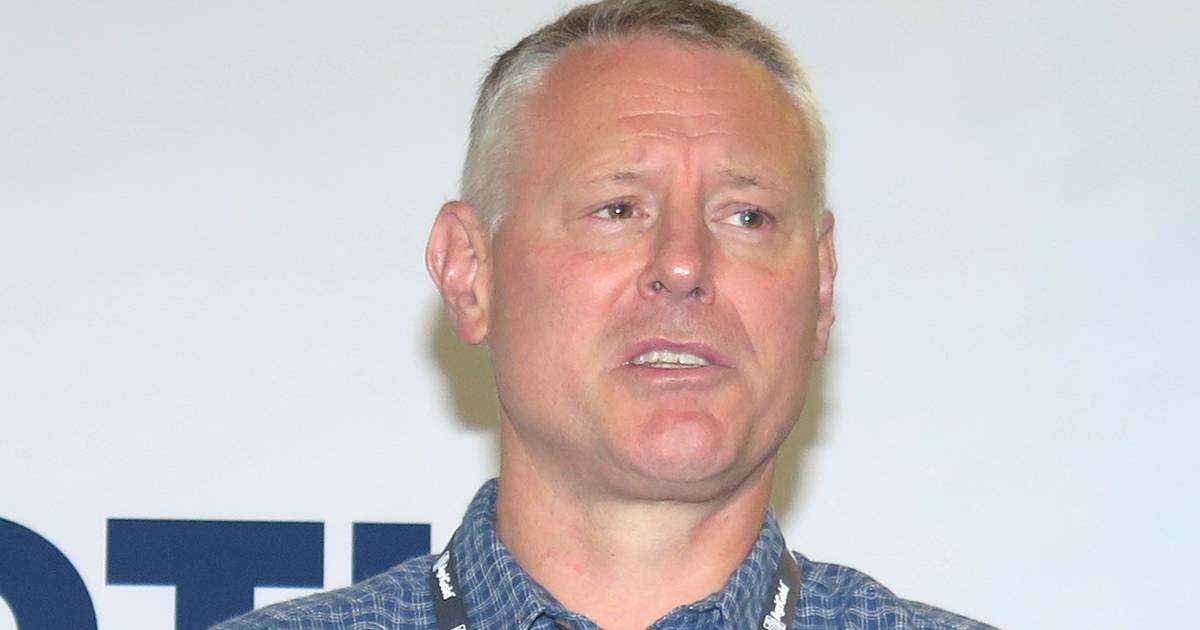
IVESDALE, Ill. — Brian Barker had been familiar with AgReliant Genetics for several years before he was named president and CEO. Then he got a phone call.
“They called me and said, ‘We do business with AgReliant, do you know them?’ and I said, ‘Yes, I know AgriGold, I know LG and I know Pride,’” Barker said at the opening of the annual AgriGold Specialty Crops Conference on June 18.
“‘I know a lot of people who’ve worked for the company and I know their reputation. It’s a really top-tier corn company and AgriGold is a top-tier corn brand. I’ve competed against them on the other side for years and have a lot of respect for them.’ I said I’d be very interested.”
Prior to joining AgReliant last September, Barker served as vice president of Corteva’s multichannel seed business unit, where he led the development and implementation of a new U.S. multichannel brand strategy and achieved margin improvement objectives across all functions.
Additionally, he served as Global Business Director for Corn Biotech and Seeds, where he led business strategy, technology development and asset management efforts, doubling sales within four years.
During his time as global business director, “I worked on a lot of technical properties and specialty products. This was when oil corn was really booming and we were trying to understand the different markets and the different applications,” Barker said.
“I learned quickly from my years with the company that AgReliant, and of course the AgriGold brand, is really committed to corn, and we are a corn breeding company.
“We are part of a network owned by two companies. One is a 150-year-old German company that has been in the corn business for many years. The other is Limagrain, a very large French cooperative. Combining these with AgReliant makes us the fourth-largest corn breeding company in the world.”
Close to the community
Barker stressed the importance of having a business plan that is closely aligned with customers at a local level, despite being a leading global corn breeding company.
“When you look at our flagship brands like AgriGold, LG and Pride, I feel we want to be small, we want to be intimate and we want to have people, including myself, who interact with our customers and understand their special needs,” he said.
“Not just the regular mainstream corn that we sell, but some of the specialty markets and the end uses from the customer all the way to the consumer, we want to understand and be intimate with all of that. But at the same time, we bring a lot of big global capabilities to do different things while still being really focused on our core crop, corn.”
“The one thing AgReliant has always had over the years, both when we looked at them as a competitor and now when we look at them as part of the company, is that we have great people. They’re not only skilled at what they do, but they’re also incredibly dedicated.”
Breeding Program
AgReliant Genetics has direct access to a global corn germplasm pool to leverage proprietary line development.
“We have a real breeding program. We don’t just take a trait and put it in corn, even though a lot of people call that breeding,” Barker said.
“When you’re in a corn or plant breeding program, you basically create your own inbred varieties and patent them. We do this thousands of times every year. Then you combine them to make hybrids. We do thousands of hybrids every year at these stations across the Midwest.”
AgriLiant has eight research stations across the Midwest Corn Belt, including a facility near Ivesdale in east-central Illinois, and invests tens of millions of dollars annually in breeding programs.
“From there, we produce our own products and also supplement that with other partnerships to bring in materials from outside. We can do both, which is a great advantage for us. It allows us to sell the genetics and the products that we’ve built and developed, but also bring in some of the products that our customers need, which is easier than developing our own,” Barker said.
“It’s a wonderful symbiotic relationship that we have and we’re very fortunate to have that option for the future of our business.
“Brimfield, Illinois, has probably one of the highest quality laboratories I’ve ever seen in the industry. I’ve seen them all — Syngenta, Corteva, Pioneer, DeKalb, Monsanto — I’ve seen them all first-hand over the years,” he said.
“Brimfield Lab is world class, the best I’ve ever seen, so people are constantly asking if they can rent our capabilities and pay us for it.”
Speciality corn
AgReliant’s core seed business includes not only the regular No. 2 Yellow Dent used on many farms, but it has also developed specialty corn over the years, and will continue to do so in the future.
“We focus on corn, and it’s not just for the commodity market. For over 20 years we’ve had people come to us looking at white corn, waxy corn, as well as specialty applications. We have a lot of mainstream products as well,” Barker said.
“These are what we call dual-purpose products that can be grown very efficiently, have high yields, have good weather tolerance on farmers’ land and can be sold to elevators.
“But as we look at them and select and test them, there are some that seem to be really good in terms of some special properties that might be interesting to our customers. We have all of them. We’re spending time and resources on them.”
investment
Barker says the amount of investment going into getting the little yellow No. 2 dent kernel right through breeding and research equals or exceeds the resources invested in the entire U.S. pesticide market.
“That little kernel of corn is really like a microchip. There’s billions of dollars of investment, high tech, a lot of scrutiny, a lot of development, a lot of testing, a lot of customization going into it, because here in the U.S. market, farmers expect high performance,” he said.
“So breeding has to be very local and very tailored to the local disease, the local environment, the local soil, the local climate. Breeding programs are broken down into very small regional units to generate regional data.”
“The same goes for some of the specialty products. If you’re looking for something that’s non-GMO at a certain level, or has a certain level of baking properties, ease of use, nutrition, then it has to be tested and it has to be developed in terms of production for these local markets.”
“We have all the capacity to do that. We do it every year. We’ll continue to do it and that’s what we’re really focused on and hopefully it benefits all of you.”
