

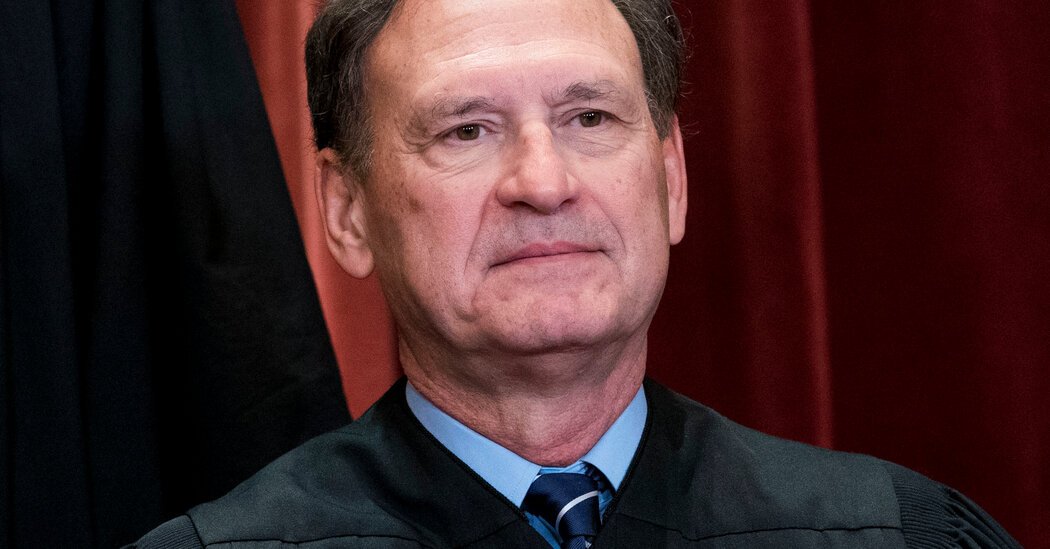
Justice Samuel A. Alito Jr. last week told a woman posing as a Catholic conservative that compromise between left and right may not be possible in America, before agreeing that the country should return to a place of godliness.
“Someone is going to win,” Justice Alito told Lauren Windsor during a special Supreme Court banquet. “There may be ways to work together, ways to live peacefully together, but it’s going to be difficult, because you disagree on fundamental points and you can’t compromise on them.”
Windsor pressed Justice Alito further. “I think the solution is akin to winning the moral argument,” Windsor said in an edited recording of Justice Alito and Chief Justice John G. Roberts Jr., which was posted to social media on Monday and widely circulated. “And that is, people in this country who believe in God need to continue to fight for that and bring this country back to sanctity.”
“I agree, I agree,” he replied.
The justice’s comments appeared to contrast sharply with those of Chief Justice Roberts, who was also secretly recorded at the same event, in which he pushed back against Ms Windsor’s argument that the Supreme Court has a duty to lead the country down a more “moral path”.
“You want me to be responsible for putting the country on a more moral path,” the chief justice said. “That’s the job of the people we elect. Not the job of lawyers.”
Pressing the justices on religion, Windsor said, “I believe our Founding Fathers were devout Christians. We live in a Christian nation and I believe the Supreme Court should lead us down that path.”
Chief Justice Roberts quickly responded, “I don’t know if that’s true.”
He added: “I don’t know if we live in a Christian country. I have a lot of Jewish and Muslim friends who say maybe we don’t, but it’s not our job to say that.”
The chief justice also noted that the United States has dealt with crises as serious as the Civil War and the Vietnam War, and said the polarization in the country is not irreparable.
When Windsor pressed him on whether he thought there was a “role for the courts” to “steer us onto a more moral path”, the justices were quick to respond.
“No, I think the role of the court is to decide cases,” he said.
The justices were secretly recorded at the Supreme Court Historical Association’s annual black-tie event, a charity dedicated to preserving the court’s history and educating the public about the court’s role. The gala was open only to members who paid $500 to join the association, and journalists were not allowed to attend.
Chief Justice Roberts and Justice Alito did not immediately respond to requests for comment, but the charity issued a statement Monday saying it “is the charity’s policy to ensure that all attendees, including justices, are treated with respect.”
The charity added: “We condemn the secret recording of the judge at our event, which goes against the whole spirit of the evening.”
Windsor describes himself as a documentary filmmaker and “advocacy journalist” and is known for reaching out to conservatives, including former Vice President Mike Pence, Ohio Rep. Jim Jordan and Virginia Governor Glenn Youngkin.
She said in an interview Monday that she felt there was no other way to convey the justices’ honest thoughts.
“The courts have refused any accountability and are shrouded in secrecy,” Windsor said. “I don’t see how these questions are going to be answered short of an undercover investigation.”
Windsor would not discuss how she recorded the conversations, other than that she did not tell the justices she was a journalist or that they were being recorded. She said she felt she needed to secretly record the justices’ conversations to make her account believable.
“I wanted to put their story on the record,” she said, “so recording it was the only way to have evidence of what happened. Otherwise, my words would just be at odds with theirs.”
Some experts in journalism ethics have questioned her tactics.
Jane Kirtley, a professor of media ethics and law at the University of Minnesota, said the case was reminiscent of tactics used by Project Veritas, a conservative group known for making secret recordings to embarrass political opponents.
“I think it’s fair to say that most ethical journalists condemn this tactic,” Kirtley said. “How can you expect your readers and viewers to trust you if you’re writing stories that are deceptive?”
Bob Steele, a former ethicist at the Poynter Institute, has developed ethical guidelines for when it is appropriate for journalists to use covert recordings or conceal their identities as reporters.
“In this case, I don’t think there’s any justification for disguising her identity or making the secret audio recording,” Steele said.
The secret recording is the latest controversy surrounding the Supreme Court and its justices, particularly Justice Alito, who was recently found to have provocative flags flying outside two of his homes, raising concerns that the flags could give the appearance of bias in cases currently before the Supreme Court related to the January 6, 2021, attack on the Capitol.
Weeks after the attack, an upside-down American flag — a symbol used by Trump supporters challenging the results of the 2020 election — was flown outside the Alitos’ suburban Virginia home. Last summer, a flag known as the “Appeal to Heaven” flag, the same one flown by the Capitol rioters, was flown at the couple’s vacation home in New Jersey.
Justice Alito refused to recuse himself from any of the cases related to January 6, saying it was his wife who raised the flag.
And this isn’t the historical society’s first time in the spotlight: The organization, which has raised millions of dollars over the past few decades, made headlines after the Supreme Court overturned Roe v. Wade, when a former anti-abortion leader came forward to say he had used the society to encourage wealthy donors (whom he called “stealth missionaries”) to donate and to have contact with justices.
