

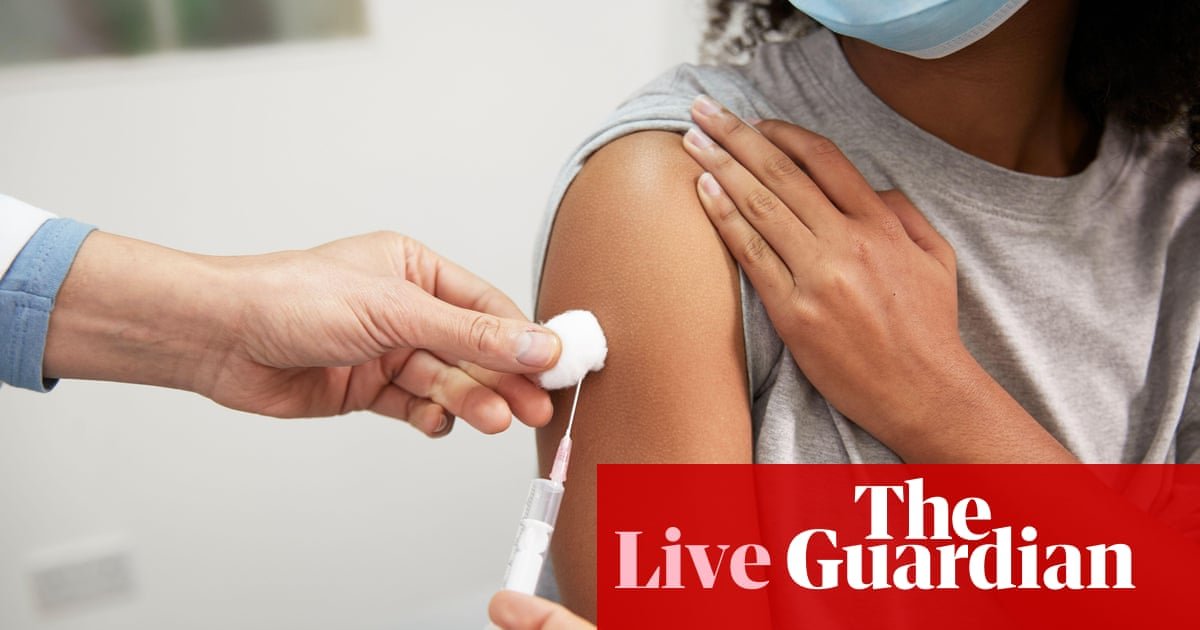
Health minister Andrew Stephenson urges MPs to ignore ‘myths’ spread by Nigel Farage about WHO pandemic treaty
Andrew Stephenson, a health minister, has urged MPs to dismiss “myths” being spread about a World Health Organisation pandemic preparedness treaty that the UK is considering supporting.
He was responding to an urgent question tabled by the Tory MP Danny Kruger. But the issue is one that has been highlighted aggressively by Nigel Farage, the Reform UK honorary president, on rightwing broadcasting channels. Yesterday Farage told Talk TV:
In two weeks’ time in Geneva, the World Health Organisation are meeting and they plan a pandemic treaty, and that’ll be binding on us, under international law.
It would give the World Health Organisation the ability, number one, to take away 20% of our PPE and vaccines to give to other parts of the world.
Number two, give them the power to dictate behaviour, such as mask mandates, such as not being able to travel without being jabbed goodness knows how many times and, the really big one, they would be able to say to us, this is now a global pandemic, you must lock down. Which of course, would take away from us the ability to do what Florida did, or to do what Sweden did, which we now learn a few years on, has led to far less long term harm in that country and that state.
In his opening statement, withour referring to Farage, Stephenson said he wanted to dispel “myths” about the proposed WHO treaty.
He said member states were negotiating the treaty, not the WHO. And he said that it was “simply not true” to claim it would require countries to give away 20% of their vaccines. Instead, there was talk about a voluntary mechanism that would involve firms agreeing to give away vaccines in return for information that would help them develop their products, he said.
He said the government would only sign up to a deal that respected UK national sovereignty and that there was no prospect of the UK allowing the WHO to mandate lockdowns.
Under no circumstances will we allow the WHO to have the power to mandate lockdowns, this would be unthinkable and has never been proposed. Protecting our sovereignty is a British red line.
Stephenson also stressed that, as yet, there is no treaty to sign up to.
The government will only accept the accord and targeted amendments to the international health regulations if they are firmly in the United Kingdom’s national interest, and no text has yet been agreed.
Key events
Starmer averts row with union leaders as Labour reiterates its full commitment to new deal for working people
Keir Starmer appears to have averted a row with union leaders over claims that Labour new deal for working people, its plan to beef up employment rights, was being watered down.
Some unions were set to raise concerns at a meeting this afternoon billed as a showdown.
But, as Jessica Elgot reports on X, both sides have agreed a statement expressing full commitment “to the new deal for working people as agreed in July”.
🚨Labour and the trade unions have agreed a joint statement on the workers rights proposals – coming shortly
— Jessica Elgot (@jessicaelgot) May 14, 2024
🚨Labour and the trade unions have agreed a joint statement on the workers rights proposals – coming shortly
Statement from Labour and all unions
“Together we have reiterated Labour’s full commitment to the New Deal for Working People as agreed in July.
“We will continue to work together at pace on how a Labour Government would implement it in legislation.”
— Jessica Elgot (@jessicaelgot) May 14, 2024
Statement from Labour and all unions
“Together we have reiterated Labour’s full commitment to the New Deal for Working People as agreed in July.
“We will continue to work together at pace on how a Labour Government would implement it in legislation.”
New drone-carrying ships for the Royal Marines will draw on lessons learned from the Ukraine war and the Houthi attacks on vessels in the Red Sea, Grant Shapps said.
As PA Media reports, the defence secretary confirmed that up to six multi-role support ships (MRSS) – designed to deliver commandos onto coastlines around the world to conduct special operations – would be built.
Shapps said “we will definitely build the first three” vessels for the Royal Marines and will plan to construct the next three. “What we’re trying to do is create a multi-role ship which they can use in all different circumstances,” he told the BBC.
Actually, interestingly, we’re learning from what’s happened in the Black Sea in Ukraine and learning what’s happening in the Red Sea currently to make much more flexible ships capable of carrying out a lot of different types of tasks.
Shapps gave more details of the MoD’s shipbuilding programme in a speech this morning. He said up to 28 ships and submarines were in the pipeline.
Photograph: Dan Kitwood/Getty Images
Scottish Labour leader Anas Sarwar says he would not accept Natalie Elphicke as candidate for his party
Anas Sarwar, the Scottish Labour leader, has said Natalie Elphicke would not be welcome in the Scottish Labour party.
Elphicke, a rightwing Conservative until her surprise defection last week, is now a member of the Labour party and sits on the Labour benches at Westminster.
But, as the National reports, Sarwar told the BBC’s Good Morning Scotland programme today that he regarded some of the things she has said in the past as unacceptable. Asked about her defection, he said:
Look, I don’t know Natalie Elphicke, I’ve never met Natalie Elphicke. Looking at some of the comments that have been attributed to her or that she has said, I find them completely unacceptable, I don’t agree with them.
Asked if she would have been allowed to join Scottish Labour, he replied:
Well, look, she certainly wouldn’t be a Scottish Labour candidate, I can be really clear about that.
Asked if he thought it was right for her to be a Labour MP, Sarwar said that she would only be a Labour MP for “a matter of weeks” because the election was coming soon.
Michelle O’Neill rejects suggestion she was ‘hypocritcal’ when she criticised Boris Johnson over Partygate rule breaking
Michelle O’Neill, Northern Ireland’s first minister, was accused of being “hypocritcal” at the Covid inquiry hearing today because she criticised Boris Johnson for breaking lockdown rules while she seemed to ignore them herself when she attended an IRA funeral.
Near the start today’s hearing O’Neill said she was “truly sorry” for attending the outdoors event in June 2020, where an estimated 1,800 people gathered at a time when funerals were only supposed to be attended by 30 people. (See 10.52pm.)
Heather Hallett, the inquiry chair, put it to O’Neill that it was hypocritical for her to criticise Boris Johnson for breaking lockdown rules when she had done the same herself.
O’Neill replied:
I don’t think so because they are two very different things in terms of the Boris Johnson approach of partying the whole way through the pandemic and drinking their way through it, to be quite blunt.
Hallett tried again.
We didn’t find out about the partying until after the pandemic, what you did was to do something the normal bereaved couldn’t do because you wanted to go to a friend’s funeral. Isn’t saying that what Boris Johnson’s government did was wrong sort of hypocritical?
O’Neill replied:
No, I don’t think so because what I did I did under the understanding of the regulations at that time. But I do accept wholeheartedly that I in some way damaged our executive relations with colleagues who had been working very hard with me the whole way through.
I also accept wholeheartedly that I damaged the public health messaging, and I had work to do to regain that. But I did that, I worked hard to regain that trust and confidence and to lead us for the next year and a half through the pandemic.
Hallett said she was pressing the point because “the point of principle is that those who set the rules should obey the rules, both in spirit and in the letter”.
O’Neill said she should have “anticipated the outworking of what I did”. But she said the attended the funeral with a personal invitation, as part of a cortege of 30 people.
That’s the basis on which I attended but I am sorry, I am sorry. I should have anticipated what would happen in the aftermath and that is why I worked hard to try to regain that confidence and trust.
Equally and more importantly, I think it’s about all the families of bereaved and people who went through horrific circumstance and the experience that they’ve had. It’s just horrendous and I would never set out to try to compound that or in any way make it more difficult for them to deal with their grief.
And Suella Braverman, the former home secretary, told MPs during the UQ on the WHO treaty that she did not trust the WHO to manage a global pandemic. She said:
I am profoundly sceptical of the World Health Organisation’s ability to manage a global pandemic in light of serious errors of judgment, poor leadership and, I’m afraid, well-chronicled conflicts of interests which have subsequently emerged.
Of course, we can help poorer countries. Of course, we can collaborate with other nations, but under no circumstances must we surrender our sovereignty or sign up to a lockdown charter.
Will the minster agree that fundamentally, and to coin a phrase, no pandemic treaty is better than a bad pandemic treaty?
Andrew Stephenson, the health minister, said that he agreed “100%” that no treaty was better than a bad treaty. But he said it was Boris Johnson who originally led calls for a new WHO treaty covering pandemics when he was PM. Stephenson went on:
And the reason behind that is we believe that commitment on stronger international collaboration and cooperation on global health are crucial to secure the UK’s health and economic security, but domestic decisions still have to be left to sovereign nation states to take the right decisions for their country.
During the urgent question on the WHO pandemic preparedness treaty, the shadow health minister Andrew Gwynne said Labour would not support anything that would “leave our population unprotected in the face of a novel disease”. He asked for an assurance that the government “will not sign up to anything that would compromise the UK’s ability to take domestic decisions on national public health measures”.
Andrew Stephenson, the health minister, said the WHO would have to “fully respect national sovereignty” for a treaty to be acceptable.
Current draft of WHO pandemic treaty not acceptable to UK, Stephenson tells MPs
The Conservative MP Danny Kruger, co-chair of the New Conservatives, a group representing rightwing Tories, welcomed what Andrew Stephenson said in his opening statement about the WHO treaty. (See 2pm.) But, in a follow-up to his urgent question, he asked Stephenson to set out what the government’s red lines were. He said that the latest draft of the treaty was concerning, and that it would still give the WHO considerable powers to direct how national governments should respond to a pandemic.
In response, Stephenson, a health minister, said that the current draft of the treaty was not acceptable to the government.
UPDATE: Kruger said:
We know from the drafts that have been submitted in recent months what the real agenda of the WHO is. They want to have binding powers over national governments to introduce all sorts of restrictive measures on our citizens …
Will the government oppose any texts that abides this or a future government in how it responds to health threats? And finally, crucially, will the government comply with CRaG [Constitutional Reform and Governance Act], the requirements to put the treaty to a ratification vote in parliament?
And Stephenson replied:
The current text is not acceptable to us, therefore unless the current text is changed and refined we will not be signing up.
The UK treaty-making process means the accord is, of course, negotiated and agreed by the government. Parliament plays an important part in scrutinising treaties under the CRaG process and determining how international obligations should be reflected domestically.
It’s important to remember that because the exact form of the board has not yet been agreed, the parliamentary and the adoption process will depend on which article of the WHO constitution the accord is adopted under.
Health minister Andrew Stephenson urges MPs to ignore ‘myths’ spread by Nigel Farage about WHO pandemic treaty
Andrew Stephenson, a health minister, has urged MPs to dismiss “myths” being spread about a World Health Organisation pandemic preparedness treaty that the UK is considering supporting.
He was responding to an urgent question tabled by the Tory MP Danny Kruger. But the issue is one that has been highlighted aggressively by Nigel Farage, the Reform UK honorary president, on rightwing broadcasting channels. Yesterday Farage told Talk TV:
In two weeks’ time in Geneva, the World Health Organisation are meeting and they plan a pandemic treaty, and that’ll be binding on us, under international law.
It would give the World Health Organisation the ability, number one, to take away 20% of our PPE and vaccines to give to other parts of the world.
Number two, give them the power to dictate behaviour, such as mask mandates, such as not being able to travel without being jabbed goodness knows how many times and, the really big one, they would be able to say to us, this is now a global pandemic, you must lock down. Which of course, would take away from us the ability to do what Florida did, or to do what Sweden did, which we now learn a few years on, has led to far less long term harm in that country and that state.
In his opening statement, withour referring to Farage, Stephenson said he wanted to dispel “myths” about the proposed WHO treaty.
He said member states were negotiating the treaty, not the WHO. And he said that it was “simply not true” to claim it would require countries to give away 20% of their vaccines. Instead, there was talk about a voluntary mechanism that would involve firms agreeing to give away vaccines in return for information that would help them develop their products, he said.
He said the government would only sign up to a deal that respected UK national sovereignty and that there was no prospect of the UK allowing the WHO to mandate lockdowns.
Under no circumstances will we allow the WHO to have the power to mandate lockdowns, this would be unthinkable and has never been proposed. Protecting our sovereignty is a British red line.
Stephenson also stressed that, as yet, there is no treaty to sign up to.
The government will only accept the accord and targeted amendments to the international health regulations if they are firmly in the United Kingdom’s national interest, and no text has yet been agreed.
Jim Shannon (DUP) asked for an assurance that the court ruling would not stop asylum seekers being removed from Northern Ireland to Britain.
Pursglove said he would write to Shannon about this. But he said the Rwanda policy was being implemented on a UK-wide basis.
MPs urge government to legislate to exempt Northern Ireland from EU law in response to Belfast court ruling
Christopher Chope (Con) told Pursglove his position was “manifestly absurd”. Echoing what the DUP’s Carla Lockhart said, he urged the government to legislate to exempt Northern Ireland from EU law.
Pursglove said the government was still taking legal advice.
The DUP’s Carla Lockhart said, instead of appealing, the government should legislate to ensure that EU law now longer has supremacy in Northern Ireland. She said appealing against the decision just amounted to stringing the people of Northern Ireland along.
Pursglove said the government would take all steps to resolve this, including appealing.
Joanna Cherry (SNP), chair of the joint committee on human rights, said yesterday’s judgment confirmed her committee’s assessment that the Rwanda policy does not comply with human rights law.
Pursglove said the government was operationalising the Rwanda policy on the basis of the Nationality and Borders Act. He claimed the yesterday’s judgment was not relevant because it applied to the Illegal Migration Act.
Gregory Campbell (DUP) asked Pursglove to explain why the government did not accept the DUP amendment to the Illegal Migraton Act that might have closed this loophole.
Pursglove said he was not minister at the time. But the record of the debate would speak for itself, he said.
Mark Francois, the Tory chair of the European Research Group, said with regard to the Windsor framework, “we told you so”. And he said the Tories should now commit to renegotiate the European convention on human rights, with a view to leaving if other countries did not agree.
Theresa Villiers, a former Northern Ireland secrtary, asked what the government was doing to stop asylum seekers going to Northern Ireland to avoid deportation to Rwanda.
In reponse, Pursglove repeated the point about the Rwanda scheme being operationalised on a UK-wide basis. He claimed there would be no benefit for asylum seekers in going to Nothern Ireland.
