

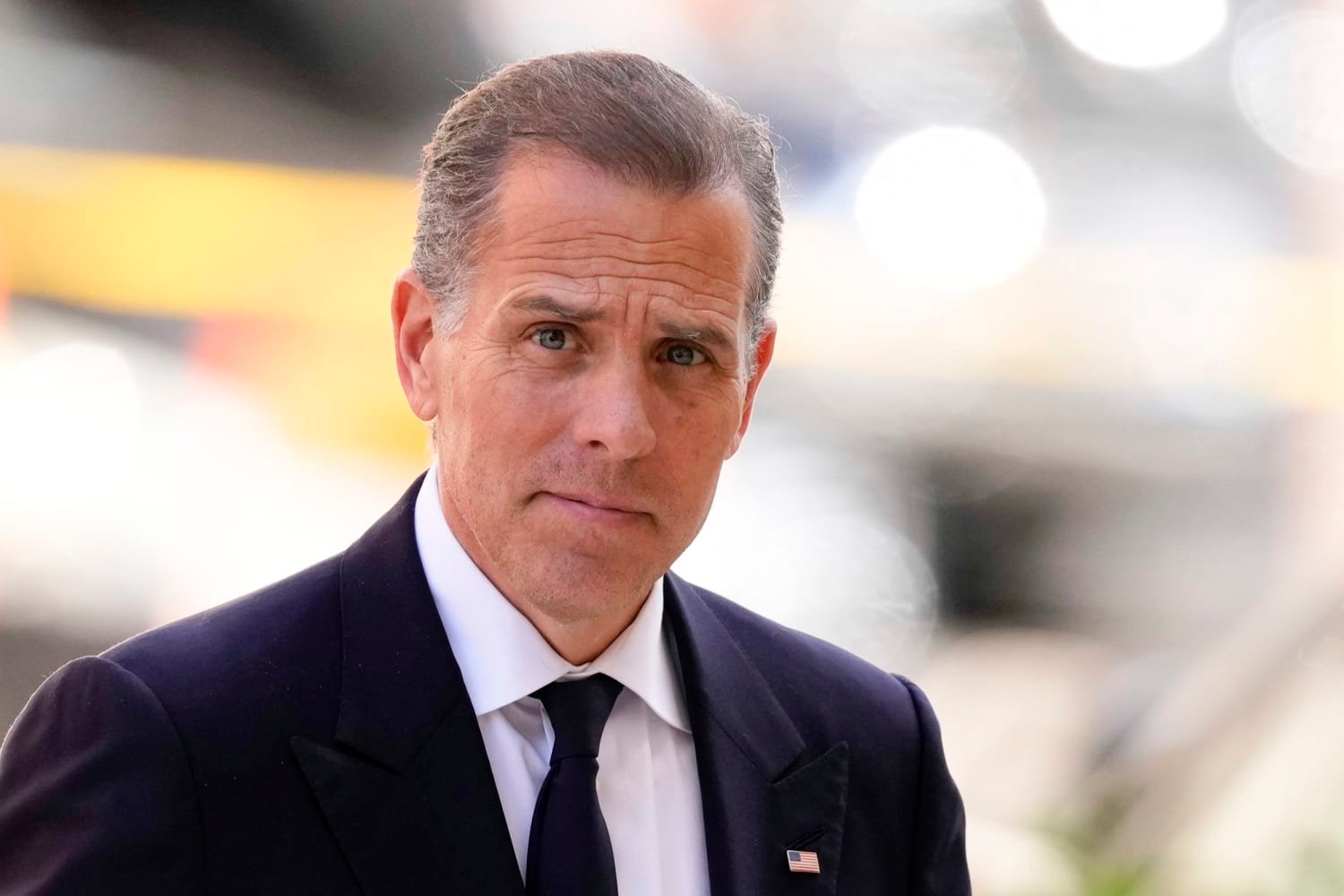
WILMINGTON, Del. — A Delaware jury on Tuesday returned a guilty verdict against President Joe Biden’s son, Hunter Biden, on three felony firearms charges after a week-long trial that focused on his drug addiction history.
Hunter Biden had pleaded not guilty in federal court in Wilmington to three felony counts of possessing a gun while under the influence of drugs. The jury began deliberations Monday afternoon and delivered the historic verdict after about three hours of deliberation.
Hunter Biden stared straight ahead as the jury delivered its verdict and nodded slightly as the verdict was read.
The trial, the first involving the son of a sitting president, comes as Joe Biden faces a tough re-election bid against Donald Trump in November. First lady Jill Biden was not in the courtroom when the verdict was read but arrived minutes later. She quickly entered the holding room where Hunter Biden was taken after the verdict.
Two of the charges are punishable by up to 10 years in prison, and the third by up to five years. He could receive more than a year in prison, according to recommended federal sentencing guidelines, but a judge can increase or decrease the sentence. Each charge also carries a fine of up to $250,000.
A date for sentencing has not yet been set.
“Jill and I love our son and are so proud of the man he has become,” the president said in a statement.
The president accepted the outcome of the case and said he “will continue to respect the judicial process as Mr. Hunter considers his appeal. Jill and I will always offer Mr. Hunter and the rest of his family our love and support. No matter what, this will not change.”
Biden has the power to pardon his son, but in a June 6 interview with ABC News he said he would not do so.
Jill Biden attended multiple days of the trial, which began on June 3 and saw three of Hunter Biden’s former girlfriends give explicit testimony about his chronic drug use.
Two of the charges accuse Biden of falsely representing that he was not using illegal drugs when he purchased a Colt Cobra revolver in October 2018. The third charge alleges he possessed a firearm while under the influence of drugs.
Biden’s defense focused on the language used in the question “Are you an illegal user of or addicted to drugs” on a federally required gun store application. Hunter Biden’s lawyer, Abe Lowell, pointed out that other questions on the form began with “ever,” but that question did not. He argued that his client had used alcohol during that period, but not crack cocaine, and that it would have been easy to tell if he had been using drugs at the time.
“There may be high-functioning alcoholics, but there are no high-functioning crack addicts,” Judge Lowell said in his opening statement.
Rowell acknowledged that his client had used crack in the months before and after the sale, but suggested he had not “knowingly” violated the law because he had not been using it at the time of the sale and did not consider himself an addict at the time.
Prosecutors countered that argument, citing passages from Biden’s books that detailed his struggles with alcohol and drug addiction.
In his closing argument, Lowell told jurors that Biden’s writing about being an addict in his 2021 book after the fact doesn’t mean he knew he was an addict when he bought his guns.
Prosecutors also presented circumstantial evidence from witnesses about Biden’s chronic drug use, as well as text messages and photos of Biden using drugs, showing he was using crack cocaine at the time. “The evidence was personal, it was ugly and it was overwhelming,” Leo Wise told jurors in his closing argument.
Prosecutors said Biden withdrew $5,000 in cash on the day of the sale and texted Hallie Biden, the widow of his brother Beau Biden, the next day saying he was looking for a dealer.
Two days after the gun sale, he texted her saying he was “asleep in his car smoking crack cocaine.”
Mr Lowell suggested his client’s claims were a “joke” and that he was merely trying to fend off Hallie Biden, who had a tumultuous romantic relationship after the death of Beau Biden. “You have no idea whether he was just saying that or whether he was actually there?” Mr Lowell asked Hallie Biden during cross-examination last week. “Exactly,” she replied.
Prosecutors also disputed the claim that Lowell’s drug addiction was preventing him from functioning normally. Another witness, Zoe Kestan, who Biden was romantically involved with, testified that the first time she saw Biden smoking crack cocaine, there was no change in his behavior. She also testified that Biden’s drug use worsened over time, to the point where he was smoking crack every 20 minutes.
Hallie Biden said Hunter Biden introduced her to crack cocaine, describing the period as “terrible” and “embarrassing.” She stopped using drugs in August 2018 and urged him to do the same. She discovered the gun in his car 11 days after he bought it and threw it out outside a grocery store out of fear it would hurt him or their children.
“I know now it was a stupid idea, but I was just panicking,” she testified. The gun was discovered by a passerby, sparking a criminal investigation.
The firearms charges were initially set to be dropped as part of a plea deal struck last year with the office of Special Counsel David Weiss. Under the terms of the deal, Biden would have received six months of probation for pleading guilty to the tax-related charges, but the firearms charges would have been dropped in two years if Biden complied with the terms of a so-called diversion agreement.
As part of the plea deal, which was ultimately rejected by U.S. District Judge Maryellen Noreika over concerns about its scope, Biden submitted a statement of facts in which he acknowledged that “at the time of the gun sales, I was a crack cocaine user and addict.”
Court documents, which the jury did not see because they were part of the rejected plea agreement, also said the defendant “regularly purchased and used crack cocaine” during the 11 days he possessed the gun.
Noreika’s refusal caused the plea deal to fall apart, and he now faces charges of guns in Delaware and tax in California.
The case is scheduled to go to trial in September.
