

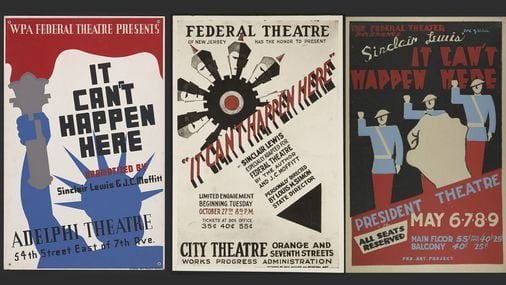
The year is 1936. Fascism is on the rise in Europe as demagogues rise to power in Germany, Italy, and Spain. In the United States, the Ku Klux Klan is actively recruiting members. Reverend Charles Coughlin’s anti-Semitic radio broadcasts reach millions of listeners, and he himself runs for president as a third-party candidate against Franklin D. Roosevelt. The country is in the midst of the Great Depression, making it prime time for a dictator.
Into this perilous situation enters Sinclair Lewis, the first American to win the Nobel Prize for Literature. With support from the New Deal’s Federal Theatre Project, Lewis adapted his dystopian novel, “It Can’t Happen Here,” about a fascist takeover of America, into a play. On October 27, 1936, the play was performed simultaneously in 21 cities from Boston to Seattle. It was performed in Spanish and Yiddish and featured an interracial cast. Thousands attended. A week later, Roosevelt was re-elected in a landslide victory, receiving 98% of the electoral vote.
In 2024, the parallels are uncanny. Nativism, economic discontent, and disinformation are once again threatening democracy. Hearing the echoes, a group called Writers for Democratic Action has adapted Lewis’ cautionary play for today. On July 19, the day after Donald Trump is expected to accept the Republican presidential nomination at the Republican National Convention in Milwaukee, WDA-organized actors will give free readings of “It Can’t Happen Here — Again” at more than 40 locations across the country.
Featuring just five people reading a scaled-down version of the script, about 35 minutes long, “It Can’t Happen Here — Again” is designed for the public to perform in their backyards, bookstores, church halls and living rooms. Anyone can apply. Some of the readings will be in Spanish. At least one will be performed abroad. Boston’s acclaimed Poets Theater will host a reading, but the venue is yet to be determined. Some will be professionally staged, including a Cape Cod reading directed by Jeff Zinn, former artistic director of Wellfleet Harbor Actors Theater (bookings required). But all can be powerful antidotes to despair.
“This is literally an expression of collective action,” author and poet Rachel DeWoskin, president of the Michigan chapter of the WDA, said in an interview. She hopes the work will motivate Americans to shake off their political fatigue and get involved. “That’s the power of art.”
As of this writing, “It Can’t Happen Here — Again” is already scheduled to open in more states than the 1936 version. “It’s a wonderful thing that’s happening,” said writer James Carroll, a member of the WDA steering committee who co-wrote the play with DeWoskin and Wesley Savic of Suffolk University’s drama department. “This is about citizens trying to find a way to take action, rather than jumping off roofs.”
In New York City, the July 19 reading will take place at The Rams, the country’s oldest professional theater club. Lewis himself once strutted the halls of this original venue late in his career, after neurotic executives at MGM studios halted production of the film “It Can’t Happen Here.” “I feel like everything we do now as artists has to serve to get people noticed,” said Walter Willison, the Tony-nominated actor and director who is producing and starring in the New York event.
Willison’s work will be professionally filmed and uploaded to social media so a wider audience can absorb its message. The next reading, which will also include work by high school and college students, is hoped to take place in late October, just before the election. “The whole concept is ‘putting seeds to the wind,'” Carroll said.
Lewis was inspired to write “It Can’t Happen Here” by his wife, the pioneering journalist Dorothy Thompson, who spoke fluent German and interviewed Adolf Hitler in 1931. She was the first U.S. correspondent to be expelled from Germany after describing the Nazi leader as “inconsistent, vocal, restless, insecure – the very prototype of a Little Man.”
Thompson delivers perhaps the most chilling line in the new play, taken from a book she has written about the dangers of fascism: “Freedom can be taken away, but it can also be taken back,” her character says.[But] If it is abandoned by default, it can never be recovered.”
In other words, complacency is the real danger. Ultimately, this choreographed reading is an effort to get people to vote, to combat the apathy and ignorance that led many Americans to ignore the existential threat posed by Donald Trump. An informed electorate is a prerequisite for a participatory democracy, and “It Must Never Happen Here Again” is a provocation, a call to action, and a lesson in history that must never be repeated.
Rene Roth’s column appears regularly in the Globe.
