


By most economic indicators, America’s rural communities have consistently lagged behind their urban counterparts, including in unemployment rates, persistent poverty, and labor force participation rates. While several federally funded programs aim to revitalize these areas, Congress created the EB-5 visa to spur further economic growth and job creation without increasing the burden on American taxpayers. Over the past three decades, EB-5 investors have made significant economic contributions, but stagnant immigration policies are now threatening the effectiveness of the program, potentially blocking approximately $10 billion in pending investments.
Under EB-5, foreign nationals can apply for a green card if they make a qualifying investment in a U.S.-based commercial enterprise that creates at least 10 new permanent, full-time jobs for U.S. workers, or preserves 10 jobs if they invest in a struggling business. Minimum investment amounts range from $500,000 to $1.05 million, depending on when you apply and where you make your investment (such as rural areas or areas with high unemployment).
To obtain a green card through this program, an investor must first submit a petition to the U.S. Citizenship and Immigration Services (USCIS) with proof of a qualifying investment. If approved, the investor can then apply to adjust status from within the U.S. or apply to obtain a visa through a consulate abroad. However, due to limited availability of visas and a continuing backlog of green cards, there may be a long period between the approval of the petition and the issuance of a visa or adjustment of status.
USCIS reported that 16,283 petitions for immigrant investors had been approved but no corresponding visas were available through the end of December 2023. Every approved petition represents an investment that USCIS has verified. However, because investments often remain in escrow until a visa or green card is obtained, these funds can remain stuck for years, drifting out of reach of the communities and businesses that need them.
Green cards are issued only to approved investors, after decades-old regulations determine the number of visas issued each year in each category and the percentage of visas issued to each country of origin. Specifically, nationals of any one country may not obtain more than 7% of the available visas in all green card categories in any one year. This is especially problematic for countries with large populations or long histories of immigration to the U.S., such as China, India, Mexico, and the Philippines. Bipartisan legislative efforts often seek to modernize these standards because, otherwise, green cards approved by Congress would go unused.
Unused visas are not only inefficient, they are costly. In addition to the overall GDP and macroeconomic benefits from visa issuance and business development, the EB-5 backlog costs the U.S. economy billions of dollars in lost unrealized investment. Escrow usage and specific investment data are not publicly available, but conservative calculations based on publicly available data provide a reasonable range of estimates.
At the minimum, targeted employment area petitions filed before March 15, 2022 (when the EB-5 Reform and Integrity Act of 2022 took effect) were each subject to a $500,000 investment minimum. Petitions filed on behalf of investors in targeted employment areas thereafter are subject to an $800,000 minimum, and non-targeted area petitions are subject to a $1,050,000 investment minimum, an increase of $50,000 from 2022.
Based on the minimum investment amount, $8.1 billion to $17.1 billion could be pending at the time of green card issuance. However, prior issuance data, approval rates, and application data suggest that $9.5 billion to $13.1 billion is most realistic. Given that approximately 93% of investors who obtained permanent residency through EB-5 in 2022 did so through regional centers, which frequently use escrow accounts, it is likely that a large portion of that $9.5 billion to $13.1 billion is actually in escrow. As a result, target companies will likely wait several years before they can access these funds.
Congress and the Administration can take action to ensure these businesses and communities receive the benefits sooner. One option is green card recall, which would allow the United States to issue green cards that were previously approved by Congress but have not been used due to administrative delays or other bureaucratic obstacles. Green card recall can be approved through a variety of administrative and legislative means, but even a limited administrative green card recall initiative could free up more than 300,000 green cards across all backlog categories. Niskanen’s previous study of green card recall details the methodology available, and the latest findings, calculated based on visa issuance through 2023, are provided below.
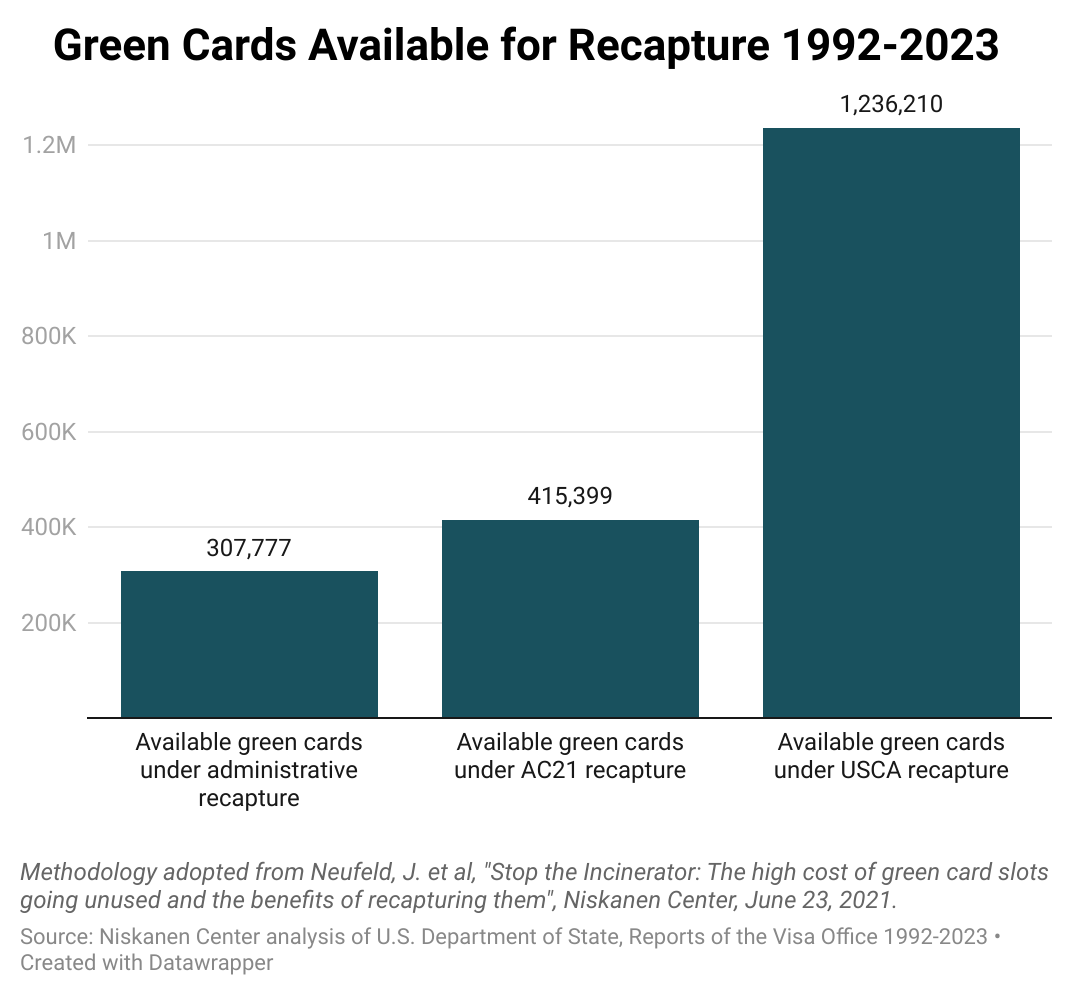
Other options include recalculating how green cards are counted and distributed. For example, dependents of EB-5 investors, i.e. spouses and minor children, can accompany the investor and apply for permanent residence at the same time. However, the green cards that dependents receive count toward the total number of green cards available in the EB-5 category, even if the dependents have not made a qualifying investment. In fiscal year 2022, about 56% of green cards issued in the EB-5 category were issued to dependents rather than to the principal investor, reducing the effectiveness of the program. To remedy this, Congress could exempt all or some of the dependents from the green card allocation, especially in EB-5 or other employment-based categories.
Congress could also increase the overall green card cap or, more specifically, revise the per-country caps. The current 7% cap for each country of origin was set in 1990 and no longer reflects the realities of our current immigration system. Under current policy, some people breezed through the green card process and received a visa almost instantly, while others who are equally eligible wait in line for decades because of their nationality. Updating these limits and similarly outdated overall green card allocations could free up slots more quickly for currently pending investments.
Since its creation in 1990, EB-5 has been essential in attracting foreign direct investment and bolstering domestic economic activity. However, outdated policies currently leave approximately $10 billion sitting in U.S. escrow accounts, never available to those who could benefit from the funds. America’s rural areas are the ones that need and stand to benefit most from this investment. Therefore, it is the responsibility of Congress and the Administration to make this investment available more quickly and help revitalize these areas through green card redemptions and modernization of green card limits and quotas.
