

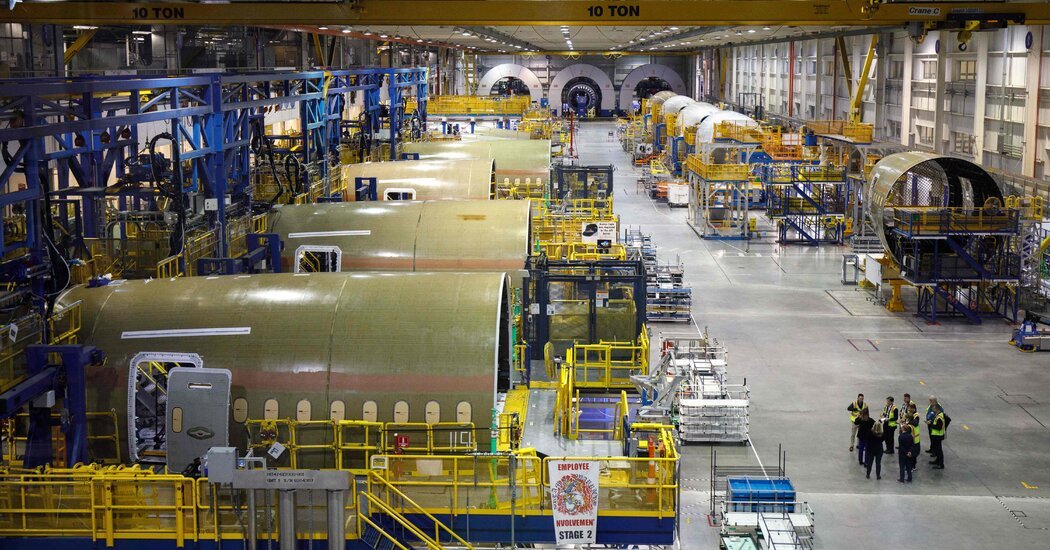
Some recently built Boeing and Airbus jets contain titanium parts that were sold with false documentation attesting to the material’s authenticity, raising concerns about the structural integrity of those planes, according to suppliers to the aircraft manufacturers.
The fake documents are being investigated by Spirit AeroSystems, which supplies fuselages to Boeing and wings to Airbus, and the Federal Aviation Administration after a parts supplier found small holes in the material caused by corrosion.
The FAA said in a statement that it is investigating the scope of the problem and is seeking to determine the short- and long-term safety impacts on aircraft built with these parts. It is unclear how many aircraft use parts made from the affected materials.
“Boeing made voluntary disclosures to the FAA regarding procurement of materials through vendors who may have falsified or provided inaccurate records,” the statement said. “Boeing has issued a public notice outlining how suppliers should remain vigilant against possible falsified records.”
The revelations come at a time of intense scrutiny for Boeing and the entire aviation industry, which has been rocked by a series of accidents and safety problems. In January, a door panel on a Boeing 737 Max 9 jet blew off in flight, sparking several federal investigations. In April, Boeing notified the FAA about another incident of possible falsification of inspection records on the wings of its 787 Dreamliner planes. Boeing informed the FAA that it may have skipped required inspections on the jet’s wings and that some Dreamliners still in production will need to be reinspected.
Boeing submitted a plan to the FAA on May 30 outlining the safety measures the company plans to implement and committing to holding weekly meetings with the agency. Boeing Chief Executive Officer Dave Calhoun is scheduled to testify before a Senate committee on the company’s safety issues on Tuesday.
The previously unreported use of potentially counterfeit titanium threatens to extend the industry problem not only to Boeing but also to European rival Airbus. Planes with parts made from the material are built between 2019 and 2023 and include Boeing 737 Max and 787 Dreamliner passenger jets and Airbus A220 jets, said three of the people, who spoke on condition of anonymity because they were not authorized to speak publicly, but it is unclear how many of those planes are in service or which airlines own them.
Spirit Airlines is trying to determine the source of the titanium, whether it was made to the proper standards despite the false documentation and whether parts made with the material are structurally sound enough to last the expected life of the jet, company officials said. Spirit Airlines said it is trying to figure out the most efficient way to remove and replace the affected parts if necessary.
“This is an issue regarding counterfeit, forged and fake documentation,” Spirit spokesman Joe Buccino said. “After we became aware that counterfeit titanium had entered our supply chain, we immediately contained all suspect parts to determine the scope of the issue.”
Spirit Airlines officials said the titanium is used in a variety of aircraft parts, including passenger doors, cargo doors and parts that connect the engines to the fuselage of the 787 Dreamliner. For the 737 Max and A220, affected parts include heat shields that protect the parts that connect the jet’s engines to the fuselage from extreme heat.
Boeing and Airbus have said tests of the affected material so far have shown no signs of problems.
Boeing said it directly purchases most of the titanium used in aircraft production, so the majority of its supplies are unaffected.
“This industry-wide issue has affected some shipments of titanium received from a limited number of suppliers, and testing performed to date indicates that the correct titanium alloy was used,” Boeing said in a statement. “To ensure compliance, we are removing all affected parts from aircraft prior to delivery, and our analysis indicates that operational aircraft remain safe to fly.”
Airbus similarly maintained that “the airworthiness of the A220 has not been compromised.”
“Numerous tests were carried out on parts coming from the same source,” an Airbus spokesman said in a statement, adding that “the safety and quality of our aircraft are of paramount importance and we work in close cooperation with our suppliers.”
The European Union Aviation Safety Agency said in a statement that it had launched an investigation into the substance after learning of the traceability issues from the Italian agency. An agency spokesman said the investigation was ongoing and that it had not yet found evidence of an imminent safety issue.
“However, officials are further investigating the root cause of the paper tracing issue and will continue to closely monitor any new developments that could lead to a potentially unsafe condition for the fleet,” the statement said.
Spirit Airlines has been plagued by quality issues and financial difficulties in recent years and came under renewed scrutiny after an incident in January involving door panels for the 737 Max, whose fuselages the airline makes.
The issue highlights the complex global supply chains that go into building modern passenger jets, and what went wrong appears to involve companies in China, Italy, Turkey and the United States.
The problems appear to have begun in 2019 when Turkish Aerospace Industries, a Turkish materials supplier, bought a batch of titanium from a Chinese supplier, according to people familiar with the matter. The Turkish company then sold the titanium to multiple companies that made aircraft parts that ended up in Spirit Airlines, which used them in Boeing and Airbus planes.
In December 2023, an Italian company that purchased titanium from Turkish Aerospace Industries noticed that the material was different from what the company normally receives. The company, Titanium International Group, also noticed that the certificate that came with the titanium did not appear to be genuine.
Turkish Aerospace Industries did not respond to a request for comment.
Spirit Airlines began investigating the matter and notified Boeing and Airbus in January that it could not verify the source of titanium used to manufacture certain parts. Titanium International Group told Spirit Airlines it did not know the documents had been falsified when it purchased the material in 2019, according to a Spirit Airlines official.
Francesca Conti, general manager of Titanium International Group, said the incident is under investigation and she could not provide further details. “We are working with the appropriate authorities to address any issues that are ultimately identified,” she said in an email.
The document in question is called a Certificate of Conformity, and Spirit officials say it acts as a sort of birth certificate for titanium, detailing its quality, manufacturing methods and origins.
According to people familiar with the matter, employees at the Chinese company that sold the titanium appear to have falsified certificate details, saying the material came from another Chinese company, Baoji Titanium Industry Co Ltd, a frequent supplier of verified titanium. Baoji Titanium later acknowledged that it did not supply the titanium. The source of the titanium remains unclear.
“Baoji Titanium has no knowledge of and does not do business with the company,” the company said in a statement to The New York Times.
Greg Brown, Spirit Airlines’ senior vice president of global quality, said it’s impossible to verify a part’s airworthiness without knowing where the materials came from or how they were handled.
“Our quality control process relies on traceability from the factory to the raw materials,” Brown says. “Somewhere along the way, traceability was lost and documentation was a challenge.”
Spirit Airlines officials said they have begun testing titanium parts to ensure they are made from aircraft-grade material, and the airline is testing parts it still has in stock and installed on undelivered planes.
So far, Spirit’s testing has confirmed that the titanium is a suitable grade for aircraft manufacturing, but the company could not confirm that the titanium was processed through an approved aircraft manufacturing process. The material passed some of the material tests that were conducted, but failed others.
Spirit Airlines spokesman Buccino said the company is working with customers to identify affected aircraft. Planes already in service will be monitored by airlines and will be grounded earlier than normal if necessary, he said. He said the affected parts will likely be removed during routine maintenance inspections, regardless of whether the titanium tests are normal.
Olivia Wang He contributed reporting from Hong Kong. Kitty Bennett contributed to the research.
