

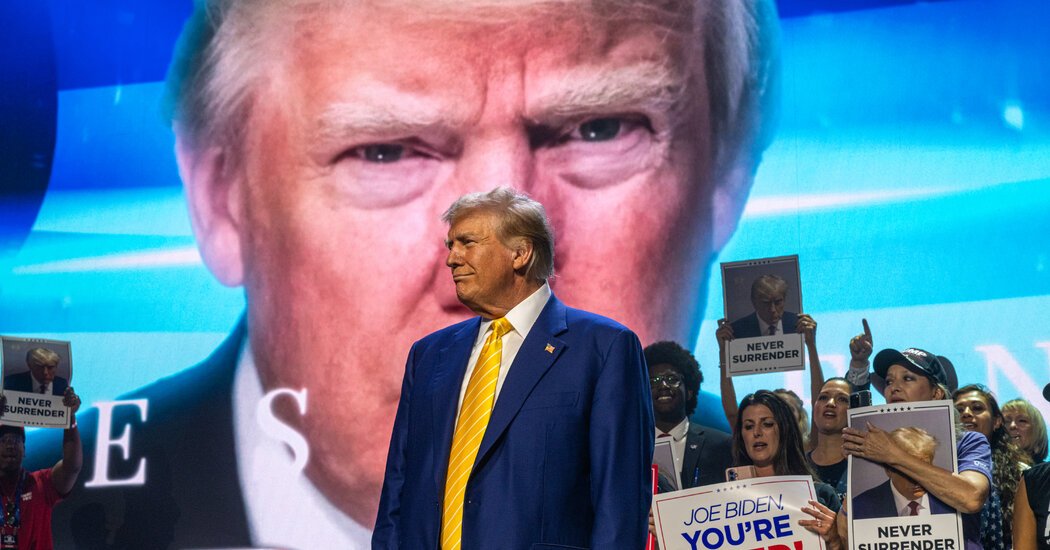
Political campaigns do their best to control everything they can: candidates, messages, surrogates, schedules, etc. But what about the weather?
As former President Donald J. Trump campaigns in the Southwest this week, his team is battling sweltering heat that is threatening the health of some of his most enthusiastic fans.
Trump arrived in Phoenix on Thursday for a campaign event at a megachurch, where hopeful attendees waited for hours in temperatures exceeding 110 degrees Fahrenheit to get in. Some people collapsed while waiting, so hot that 11 were taken to the hospital for treatment of heatstroke.
The Trump campaign is taking steps to avoid a similar situation as Trump is scheduled to speak at an outdoor rally at noon Sunday in a Las Vegas park, where forecasters expect temperatures to hit about 105 degrees Fahrenheit.
Much of the western US has been hit by a heatwave this week, with Phoenix and Las Vegas under heat alerts for days and afternoon temperatures approaching triple digits.
And the temperatures were historic: Phoenix reached 113 degrees Fahrenheit on Thursday, while Las Vegas reached 111 degrees, the highest daytime temperatures in both cities.
Still, Trump’s rally in Phoenix was held indoors, offering people who made it there the peace and air conditioning that might be hard to find at an outdoor rally in Nevada.
The weather service’s heat warning for Las Vegas is scheduled to be lifted at 9pm on Saturday, the day before Trump’s rally, but temperatures are currently expected to reach a maximum of 104 degrees on Sunday with few clouds.
Supporters hoping to attend Trump events typically arrive hours before the candidate does and wait in long, slow lines to get through security and secure a good spot.
The Trump campaign said it would stock thousands of bottled water in Las Vegas to provide to people waiting in line and those already inside the security area, and it would set up tents around the park to help people get out of the sun, at least one of which would be air-conditioned.
Campaign staff will set up several misting fans to help attendees stay cool, and although Secret Service and security guards have sometimes confiscated umbrellas for fear they could be used as weapons, the Trump campaign said it would allow small umbrellas to provide shade at Sunday’s event.
Trump may face similar problems all summer long, with the National Oceanic and Atmospheric Administration’s seasonal forecast predicting above-normal temperatures over the next three months across most of the US.
As the planet warms due to climate change, periods of extreme heat are becoming more frequent, longer and more intense.
Trump has downplayed the threat of climate change, saying in an interview with Fox News’ Sean Hannity this week that “the only global warming that matters to me is nuclear global warming, because that’s real,” and has mocked President Biden for being overly concerned about climate change and calling it an existential threat.
Still, Trump often holds rallies in extreme weather conditions or cancels them because conditions are too dangerous.
When a severe snowstorm hit Iowa a week before the caucuses earlier this year, Trump canceled all but one of his rallies, citing the possibility of bad weather.
At his actual event, attendees braved sub-zero temperatures and extreme wind chills to line up, and the campaign provided three heated motorcoaches to keep people warm while they waited.
In April, Trump canceled a rally on the tarmac of a North Carolina airport due to safety concerns as severe thunderstorms approached.
