

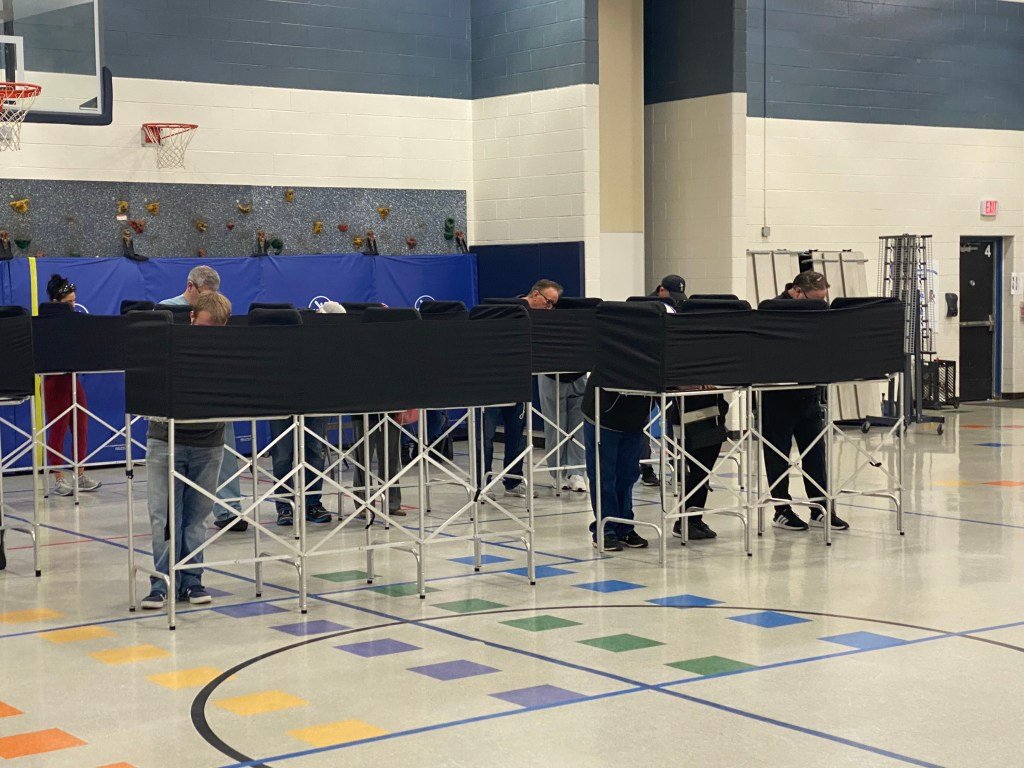
File image of voters casting their ballots. (Stephen Fry/Media News Group)
Every four years, a topic of concern to clients comes up in review meetings. If it sounds related to the election cycle, you’re right. Presidential elections bring out a wide range of emotions in people: hope, frustration, anger, doubt, apathy, the list goes on. This topic will continue to come up through Tuesday, November 5th.
It doesn’t help that we are constantly bombarded with ads, texts and news reports. But should elections affect your finances? Should you change your investment strategy in an election year? To make it easier to understand, let’s look at the history of the stock market in election years.
Since 1948, the S&P 500 Index has returned an average of more than 10% in every election year. The index is a market-capitalization weighted index that tracks the stock price performance of the 500 largest publicly traded companies in the United States.
The average annual decline in election years was 14%, which is in line with the historical norm for all years. Volatility is nothing new in the investing world. While everyone wants their accounts to grow on a steady upward trajectory every year, that’s not the world we live in.
People have always found reasons to wait on the sidelines until market volatility subsides, but that’s not always the wise thing to do. Consider what happened in 2008 when I graduated from college.
Lehman Brothers famously collapsed just two months before the presidential election, and the global economy was in freefall, but investing in the S&P 500 index at the start of 2008 would have earned investors an average of about 8% annually over the next decade.


It’s hard to remove emotion from investment decisions. I recently came across a chart that shows just how difficult it is: Considering every election year since 1992, the average net inflows into money market funds exceeded the average net inflows into investment funds by almost four times. In times of uncertainty, many people are seeking safety when they should be seeking opportunity.
So what will happen this election year? Since the S&P 500 Index was created, there have been 24 elections. Of those 24 elections, 20 have had positive returns, with an average annual return of just over 11%. Of course, every year is different, and past performance is not indicative of future results. The key is to control what you can control. One of the hardest things to do as an investor is to resist the urge to say, “This time will be different.”
Ultimately, I think it’s wise to stick to the plan: Stick to the plan. If you haven’t taken the time to discuss your financial future yet, 2024 is a good year to start.
There is always a reason, or perceived reason, to wait for the uncertainty to pass. The world is showing us that the next challenge to our economic well-being will be one no one could have imagined.
We didn’t expect a global pandemic to hit us in 2020. But now the markets have proven resilient. So, if you’re feeling anxious about the upcoming election, you’re not alone. Elections are emotionally charged. Just don’t let them affect your investment strategy.
If you have any questions, please email me at kenmorris@lifetimeplanning.com.
Securities are offered through Kestra Investment Services, LLC (Kestra IS), member FINRA/SIPC. Investment advisory services are offered through Kestra Advisory Services, LLC (Kestra AS), an affiliate of Kestra IS. Society for Lifetime Planning is not affiliated with Kestra IS or Kestra AS. https://kestrafinancial.com/disclosures
The opinions expressed in this commentary are those of the author and do not necessarily reflect the opinions of Kestra Investment Services, LLC or Kestra Advisory Services, LLC. It is intended for general information only and is not intended to provide investment advice or recommendations to any specific individual. You are encouraged to consult with a financial professional, attorney or tax advisor regarding your individual situation. Comments regarding past performance are not forward-looking and should not be viewed as indicative of future results.
