

Growing up in Bozeman, Montana, Dylan Heintz loved the beautiful scenery of snow-capped mountains and small-town charm of the area, where the cost of living was so low that his father bought a house for about $80,000.
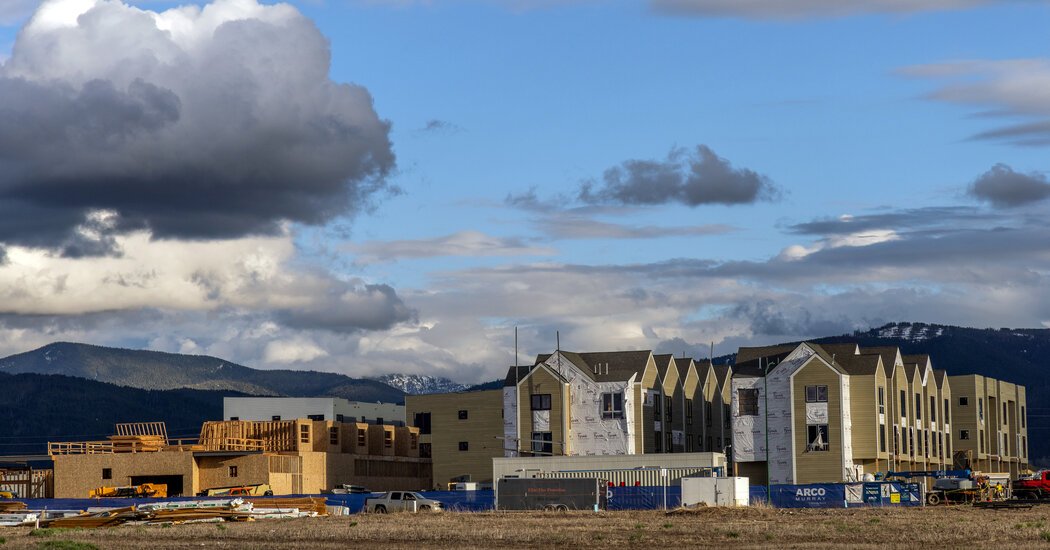
Bozeman feels less quaint these days. A steady influx of out-of-state migrants into Big Sky Country has inundated the area during the pandemic, leading to soaring prices, a boom in luxury condominiums that eclipse the pristine landscape, and a proliferation of upscale stores like Whole Foods. Drawn by Montana’s natural beauty and easy outdoor activities, the newcomers have sparked high home prices and a backlash from locals that is reshaping the state’s economy and politics.
“I love the place, but it’s a tough place to live,” said Heintz, 28, an auto-body repairman. Rent for his mobile home has doubled, and he and his wife can’t afford a home in town, so they’re considering moving to Florida. “A lot of people from out of state have a lot of money, and a lot of them are willing to pay more than the asking price. It’s definitely hurting people.”
A new wave of wealthy residents — many of them retirees, tech workers who can work remotely and others who have moved from bigger cities — is one of the biggest question marks hanging over Montana’s key Senate race. Tensions over the state’s explosive population growth will be a key issue in November as Democratic incumbent Jon Tester tries to fend off presumptive Republican nominee Tim Sheehy, a businessman and former Navy SEAL.
And how Montana’s new vote could prove decisive.
On the surface, their presence might seem to work in Tester’s favor: A sizable portion of them — 35% of 2022 arrivals — come from left-leaning states like California, Colorado, Oregon and Washington, according to census data analyzed by real estate firm CBRE. But some political experts think the arrivals could lean further to the right, pointing to a broader phenomenon of conservatives leaving their home states for what they see as liberal excesses.
“Especially during the pandemic, we’ve seen people moving out of Democratic-leaning areas looking for a different way of life that leans more Republican,” said Dr. Jesse Bennion, a political science professor at Montana State University. “I would guess that’s what’s driving a lot of the movement into the state.”
These voter trends remain up for debate because Montana does not have a party registration system.
“It’s a mystery,” Dr Bennion says. “The next election will reveal a lot about how voters approach politics.”
Migration slowed last year but can still account for a significant portion of the vote: About 52,000 more people moved to Montana than left it between 2020 and 2023, according to the Montana Department of Labor and Industry. Tester won re-election in 2018 by fewer than 18,000 votes. The state’s total population is just over 1.1 million.
Montana is a traditionally conservative but contrarian state that votes solidly Republican for president but has repeatedly sent Tester back to the Senate and elected a Democratic governor to lead the state from 2005 to 2020. Still, political strategists and experts say Montana has been moving rightward in recent years.
State Republican Party Chairman Don Kaltschmidt suggested an influx of new people was a big factor.
“There’s a lot of what we call political refugees,” Kaltschmidt said. “There’s more and more conservatives moving in from Democratic states.”
The National Republican Senatorial Committee, which works to elect Republicans and has supported Sheehy, said its analysis found that about 41% of newcomers who registered to vote in Montana since late 2018 were registered as Republicans in their home states, compared with about 25% who were registered as Democrats.
Democrats dispute the claim that newcomers overwhelmingly belong to a particular party, arguing that their data is more complicated: They point out that Montana’s fastest-growing counties are leaning left, suggesting liberals are moving to those areas.
Tester has relied on his bipartisan reputation and rural farming background to win over Republican voters in past elections, and appealing to newcomers to that legacy could be crucial to his ability to stay in power.
Tester “absolutely needs to win over the minority of voters who are willing to split their vote,” Dr Bennion said.
Jennifer Glad and her husband moved to Bozeman from Redondo Beach, California, in late 2020, attracted by easy access to ski areas and good public schools for their children, but also by a desire to get away from California and its left-leaning political leanings.
“It’s all so volatile, and I can’t stand the policies and the taxes and everything that comes with it,” said Mr. Glad, 47, a lawyer who declined to say how he would vote in the Senate election. “I’m sick of the crime and the homelessness.” By contrast, he said, Mr. Boseman seemed “fairly centrist.”
Recent immigrants tend to lean left.
Greg Jemmett was already splitting his time between Palm Springs and Bozeman, Calif., when the pandemic shut down the country. He loved being close to the outdoors, and the area wasn’t as conservative as he’d feared, so he and his husband decided to make the place their permanent home.
“I said to myself, if the world is going to end, I might as well die here because this place is beautiful,” said Jemmett, 60, a clothing executive who plans to vote for Tester.
Regardless of political stance, out-of-state migrants have a significant impact on the local economy. According to the Montana Department of Labor, the median home price at the end of last year was about $425,000, up 75% from five years ago. The state also expects to add 18,450 jobs in 2022, the most in the state’s history. That same year, Montana had the fourth-highest wage growth in the nation, with the average annual salary at $54,525, up $12,000 from five years ago.
But residents say rising property taxes, which rose an average of 21 percent last year, are straining bank accounts and sending the costs of groceries, gasoline and other necessities soaring. While luxury homes are springing up, locals say affordable new housing is in short supply. But Republican Gov. Greg Gianforte is pushing a series of new housing policies aimed at alleviating the housing shortage.
Nowhere is the crisis of rising home prices felt more acutely than in Bozeman, a city of about 56,000 people near Yellowstone National Park and the upscale ski resort of Big Sky. With an average home price of about $770,000, Bozeman has long attracted so many out-of-state residents that Montanans sometimes refer to it as “Boz Angeles.”
In Bozeman, luxury rental properties are being built one after another next to historic homes, and as new residents buy them up, tents and campers are beginning to dot the outskirts of town, homeless residents who can no longer afford to live there due to rising rents.
Many longtime Montana residents resent the newcomers, with many bumper stickers reading “Montana is Full” and sometimes including expletives. Some locals blame the popular TV show “Yellowstone” for glamorizing the mountain West to lure people to the state.
Bozeman Mayor Terry Cunningham, a nonpartisan city council member, said many of the city’s longtime residents moved there decades ago and that “it’s not fair to blame the newcomers.”
Still, he said he spends a lot of his time urging developers to build affordable housing and trying to ease tensions in the community.
“Frankly, the tension is what keeps me up at night,” Cunningham said.
Not surprisingly, liberals and conservatives in Montana don’t agree on who should be held responsible for these problems.
Republicans have argued that President Biden bears responsibility for inflation, which has led to higher prices and an overpriced housing market. (Economists say Biden’s pandemic-era stimulus package certainly contributed to higher inflation; former President Donald J. Trump also signed a string of stimulus bills.) Republicans also point out that Tester voted for several bills that contributed to higher inflation, including the stimulus package and a 2021 package to modernize the nation’s infrastructure.
Democrats and many county governments hold Gianforte and the Republican-controlled state Legislature particularly responsible, saying the state failed to protect property owners from the hit of higher taxes when home values were reassessed.
Sheehy, a billionaire who grew up in Minnesota, is said to be typical of wealthy out-of-state residents, even though he moved there a decade ago and made his fortune in the state.
“He’s trying to turn our state into a playground for wealthy immigrants like him,” said Tester’s campaign manager, Shelbi Dantic.
Katie Martin, a spokeswoman for Sheehy’s campaign, said Sheehy and his wife, Carmen, “chose to call Montana home, raise their family and start a business because it was a place that aligned with their values and the way they wanted to live their life.”
Cunningham said he has voted for both Democrats and Republicans and remained diplomatic about the Senate election.
He praised Sheehy’s donations to the local health care system and said he was committed to improving the community, and said Tester was instrumental in increasing funding for low-income housing tax credits.
“I saw two guys who loved their state, loved their community and were trying to do good,” Cunningham said.
