

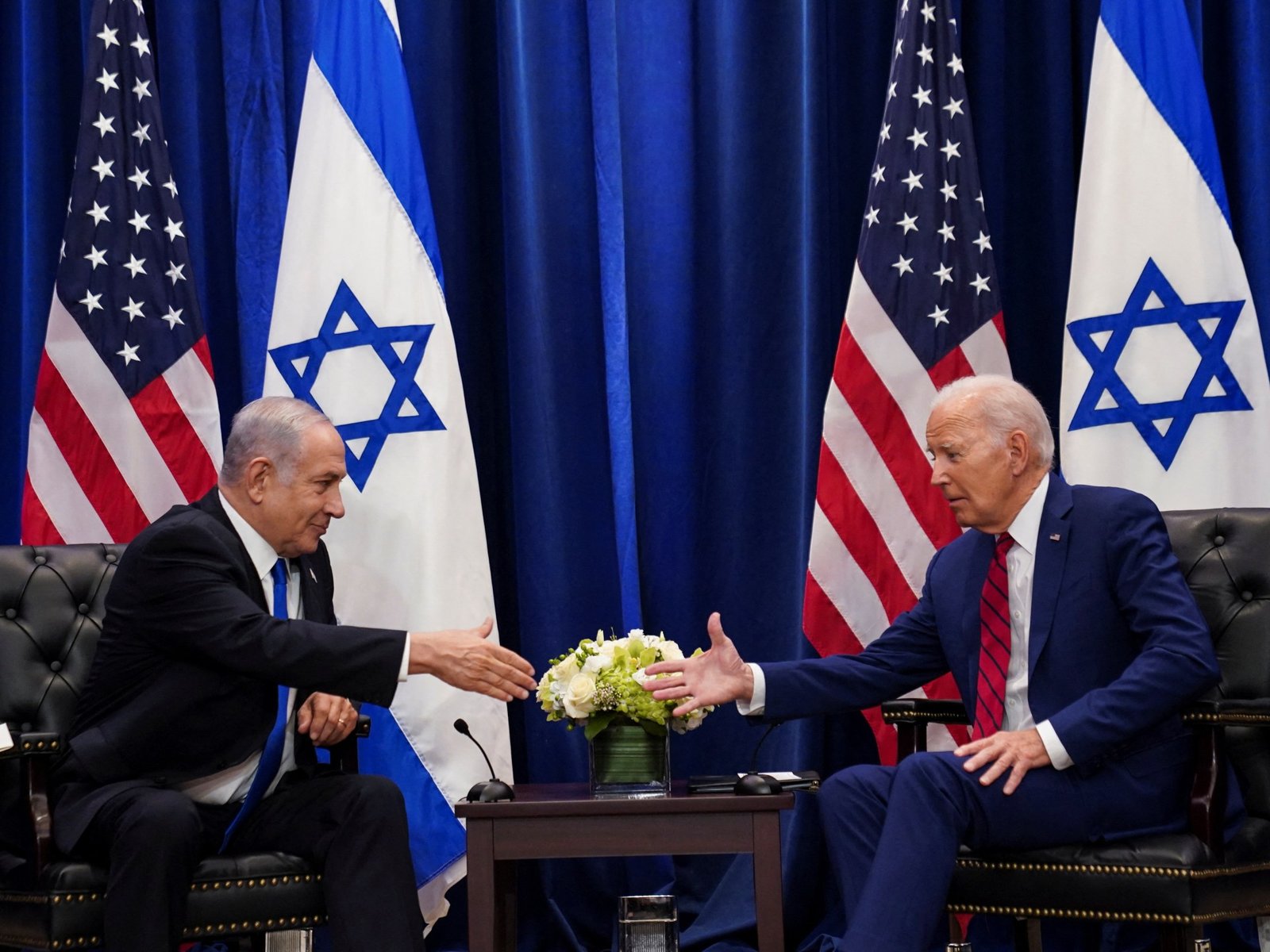
The US president’s comments came as Washington seeks a ceasefire and prisoner agreement between Israel and Hamas to end the conflict.
Washington DC – US President Joe Biden suggested Israeli Prime Minister Benjamin Netanyahu was prolonging the Gaza war for political reasons, highlighting apparent tensions between the two leaders.
In an interview with Time magazine published on Tuesday, the US president said there was “good reason to conclude” that Netanyahu was prolonging the conflict for his own political purposes.
Biden’s comments come as the administration pushes for a ceasefire and prisoner exchange between Israel and Hamas that Washington says would lead to a “lasting ceasefire” and eventual reconstruction of Gaza.
The United States presents the proposal as an Israeli plan and claims Hamas is the only obstacle to an agreement.
The Palestinian group said on Friday, hours after Biden made his proposal public, that it was dealing with the plan “positively and constructively,” but has not issued a formal response.
Meanwhile, Prime Minister Netanyahu said the agreement “allows Israel to continue the war until all its objectives are achieved, including the destruction of Hamas’ military and governing power.”
Differing explanations of the proposal by U.S. and Israeli officials have added to the confusion.
Still, the move marks a shift in position from the Biden administration, which has so far rejected a permanent end to the war, insisting that Israel must eliminate Hamas before a lasting cease-fire can be achieved.
Biden on Friday criticized Israel’s war efforts. “An indefinite war in pursuit of some vague notion of ‘total victory’ will only trap Israel in Gaza, deplete its economic, military and human resources, and further isolate Israel in the world,” he said.
The US president’s comments to Time magazine about Netanyahu appear to further underscore his growing frustration with the conflict.
Before the war broke out on October 7, Netanyahu was dealing with nationwide protests calling for reforms to the Israeli justice system and is also facing domestic corruption charges.
Palestinian rights groups have warned for months that Netanyahu has a personal political interest in prolonging the war to enhance his standing in Israel and extend his political career.
Recent surveys in Israel show that Prime Minister Netanyahu’s popularity has rebounded during the war, narrowly surpassing his chief rival, war cabinet minister Benny Gantz.
Israeli officials close to Prime Minister Netanyahu have previously suggested the conflict in Gaza could be protracted.
Days before Biden announced his ceasefire proposal, Israeli national security adviser Tsahi Hanegbi said fighting in Gaza would continue for at least another seven months.
In the United States, Biden’s handling of the Gaza war could hurt his chances of reelection, with polls showing Arab, Muslim and younger voters are unwilling to vote for a Democratic president who supports Israel.
Biden, a self-described Zionist, has staunchly defended the war, and his administration has vetoed three UN Security Council resolutions calling for a ceasefire.
The president also approved an additional $14 billion in military aid to Israel in April, and the administration has continued to arm Israel despite the withholding of aid, the killing of non-combatants, the torture of detainees, and mounting allegations of war crimes, including attacks on civilian infrastructure.
Karim Khan, the prosecutor at the International Criminal Court, has sought arrest warrants for Prime Minister Netanyahu, Defense Minister Yaov Galant and Hamas leaders on suspicion of war crimes.
Biden last month condemned the ICC prosecutor’s move as “outrageous,” but the White House has opposed any congressional efforts to impose sanctions on ICC officials investigating Israel’s actions.
Israeli attacks have left more than 36,500 Palestinians dead and pushed Gaza to the brink of famine.
In an interview with Time magazine, Biden said he was “uncertain” about whether Israel was committing war crimes in Gaza.
Biden said in December that he was losing support for Israel’s war in Gaza, citing the war crime of “indiscriminate bombing” of the Gaza Strip.
