

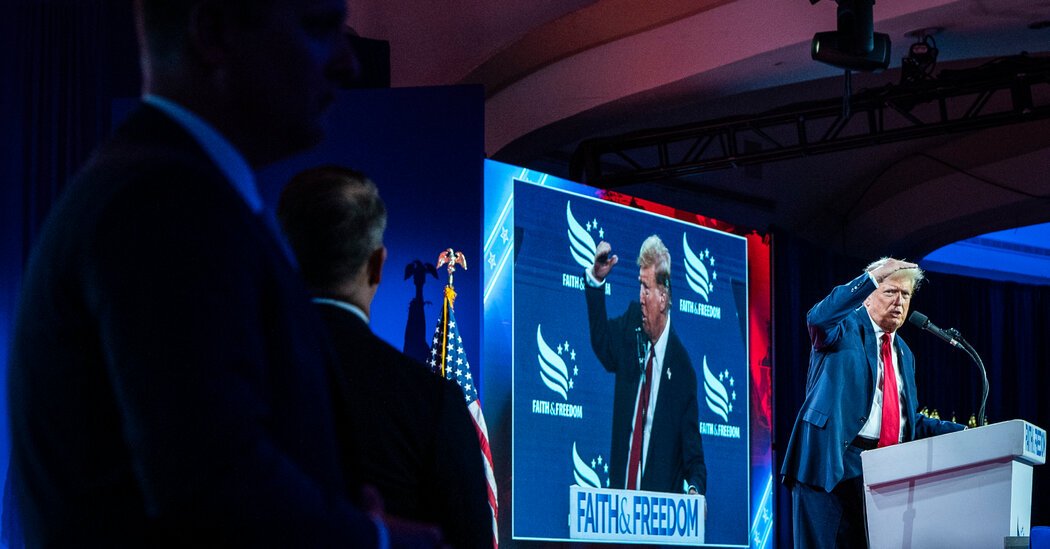
Former President Donald J. Trump spoke to the Evangelical Faith and Freedom Coalition in Washington on Saturday, presenting himself as a defender of religious freedom and a martyr for Americans of faith and denouncing what he called mass persecution of Christians.
Alluding to his own legal troubles, Trump also suggested his political beliefs were being targeted and portrayed himself as having “wounds all over his body”.
“At the end of the day, it’s not me they’re after, it’s you,” Trump said. “I just happen to be standing there with great pride in their eyes.”
“We need Christian voters to turn out in record numbers to say to evil Joe Biden: ‘You’re fired!'” he added to thunderous applause.
Trump’s appeal to evangelicals comes at a crucial moment in the presidential election, when President Biden and President Trump face off in an unusually early debate on CNN on Thursday, with polls predicting a close race.
The appearance marked something of a triumphant return to the event for the former president, who is now considered a leading Republican presidential candidate. Thirteen years ago, Trump was hardly an image of a social conservative warrior. Speaking before the group for the ninth time, the former president voiced his support for many of the positions taken by conservative and religious leaders on cultural issues and outlined his vision for what a second term as president could offer the Christian right.
He supported a new Louisiana law requiring the Ten Commandments to be displayed in all public classrooms, and wondered aloud whether anyone was opposed to displaying religious literature in schools, adding that “religious rights do not end at the front door of a public school.”
He also pledged to “shut down the federal Department of Education” if elected, a promise that drew a standing ovation from the audience and lawmakers began chanting “Vote, vote, vote.”
He also repeated the lie that the 2020 election was stolen from him and fabricated a narrative that the Biden administration is persecuting Christians for their faith while suggesting his own legal troubles made him a martyr on behalf of his supporters. He said that if elected, he would “create a new federal task force to combat anti-Christian bigotry across the country.”
Trump’s fierce, righteous rhetoric has been fused with efforts to appease parts of the Christian right who say his policies on abortion fall short. His supporters have implored the former president to support a nationwide abortion ban or adopt a plan to criminalize abortion pills through the implementation of the Comstock Act.
On these issues, Trump did not give hard-line evangelicals what they had hoped for: He repeatedly assured them that those who support stricter regulations “should follow them wholeheartedly,” but he added that “we have to win the election.”
Michael Whatley, a Trump ally and chairman of the Republican National Committee, supported Trump’s position against a nationwide abortion ban after his own speech to an evangelical group ahead of Trump’s speech.
“We’ve been fighting for more than 50 years to end the tyranny of Roe v. Wade,” Whatley told reporters after his speech at the Faith and Freedom Coalition, adding, “This needs to be a state-by-state debate.”
“We feel very good about this campaign and the direction we’re heading on this issue,” he added.
The Biden campaign issued a statement that barely addressed Trump’s religious rhetoric, instead criticizing his speech as a “disjointed, confused and long-winded speech” and highlighting a moment in which Trump said he had suggested to his ally, Ultimate Fighting Championship CEO Dana White, that they start an “immigrant league” that would pit immigrants against each other.
“Mr. Trump’s incoherent and erratic rant showed voters that, in his own words, he is a threat to our freedoms and too dangerous to ever be allowed near the White House again,” Biden campaign spokeswoman Sarafina Chitica said in a statement.
Donald Eason, senior pastor of Metro Church of Christ in suburban Detroit, who attended the Faith and Freedom Coalition conference, said he supports leaving abortion issues to the states.
“Any power not vested in the federal government automatically becomes part of state government. The Supreme Court should never have gotten involved in this in the first place,” Eason said, but left open the possibility of national regulation, adding: “Of course, Congress could step in and issue a nationwide ban.”
Eason also supported Louisiana’s law on the Ten Commandments in public classrooms and said the policy should be expanded to other states.
