

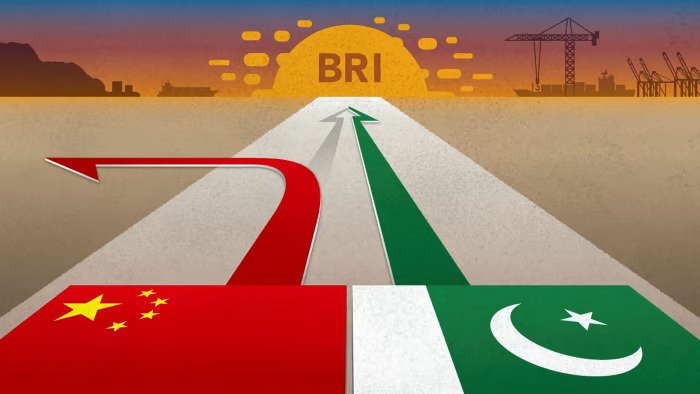
New Delhi: China has curbed its CPEC investments in Pakistan by 74% in 2023 compared to 2022.
Lack of investment returns, delays in project completion and security concerns have led China to cut its investments in Pakistan by up to 74 percent in 2023 compared to 2022 as part of the China-Pakistan Economic Corridor (CPEC), which is part of the larger Belt and Road Initiative (BRI).
Currently, 151 countries are part of the BRI, with Pakistan being one of the original seven countries to join the initiative when it was launched in 2013.
A recent report by the Green Finance and Development Center at the Fanhai School of International Finance (FISF) of Fudan University in Shanghai, China, which provides independent research, advisory and capacity development on green finance and investment with a focus on China, found that cumulative commitments to the BRI have surpassed the US$1 trillion mark since its launch in 2013 and are expected to reach US$1.053 trillion by 2023, of which approximately US$634 billion is in construction contracts and US$419 billion is in non-financial investments.
In detail, the report said that Chinese loans and investments will span 61 countries by 2023, with 37 countries receiving investments and 45 countries receiving construction-related involvement.
The country with the highest construction volume in 2023 will be Saudi Arabia, with approximately US$5.6 billion (up from US$2.6 billion in 2022), followed by Sri Lanka (US$4.5 billion), Tanzania (approximately US$3.1 billion), and the UAE (US$2 billion).
In terms of BRI investments, Indonesia was the largest beneficiary with investments of around US$7.3 billion, followed by Hungary (US$4.5 billion) and Peru (US$2.9 billion).
Nineteen countries, including Kenya, Myanmar and Turkey, have reduced their BRI commitments by 100% compared to 2022.
Most notable on this list is Pakistan, which saw its involvement fall by about 74%. Pakistan has received US$28 billion so far through investment and construction contracts, most of which are hydroelectric and coal projects.
The only agreement China and Pakistan have signed in 2023 was a January 2023 contract to build a 300MW coal-fired power plant in Gwadar. However, financial details of the project have not been made public, leaving doubts as to whether the project has actually started.
The countries that saw the highest growth in their BRI engagement over the same period were South Korea (577%), Bolivia (493%), Namibia (457%), Tanzania (415%) and Uzbekistan (375%), indicating that Beijing’s decision to halt investment in Pakistan was a conscious one and not driven by the economic slowdown caused by the COVID-19 pandemic.
China’s ultimatum
The recent decline in engagement and initiation of new projects indicates a potential shift in China-Pakistan economic relations within the framework of the BRI.
Shaken by the failure of its investments under the Belt and Road Initiative and the assassinations of its citizens in Pakistan, China has issued an ultimatum to Pakistan to eliminate all credible threats the Belt and Road Initiative faces from armed resistance groups.
During a five-day visit to China earlier this month, Pakistani Prime Minister Shahbaz Sharif was criticized by Chinese President Xi Jinping for failing to secure China’s interests in Pakistan and was asked to launch military operations against militant groups, particularly the Taliban Movement (Pakistan) and groups in Balochistan.
Then, on June 22, Chinese official Liu Jianchao, who is also head of the Foreign Relations Department of the Communist Party of China Central Committee, spoke at the Pakistan-China Joint Consultative Mechanism meeting in Islamabad and openly criticized Pakistan, saying the country’s domestic security deficiencies were a major challenge undermining investor confidence.
Expressing concern over the security situation in Pakistan, Liu targeted Chinese personnel involved in various CPEC projects, saying, “Security threats are the main threat to CPEC cooperation. As the saying goes, trust is more precious than gold. In Pakistan’s case, the security situation is the main factor shaking the confidence of Chinese investors. Without security, the business environment cannot really improve,” he said, adding that this could undermine development in the long run.
After the speech, Liu met with Pakistan Army Commander General Syed Asim Munir at General Headquarters (GHQ) in Rawalpindi.
Shortly after the meeting, the Pakistani military announced the launch of a military operation dubbed “Azm-e-Istekam” (Strong Resolve for Stability) in an effort to appease China.
The Pakistani military has conducted more than 15 similar operations over the past two decades without any lasting success.
Islamabad Takes Advantage of Washington
Interestingly, a few days before this announcement, Islamabad’s envoy to Washington, Masood Khan, had said the US should urgently provide Pakistan with additional military equipment to counter the surge in attacks by the TTP, which he blamed on the US withdrawal from Afghanistan in 2021.
Washington has been covertly supporting Pakistan’s military operations on its western border with Afghanistan. U.S. military strategists were compelled to support the Pakistani military after being informed in detail why Washington needed GHQ’s assistance to prevent and control Islamic groups from repeating 9/11-style attacks against the United States in the wake of the Taliban’s occupation of Afghanistan. GHQ also told Washington that Islamabad would turn to Beijing for help if military assistance was not forthcoming from the United States.
Apart from Washington’s concerns that increasing Chinese investment in Pakistan will ultimately impact Pakistan’s ability to make independent strategic decisions, some in Islamabad are also concerned about the huge obligations that Pakistan has assumed under CPEC.
The fact that Chinese investments could ultimately be used to coerce host countries has been a topic of discussion behind closed doors among academics, journalists and diplomats in Islamabad.
This section believes that sooner or later China will have military bases and armed personnel in Islamabad to protect its investments.
China is actively promoting military-civilian interoperability under its military-civilian fusion program and China Standard 2035 initiative.
China Merchants Bank signed the first commercial lease for a property in Djibouti, which China later used to develop a military base.
Similarly, Sam Enterprises Group, which has close ties to the Chinese military, has bought land in Vanuatu and the Solomon Islands.
Similarly, as in the case of Pakistan, Chinese state-owned banks, state-owned enterprises and sovereign wealth funds have funded a large portion of Chinese overseas loans and investments. The way it works is that the Chinese government pays Chinese companies for the projects they undertake and the host governments pay China for these projects.
According to an assessment by the Congressional Research Service (CRS), which provides information to members of the U.S. Congress, these projects are not aid (because they tend to be issued on or near market terms, rather than interest-free), nor are they truly commercial, because repayment is often backed by collateral pledges to Beijing. Collateral recipients may include state-owned enterprises that were not parties to the original deal but were designated by the Chinese government.
In 2017, when the Sri Lankan government was unable to repay its debts, China Merchants Port Holdings Ltd bought a majority stake in the company that runs Sri Lanka’s Hambantota port and was awarded a 99-year concession to operate the port.
According to CRS analysis, China’s strategic investments are typically state-sponsored and aimed at advancing national economic and foreign policy objectives. Most projects are run by a small number of state-owned enterprises that are funded by and report directly to the central government, including China Port Corporation, CRRC, State Grid Corporation, China Three Gorges Corporation, and COSCO. Chinese projects strategically position national leaders such as Huawei, ZTE, and Alibaba by establishing technology and infrastructure platforms, architectures, and systems built to Chinese standards.
“For example, Alibaba’s internet project in Malaysia provides the foundation for data/cloud, e-commerce and financial services for China. Projects appear to pursue interconnection and interoperability in transportation (e.g. rail gauge), energy (e.g. power grid) and communications (e.g. 5G), giving China control over sensitive infrastructure and related services. Cobalt, lithium and nickel projects support China’s battery and electric vehicle industrial policy,” said a recent analysis on the subject by CRS.
“While some observers note that Chinese investments in developing countries have brought economic benefits, others argue that China introduces unsustainable debt obligations and opportunities to obtain concessions. China has a tendency to extend loan terms rather than forgive debt repayments, which can create long-term financial dependencies. Opaqueness in Chinese lending came to a head in 2019 when the U.S. government questioned whether an International Monetary Fund bailout for Pakistan could also be used to repay China. The Chinese government argues that most state-owned banks and state-owned enterprises are not subject to the sovereign loan terms adopted by the United States and other major creditors in the Paris Club. Chinese loans often violate multilateral debt restructurings.”
“Chinese companies are expanding overseas in many sectors that China has restricted to foreign investors in China, including construction, transportation, finance and communications. China does not provide reciprocal market access to rights reserved in other countries, challenging core principles of the global trading system and giving Chinese companies an asymmetric advantage over their competitors. Instead, China creates entry into overseas markets through ‘deal-ready’ state financing and implementation of integration projects,” CRS said.
