VermontBiz by Joyce Marcel This story comes in two parts. Ann Clark Ltd. of Rutland is a stone-solid, lean manufacturing business wrapped up in a cheerfully decorated cookie made to look like a cute girl with an upturned nose and a ponytail. So before the cookie crumbles, let’s get into it.
Ann Clark Ltd. makes cookie cutters. Yes, this Rutland company, which employs 32 people and has revenue between $10 million and $15 million a year, dominates the cookie cutter market in North America. It’s only competition globally — and competition is rapid as well as fierce — is China.
Cookie cutters? In Rutland? Who knew?
Well, the cookie world, which is large, passionate and excessively pink, knows Ann Clark Ltd. well.
The company sells between 4 million and 5 million cookie cutters comprising more than 700 shapes each year. And it is always researching new ideas and products; it also now sells icing, food coloring for icing, pancake and waffle mixes, baking supplies, baking mixes and kitchen tools.
“We probably have 65% to 70% cookie cutter market share in the U.S.,“ said Ben Clark, Ann Clark’s son and CEO of the firm. “In food coloring gel for American-made food coloring, we’re probably 35% or 40% of the market on Amazon. As we get into more and more food, we’re competing with the high-end stuff. We’re not competing with Betty Crocker.“
Ann Clark, who founded the eponymously named company with her husband, John, in 1989, is a small, neat, tanned woman with a smiling face and a helmet of white hair. She is of the generation that refuses to give their age.
I asked her what it was like to be a brand.
“Oh, it’s incredible,“ she said. “Many years ago, when we had been in the business for maybe two years, our accountant said, ’You’ve got to incorporate, you know, because you’re speeding ahead with the sales. I decided to keep the name and park ’Ltd.’ behind it in case the cookie cutter business failed. Then I could use the same name for interior decorating or any other thing that interested me.“
Ann, who is an artist, eventually gave the business to her son and daughter and went back to painting and dabbling in the business as a sideline. Ben bought the company outright in 2013.
Ben, 59, is an intense and energetic man who practices lean manufacturing and has turned his company into a cookie cutter powerhouse.

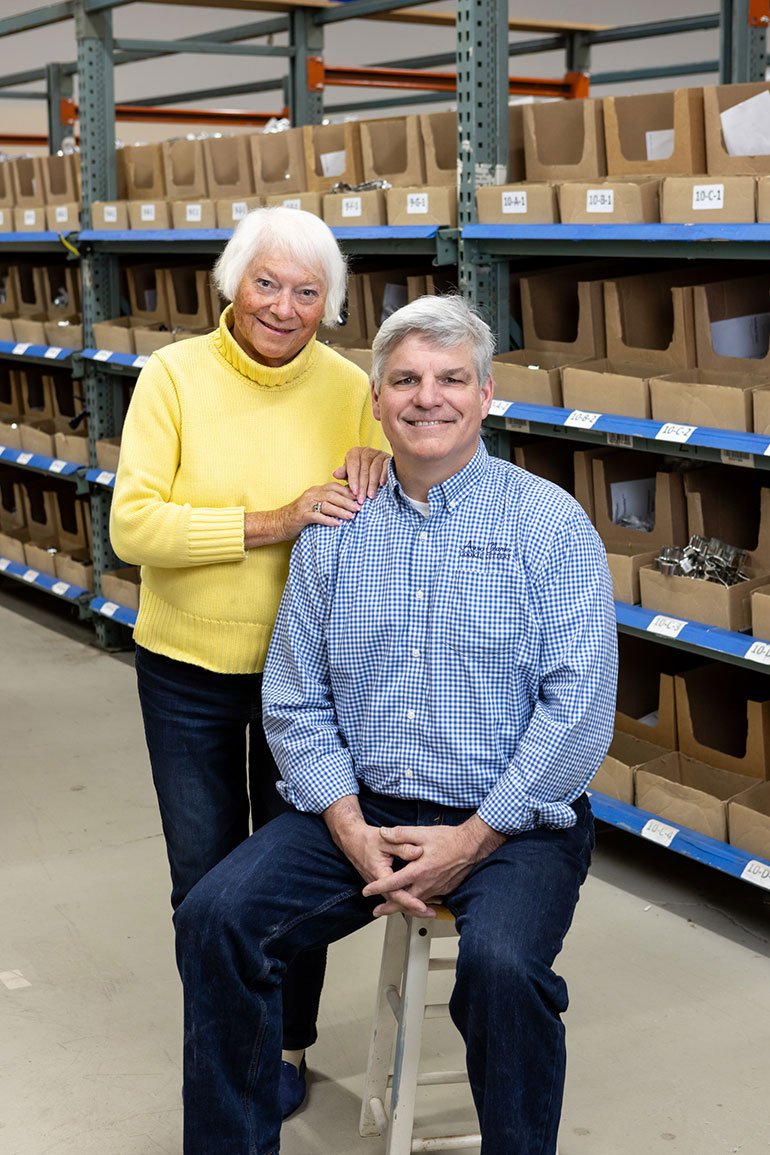
Photo: Mother and son duo: Ben Clark, CEO and founder of Ann Clark Ltd. Ann Clark. Photo: Baldwin Photography
“I think all of us are equally impressed with the exponential growth of Ann Clark,“ said Lyle Jepson, executive director of the Chamber & Economic Development of the Rutland Region. “I think it is one of those examples of an ’in your garage’ type of business that grew and grew and continues to grow today. And one of the exciting things is how the company is diversifying its product line. They are now putting together packages of opportunity for people to purchase not just cookie cutters, but all the ingredients from food coloring to baking supplies that they would need to enjoy staying home and baking.“
It was Ann Clark’s business sense, passed on to her son, that drove the success, Jepson said.
“Ben Clark has taken advantage of all opportunities, including working with the Vermont Manufacturing Extension Center, to incorporate a lean process that makes a manufacturing facility operate at its peak performance,“ Jepson said. “They are the at the top of the market, and have really leveraged the online marketplace through Amazon.“
The company has grown hand in hand with the Rutland Chamber, Jepson said.
“They were one of the tenants in a building that we own, which they then outgrew,“ he said. “Now they have their own manufacturing plant just down the road. But interestingly enough, they’ve outgrown that space too. And so they’re back in the original building with us, where they are creating some of their products. I would expect that in the future, Ann Clark will need even more space.“
Growth will develop into a need for more employees, Jepson said.
“I think they’ve definitely grown their employee base from when they started,“ he said. “They have a number of marketing folks, and all the front-office people that you need. They’re a very sophisticated business made right here in Rutland, Vermont. I think this is a perfect example of entrepreneurship, where you can take an idea and you can make it into an enterprise.“
I spoke to one of Ann Clark Ltd.’s wholesale customers at the Vermont Kitchen Supply Store in Manchester. Owner Kerry Comollo Mackinnon has been in business for 23 years, and she’s been a customer of Ann Clark’s from the beginning.
“They were one of my first vendors,“ Mackinnon said. “There was a trade show to introduce new products, and a friend of mine was talking to them about being their sales rep. He came to me and said, ’You should really check out this company. It’s right in Rutland.’ I was like, ’You’re kidding.’ Since I’m only in Manchester, I used to pick up the orders myself. And they were so nice. I would go in the back door. They were so small. And as the years went by, they just offered more and more. It’s enough for me that the products are made in the U.S. but to be made in Vermont is a home run.“
Ann Clark is a “feel-good“ company, Mackinnon said.
“The people are lovely,“ she said. “They’re so supportive. It’s wonderful to work with small vendors like that. Well, it’s not that they’re so small anymore, but it’s still wonderful to work with them.“
Ann Clark Ltd. offers exceptionally well-made products with unique designs, Mackinnon said.
“Within the last year or so, they’re really blowing it up,“ she said. “They’re adding products that are hard to find in the industry. They’re doing great packaging. Their products are exceptionally well made. I’m just so proud to sell everything that they have. It’s one of the better companies that we deal with. And I’m so glad to keep my money in Vermont.“
It feels good to support a small Vermont business for many reasons, Mackinnon said.
“They treat their employees really well,“ she said. “Their employees stay with them for like a million years. They have all of these people who have worked with them since I started going there. And they’re still there. It makes you so proud to be a Vermonter when you see people being innovative and resourceful, keeping their eye on quality and making sure that they’re always on trend.“
Yes, there are trends in the cookie world. For example, when the blockbuster movie “Barbie“ came out at the beginning of last summer, Ann Clark Ltd. was quick to have a “Barbie“ cookie cutter.
“We sold about a billion of those,“ Mackinnon said. “Any time they come up with a new and trendy design, we break them out, l put them in a big bin and put the bin right at the counter. And people go for them. Ann Clark Ltd. is small enough to know what’s going on and able to react to it quickly. I give them a lot of credit for that. It’s not easy to do. You have a competitive market. They’re up against products that are made in China, products that are less expensive. But if you put the two products side by side, you would gladly pay twice as much for the product that they make, because the quality is amazing.“
While I was talking to Mackinnon, she was driving out to visit her grandchildren; she had with her a variety of Ann Clark Ltd. cookie cutters.
“People buy them as gifts a lot,“ she said. “It’s a really fun thing to do. Decorating cookies is a huge category for us, especially at Christmastime. That’s the number one time for making cookies. But now we sell cookie cutters year-round. It used to be really a fourth-quarter market for us. I would say that fourth-quarter is probably 50& of the year. I can’t say enough good things about their company. They’re definitely one of my Top 10 vendors.“
For many people, making a cookie, much less decorating it with a rose or a cheerful young girl in a pinafore with a flower in her hair, is not a high priority. But for those in the cookie world, Ann Clark is a rock star. And her company has many, many devoted fans.
The biggest selling cookie cutter is in the shape of a large number 1. It’s a perennial and versatile shape useful for birthdays, sporting events and graduations.
The gingerbread man is the second-most popular shape, followed by a unicorn head, dog bones, hearts, a llama, a holy cross, snowflakes, mason jars and a vintage truck with a tree. A heart shape comes in at No. 11 and the Easter bunny at No. 20.
You can even make a cookie in the shape of Vermont. Start eating it at Brattleboro and work your way up to Burlington and the Northeast Kingdom.
All Ann Clark cookie cutters are made of metal with precision edges and are loved for their durability and longevity. They come packaged with a card containing a recipe.
You would be hard-pressed to find a more devoted fan of the company’s products than Anne Yorks, owner of the Flour Box bakery in Centre Hall, Pennsylvania. She went from stay-at-home mom to professional baker and now teaches all levels of cake and cookie decorating via online classes.
“We converted a building on our property into our shop space, but we’re an online business for the most part,“ Yorks said. “We sell cookie cutters, and we teach people how to decorate cookies.“
Yorks has been into cookies for a long, long time.
“I actually decorated cookies with my mom growing up, but we didn’t decorate them like I do now,“ she said. “We did simple things like putting the icing on with a knife and using sprinkles and things like that. Then as an adult, I started decorating in this more detailed way, using royal icing. The very first cookie I ever decorated with royal icing was the teacup from Ann Clark. I still have that cookie cutter; I display it in my kitchen because it’s my favorite one.“
Ann Clark products are essential to Flour Box’s business, Yorks said.
“I had started baking and exploring an idea of having my own business,“ she said. “I was expecting my first daughter, and the job I had was going to be turned into a part-time job. So I was working from home and looking for a way to explore my creativity and earn a little income to pay the bills. I started baking and put myself out there a bit. Then a local business asked if I could make teacup-decorated cookies for an event they were having. And I said sure.“
Yorks’ business was on its way.
“That was my first step into that kind of cookie decorating, and I loved it,“ she said. “I never went back to anything else. I remember being completely amazed at what you can turn into a cookie. It’s really anything. There’s hundreds and hundreds of cookie cutters. The possibilities seemed endless. And that seemed really exciting.“
When she started teaching classes, she found that her students wanted to buy baking supplies. She began to buy them wholesale.
“Setting up wholesale with some of my favorite vendors was the next step in my business,“ Yorks said. “That was in addition to making cookies, teaching classes and starting a small online business. It was a lot, you know. Then I had a second child and really needed to figure out what I enjoyed the most. It was teaching the classes and having my supply shop. Now I focus on those two things.“
Decorating cookies is a labor of love, Yorks said.
“There is a little bit of planning that goes into this kind of cookie decorating,“ she said. “But the best part is, if you ever make a mistake — and people are always worried about making a mistake — this is an edible art. You can always gobble it up.“
Ann Clark products emphasize fun, Yorks said.
“I love to decorate with my daughters,“ she said. “When you decorate with others, it lightens the work because you have more hands to help. And it’s fun. You’re talking while you’re decorating and really enjoying your time. It’s such a neat activity to do in the kitchen with family or friends.“
Ann Clark food coloring is a favorite for cookie decorating because the colors are highly concentrated and make “bold, beautiful icing colors,“ Yorks said. As she was writing her book on cookie decoration, Yorks was able to work with the company’s engineers on cookie cutters specifically for the book.
“Ann Clark Ltd. makes cookie decorating possible for both the new decorator and the professional,“ she said. “Their cookie cutter shapes are so thoughtful. They design them well. More than any other business in the cookie world, I feel like they have made cookie decorating possible for all people. They’ve grown this awesome business, and they continue to bring out new shapes and inspire the pros as well as the people who are just getting started.“
The cookie world holds an annual event called CookieCon, a multiday convention where cookie decorators come together, take classes and display their art. (The 2024 show is scheduled to take place Sept. 17-20 in Austin, Texas.) The real Ann Clark, as well as her eponymous company, are stars at these gatherings.
“The company is just so involved,“ Yorks said. “They’re so critical to the cookie world. They’ve been amazing to work with. Going back to my very first cookie cutter that I got from Ann Clark, they had the recipe for the cookie right there on the cookie cutter tag. They made it so easy to get going. There’s a whole world — thousands and thousands of people love to do cookie decorating. It’s a really friendly community where everyone is welcome.“

Photo: Ben and Ann Clark checking cookie cutters on the manufacturing floor. Photo: Baldwin Photography
Early Years
Ann Clark grew up in the suburbs of Washington, D.C. Her mother was an elementary school principal, and her father worked for the FBI.
“I was always drawing and painting, and my best friend in my childhood was a writer,“ Clark said. “We used to do stuff together in the summer.“
After graduating from Northwestern High School in Hyattsville, Maryland, Clark enrolled at the University of Maryland as an art major. She met her future husband during her first year there.
“We decided we wanted to live in New England,“ she said. “So we looked at Vermont first and found a house right away. He found a job right away. And here we are.“
The idea for the company began one fall when Clark was baking Christmas cookies to freeze for the holidays.
“I had done these three Christmas ornaments that I showed at craft shows, and a catalog picked up on one of them,“ she said. “It was a fat little piggy with a wreath around its neck. I thought, ’Oh, he’d make a cute cookie cutter.’ So I called a friend of mine who owned a kitchen shop, and she gave me the name of her distributor. I called the distributor, who said, ’Oh, we don’t make them, but I’ll give you the name of the manufacturer.’ He was in Pennsylvania. I called him and asked if he could make some samples for me. But he was completely chauvinistic.“
After the manufacturer turned her down once, Clark persevered and sent him her drawings. That changed everything.
“He called and said, ’Oh, my God, these are fabulous! These are so easy to do!’ And he made me six samples.“
Clark’s husband, John, then urged her to show her wares at a trade show. The Clarks took a booth at the Philadelphia Gift Show and wrote about $3,500 worth of orders for the pig alone.
“On our way home, John said, ’Why don’t you just do this (full time)?’“ she said. “I came home and thought I would start with a Vermont theme. I got a cow, the pig, a sheep and a horse, and it just zoomed from there.“
John handled the business side of the company until he died, and then Ben joined the firm.
Ben “has now taken over the whole thing, which is great,“ Clark said. “I come in every morning and sort of doodle around and see what everybody’s doing. I’m basically semi-retired, I would say. Ben’s running that company, and he’s running it beautifully.“


Photo: Now semiretired, Clark has returned to painting. Photos: Baldwin Photography
Ben, an outdoor enthusiast, compared growing up in Vermont to attending a year-round outdoor camp.
“We ski-raced all winter and sailboat-raced all summer,“ he said. “Mixed in were golf, hiking, hunting and fishing. It was a very active outdoor lifestyle.“
He went to the University of Vermont to study mechanical engineering.
“I got a job in manufacturing in Burlington while I was still in school, working part time,“ he said. “The company we were working with in Burlington moved to North Carolina, and I went with them.“
After earning his undergraduate engineering degree at UVM, Clark went on to get an MBA from the University of North Carolina. He and his wife then moved to Annapolis, Maryland, where Ben worked in new-product development at Black & Decker and his wife took a job at a law firm.
It wasn’t long Ben had designs on returning home.
“We had no intention of moving back to Vermont,“ Clark said. “When we were pregnant with our oldest daughter, it sort of hit me that I wanted to raise my kids in Vermont. It’s a great place to grow up. The appeal of the cookie cutter company was really a reason to come back to Vermont and have something to do. You know, a small niche business. I said, ’I think we can do something with this.’“
With degrees in both engineering and business, Clark was perfectly placed to turn his parents’ nascent business into a powerhouse. He moved his family back to Rutland in 1998. At the time, his younger sister was also working in the family business.
“When we came back to town, my parents gave part of the company to me and part of the company to my sister,“ Ben said. “And then, over time, my sister left. We reached a point where the business was really starting to take off, so I bought out my sister and my mom. They still own a small percentage.“
Though people outside the family expressed interest in buying into the company, Ben decided against seeking investors.
“We were invited to an angel investor meeting at Dartmouth,“ he said. “We put together a long-term plan and said that if we got investment dollars, we could grow this a lot faster. But there’s a disadvantage to having investment dollars. I talked to several investors, and I said, ’If I do this, in five years am I going to own the company?’ And they said, ’No, we’re going to grow it and sell it. You’ll have to do something else.’
“With a company like ours, you have two choices,“ he continued. “You can grow fast with investment dollars, or you can grow slow and own the whole thing. If I had to do it again, I don’t know which one I’d choose.“
Growing the Company
When Ben’s parents started the company, their inventory consisted mostly of a collection of popular cookie cutters and a few Christmas tree ornaments.
“But basically, it was cookie cutters,“ Ben said. “And it was a cookie cutter with a handle. My parents would buy those products from the company that created them, ship them to Rutland, attach a recipe card that Mom designed, and sell them to gift stores.“
When his sister joined the company, the company started offering custom cookie cutters with school or company logos.
“I decided that we needed to be making the cookie cutters or this wasn’t going to work,“ Ben said. “So we figured out how to make cookie cutters with some very rudimentary machinery.“
Ann Clark Ltd. started buying fewer cookie cutters from their vendor, Creative Products, and making more product in-house.
“We got to the point that we were making all our own cookie cutters,“ Ben said. “Every year we’d invent a new machine. We kept trying to get better and better until we were relatively competitive to the price we were paying when we bought the cookie cutters.“
While sales were brisk, the family wanted to expand beyond its gift store niche. So they approached Creative Products, which had established a foothold in the kitchen store market, and asked if they were interested in selling, “I said, ’If you’re ever sick of this, let me know. I’d love to buy your company,’“ Ben said.
A few years later, Creative Products came calling.
“They said, ’We’re sick of this. You want to buy the company?’“ Ben recalled.
And with that, a completely new market opened to Ann Clark Ltd.
“We got Williams Sonoma, Bed Bath & Beyond, Crate & Barrel, Cracker Barrel, Tractor Supply,“ Ben said. “There’s a whole bunch of those types of accounts that just wanted to buy cookie cutters. And that’s what we moved into.“
Worldwide Expansion
This marketplace expansion allowed Ben to build the cookie cutter machine of his dreams.
“We designed and built it, and that really changed the world,“ he said. “Now we could make cookie cutters at the same price that you could import them from China. Basically, cookie cutters were either made by us or in China. And now we had equal footing. That’s where we excelled. That’s where we said, ’Let’s be the biggest cookie cutter maker in the world.’ And we actively set out to do that.“
The company launched new shapes, improved product quality, went to trade shows, and began advertising via direct mail, catalogs and telemarketing. Times were good.
“We were selling to kitchen stores. We were selling to gift stores. We were selling to baking-supply stores. We were selling to online retailers. That was our game, and it worked very well.“
And then Amazon came along, opening a new, lucrative chapter in Ann Clark’s history. The Clark family worked with a series of consultants who understood how to leverage Amazon’s business model, and the business soared to even greater heights.
He demonstrates the impact of Amazon by inventing a conversation among members of a typical family planning their activities for the coming week.
“You’re sitting here on a Sunday afternoon, wondering what you’re going to do next weekend. And you say, ’Oh, you know what, Sally’s birthday is next weekend, and she would love butterfly cookies.’
He continues, “Where are you going to get the cookie cutters to make those butterfly cookies? Well, you can take out your phone, place your order in two clicks and have the cookie cutter at your door in two days! It was magical. Suddenly, we had 700 items on Amazon in the U.S. Sales took off dramatically.“
But don’t be fooled: Selling on Amazon is “amazingly complicated,“ Ben said.
“We worked really hard and grew a substantial marketing team internally to do that,“ he said. “While we still work with some consultants, 90% of the work is done in-house. We’re now in 19 countries, all through Amazon. That’s been pretty tremendous.“
But that doesn’t mean the company plans to rest on its laurels.
“We set the goal of being the largest cookie cutter maker in the world,’“ Ben said. “We know we’re the biggest in the U.S. I think we’re the biggest in the world. I just can’t prove it.“
Building the Brand
Ann Clark’s growth in market share necessitated building larger quarters. To achieve this, the family sought the expertise of the Vermont food community.
“As we were laying out our new warehouse, I was thinking to myself, ’I’m not the first person to do this.’ So we called King Arthur Flour, who’s a customer. We called Vermont Country Store, who’s a customer. They immediately invited me down to tour their facilities. And we did it exactly the way they did it.“
Ben said he is happy to share his new-found knowledge with others by giving tours of the warehouse and explaining how his company has succeeded with Amazon.
“I’ve toured a couple dozen factories around Vermont,“ he said, “and I’ve had a couple dozen people tour our facility in Vermont. The community is very good at sharing, as long as you’re not a competitor. We’ll share how we do things because we all want to succeed.
“I spent two days with Rhino Foods saying, ’Hey, how do you do this?’ And they walked me through the whole business. That was incredibly helpful. And we were just having a two-hour conversation about marketing with them.“
Diversifying the Business
Once Ben felt he had the cookie cutter market sewn up, he started looking around for other products to sell and new markets to explore.
“We started saying, ’Hey, what else do people who buy cookie cutters buy?’“ he said. “We own the cookie cutter market. What else can we do? So we went to a company who private-labeled a bunch of products for us to try out. We tried sprinkles and food coloring and a handful of other things. The food coloring took off. And we ordered more and ordered more to the point where they couldn’t keep up making the food coloring we needed.“
As he had done successfully with other products, Ben took the food coloring business in-house.
“We came up with recipes,“ he explained, “and then we built a facility and flew a machine here from Italy to manufacture the food colors. Suddenly, we’re making high-end food coloring gel. Today, we have about 40% of the market on Amazon, which is amazing.“
With the food-coloring business thriving, the company shifted its focus to cake mixes and the broader world of desserts.
“We started looking at desserts we grew up on, like Duncan Hines and Betty Crocker cakes. They’re actually terrible — they have very little flavor. So we would put Pillsbury frosting on them, which is just pure sugar. You can get a cake and frosting mix for $4. It’s not very good, but that’s what we all got used to.
“So we asked ourselves, ’What if we made a cake and frosting that is a mix?’ Or, ’What if we made one that you could serve in a wedding?’ Or, ’What if my daughter’s boyfriend is coming for dinner and it’s his birthday? What if I want to make a really good cake, not a $2 Duncan Hines kind of cake?’ And we made those.“
The company also launched pancake and waffle mixes.
“Again, we’re doing some of the development ourselves, and some by working with consultants,“ Ben said. “And we came up with a slogan: ’Dessert Is Fun.’ It should taste great. It should look great. And it should be fun to make.“
The company’s sweet success in the world of, well, sweets, has necessitated yet another round of expansion.
“We’re building a new facility within our facility,“ Ben said. “And we launched meringue powder, we do egg whites, we’ve launched espresso powder and cornbread. We did a line of ice mixes. We did parchment paper. We did piping bags. We did a special cookie rolling pin. And we have a whole list of new products we want to launch. They’re all around the idea that ’Dessert is Fun.’ If we’re going to have the calories, it better be worth it. Let’s stop making crappy desserts.“
Staying Lean
Lean manufacturing is one of the key ingredients behind Ann Clark’s success. Much of what Clark has learned in this area came from courses he took through the Vermont Manufacturing Extension Center.
“We learned to make very small batches,“ he said. “When I went to school, it was about the economies of size. For example, this year we’ll sell about 30,000 gingerbread boy cookie cutters. I was trying to set up the machines and run 30,000 gingerbread boys. That way you only have to run them once. But what if you make 30,000 cookie cutters and you guess wrong and only need 25,000? So we learned to make 300 or 400 at a time and just remake them three or four times a week. That’s what we do now.“
Patrick Boyle, VMEC’s executive director and CEO, was not in his current position when Ben first sought help from the center, but he has since become an integral adviser. He explains that lean manufacturing is fundamentally about process.
“Take a process and then break it down to all the steps in that process,“ Boyle said. “Then look at all the time it takes to do all those steps. And then look at what’s called the ’as is’ process. This is the process we run today. The lean production adviser can come and say, ’OK, how can we reduce the number of steps in this process to simplify it? What’s in this process that is waste, and how can we eliminate it?’“
Essentially, it’s a way of making a manufacturing process more efficient by reducing the number of steps — but in a scientific way.
“Look at each part of the process and decide if you need to do it or not,“ Boyle said. “Is this valuable to the end outcome of the process or not? And usually you get from a very long set of steps to a much shorter set of steps, which can save you time and money.“
It also allows the manufacturer to deploy employees to other steps in the process. The general result is an increase in quality, Boyle said.
“When you strip out waste, then efficiency and effectiveness rise and you have a rise in quality,“ Boyle said. “Basically, it simplifies your production. It helps you increase your quality and it helps you do efficiency and effectiveness for your process as well.“
Boyle thinks Ben and Ann Clark Ltd. have done a great job of with its basic production process.
“I think they show courage and tenacity in looking at how we do it today versus how could we do it in the future that could give us a competitive advantage,“ Boyle said. “Taking the decision to change the way they did things to a much more lean production environment? That is a huge decision for any manufacturer, because you need to change just about everything.“
Ben liked the results so much that he joined VMEC’s board, which provides guidance and advice to the director. Boyle was happy to have him.
“Ben speaks his mind,“ Boyle said. “As a client, he’s willing to learn and he’s willing to engage in a discussion about how to improve things. He’s always open to new approaches. And as a board member for VMEC, he brings ideas. He brings feedback to us. He suggests new services we might want to be investing in, based on his experience as a manufacturer. He certainly has his own approach. And yet he is willing to listen and learn and adapt if it makes sense. All this gives him a competitive advantage.“
A Better Cookie Cutter
A cookie cutter is roughly 3 inches in diameter. It needs to be made of sturdy, food-safe steel. There is actually a science to it, Ben said.
“All of our steel is made in the United States,“ he said. “It all goes through rigorous testing to make sure it doesn’t have any bad stuff in it. It needs to be sturdy enough to hold its shape. And it needs to be shaped so that when you bake the cookie, it bakes right. And it needs to be perfectly flat so you can easily cut the cookie.“
When Ann Clark Ltd. bought Creative Products, the company came with about 2,500 cookie-cutter dies. Ann Clark. had about 600 of its own.
“Now we’re somewhere around 3,500 and have stopped counting,“ Ben said. “But we’ve discovered that we have redesigned virtually almost every cookie cutter we use. We usually stick to about 700 shapes a year that we actually make. And we’ve redesigned most of them.“
All of this is done to ensure the cookie-maker has a truly excellent experience every single time.
Agility Is Crucial
Being able to turn on a dime is crucial in the cookie-cutter world; China is hot on Ann Clark’s heels, and the internet does not make it easy.
“I was talking to George Chandler, the co-founder of Hubbardton Forge,“ Ben said. “I asked, ’How quickly does your stuff get copied?’ He said he’ll introduce a new lamp at a trade show and before the end of the show, there will be a knockoff of his new shape in the United States. People walk by the exhibit, photograph the lamp, email the photograph to China, they make it and FedEx it back to the United States in like three or four days.“
The Chinese and American manufacturing markets are starkly different from one another.
“The Chinese have no labor rules or environmental rules,“ Ben said. “They’re hungry. They’ll make it quickly. They’ll work all weekend. That’s sort of what their business is and what they’re good at. They’re studying all the same manufacturing books we’re studying. And they’re getting really good at it. And they’re getting fast.“
It only takes a week or so before a new product gets knocked off.
“They’re not making these products for themselves,“ Ben said. “They’re looking at what people in the United States and in Europe are buying. And they’re making that. They’ve got over a billion people that are looking for something to do. We think we have a job problem here? They’ve got a lot of people that need work. The pay is low. Without labor or environmental rules they can make things really inexpensively. And they’re good. The person in China has no idea what a cookie cutter is or what it’s for. They don’t care. They just know they need to make it.“
With lean manufacturing, Ann Clark Ltd. has become faster and more agile, being able to respond to customer demand in small batches. It is capable of turning out product quickly and getting it to Amazon in a matter of days, often beating out the Chinese.

Photo: Mother and son duo: Ben Clark, CEO and founder of Ann Clark Ltd. Ann Clark. Photo: Baldwin Photography
What’s Next?
Expansion is the plan for the future.
“There are a couple of things we think about,“ Ben said. “Can we make it? Can we do it profitably? We have a whole formula we go through to figure out if this is a product we should launch. And then we do it.“
The team is currently experimenting with a number of new mixes. It’s anyone’s guess as to which will hit the market first.
“We keep looking at what else people need to make desserts,“ he said. “We can see a number of markets we can go into, and we’re really going after it. We’re hiring people. We’re ordering equipment. We’re building some new space. And our goal is to significantly grow the business.“
Finding workers is not a problem.
“We found that if you’re nice to people and you treat them well, they love to come and work for you,“ Ben said. “It’s really not that complicated. I think pretty much all of our employees are friends with each other. They do things together after work and on weekends, and that gives me a very good feeling. And we’re in a beautiful area. So hanging out outside of work is easy. You can just go for a bike ride.“
Lean manufacturing reduces stress, Ben said.
“Things operate pretty smoothly and efficiently in both manufacturing and the administrative offices,“ he said.
Today the Ann Clark Ltd. brand is well-known and well-respected.
“It took years to do,“ Ben said. “It’s not something we started last Tuesday and suddenly we’re there. We’ve had a lot of failures along the way. There’s lots of products we’ve launched that didn’t work. We know that of the products we’re launching now, some will fail. But we keep pushing on. We know that if we maintain a high level of quality, if we only make great products, it will ultimately work.
“Internally, we want to keep it fun. We actually appreciate a work-life balance. Nobody works 80 hours a week. We don’t work weekends. We’re in Vermont, and we’re in the area because it’s a beautiful place to live. Let’s enjoy that. If we’re going to work 90 hours a week, let’s go back to the city.“
Joyce Marcel is a journalist in southern Vermont. In 2017, she was named the best business magazine profile writer in the country by the Alliance of Area Business Publishers. She is married to Randy Holhut, the news editor/acting operations manager of The Commons, a weekly newspaper in Brattleboro.
To support great journalism, access our archives and get unique features like our award-winning profiles, Book of Lists & Business-to-Business Directory, subscribe HERE!