

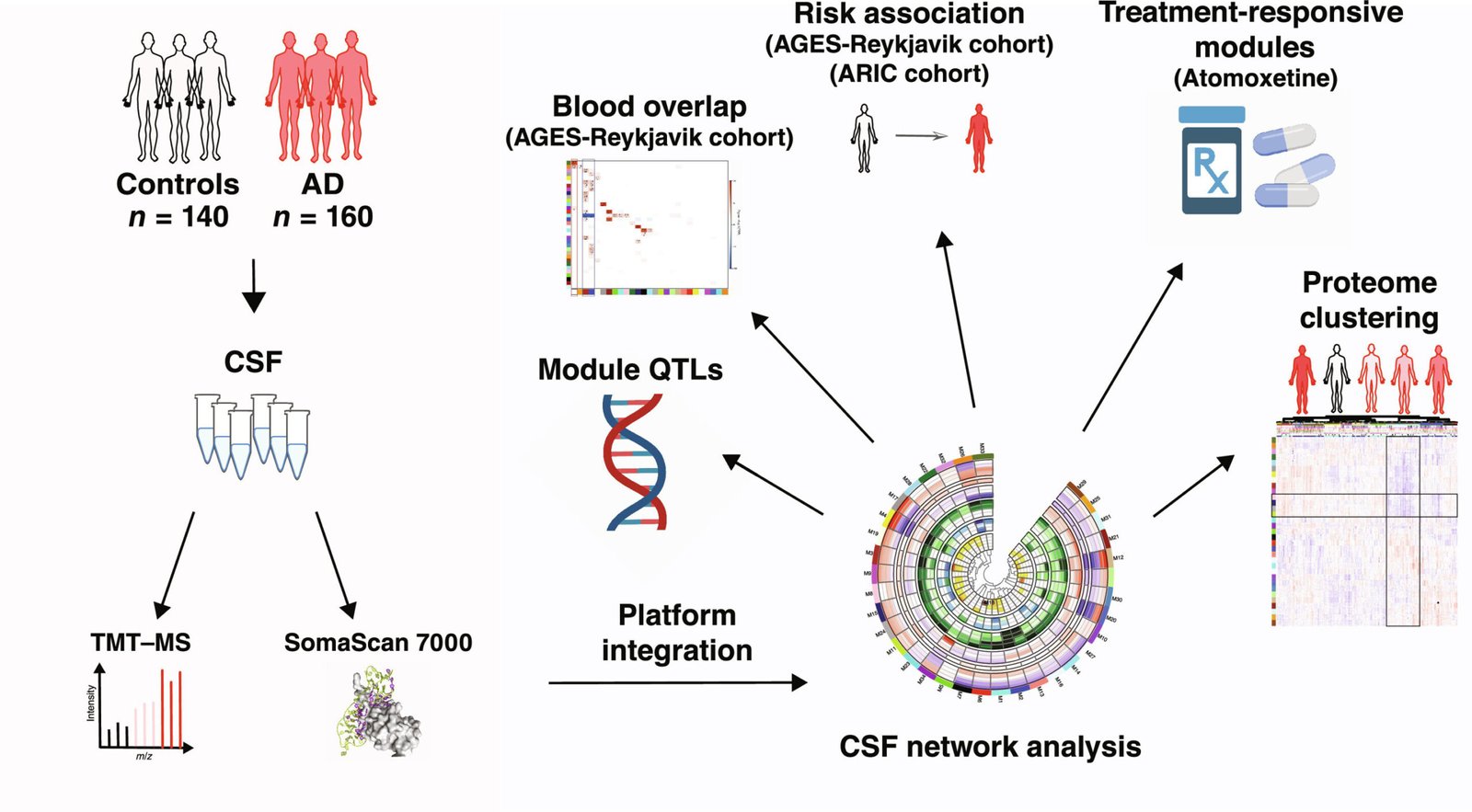
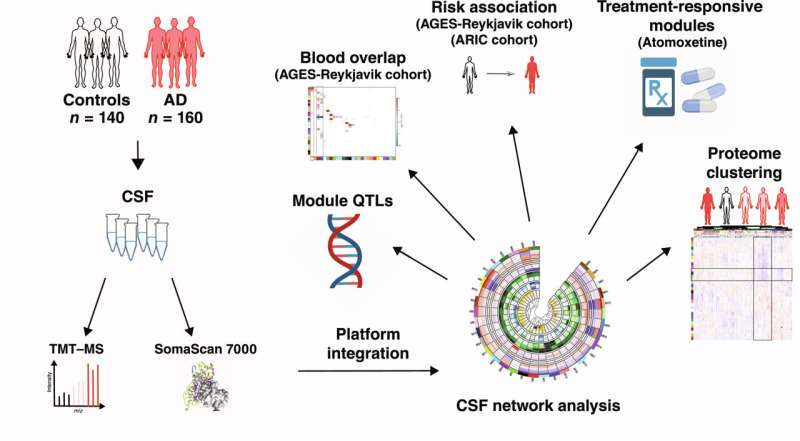
Study Overview: CSF was collected from 140 control and 160 AD patients as defined by CSF tTau/Aβ.1-42 ratio. The CSF AD network was used to assess the impact of pharmacological intervention with ATX on disease-related pathophysiology. Key hub proteins across the network were used to cluster participants into groups based on similarities in their CSF proteomic signatures, regardless of CSF Aβ and tTau status. Credits: Science Translational Medicine (2024). DOI: 10.1126/scitranslmed.adn3504
A large team of neuroscientists, biochemists and Alzheimer’s disease experts from institutions in the United States and Iceland have created a protein map to look for patterns in cerebrospinal fluid that could be markers of the onset of Alzheimer’s disease decades before diagnosis.
According to a study published in the journal Science Translational MedicineUsing high-resolution scanning technology, the research team hoped to uncover the underlying causes of the disease.
Alzheimer’s is linked to the buildup of amyloid beta and tau proteins in the brain, and previous studies have shown that scanning and analyzing blood and other bodily fluids can detect and confirm a diagnosis of Alzheimer’s, but doctors can only do so after the disease has progressed.
Doctors (and their patients) want biomarkers that can suggest when someone is likely to develop Alzheimer’s, when their progression can potentially be slowed or halted. That means finding tests that can predict the disease years before symptoms appear.
In the new study, the team turned to cerebrospinal fluid, which they believe may contain signs of Alzheimer’s disease long before symptoms appear.
The researchers collected thousands of cerebrospinal fluid samples from 160 people at various stages of the progression of Alzheimer’s disease. They then scanned all of the samples using tandem mass tag mass spectrometry and analyzed them using SomaLogic’s improved aptamer-based SomaScan 7000 assay to create a profile of each sample and compare them to each other.
This allowed the team to create a map to simultaneously search for patterns of several types of proteins that, when combined, could provide early markers of Alzheimer’s. The team developed 34 modules for use in the test.
After testing the module, the researchers discovered a possible correlation between Alzheimer’s disease and the genetic risk factor APOE ε4, a finding that could lead to the discovery of a marker for Alzheimer’s that could be used 20 years before current diagnostic methods.
For more information:
Eric B. Dammer et al., Proteomic analysis of Alzheimer’s disease cerebrospinal fluid reveals changes associated with APOE ε4 and atomoxetine treatment, Science Translational Medicine (2024). DOI: 10.1126/scitranslmed.adn3504
© 2024 Science X Network
Quote: Protein Map to Find Markers of Alzheimer’s Disease Using Cerebrospinal Fluid Scanning Technology (June 28, 2024) Retrieved June 28, 2024 from https://medicalxpress.com/news/2024-06-protein-scanning-technology-cerebrospinal-fluid.html
This document is subject to copyright. It may not be reproduced without written permission, except for fair dealing for the purposes of personal study or research. The content is provided for informational purposes only.
