

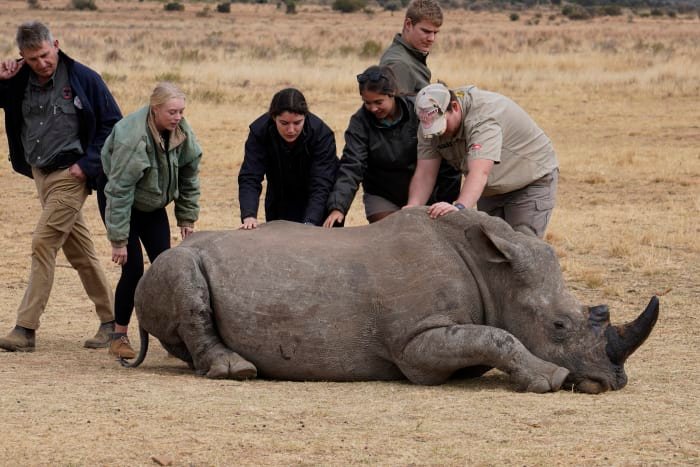
Mokopane – South African researchers injected radioactive material into the horns of 20 rhinos as part of a research project aimed at reducing poaching.
The idea is that radiation detectors already installed at the border will detect the horns and help authorities catch poachers and traffickers.
The research, which also involves veterinarians and nuclear experts, begins by anesthetizing the animals and then drilling holes in their horns to carefully insert the nuclear material. This week, researchers from the Radiation and Health Physics Unit at the University of the Witwatersrand in South Africa injected 20 live rhinos with the isotopes. The researchers hope to replicate the process to help other wild species vulnerable to poaching, such as elephants and pangolins.
“We’re doing this because it makes it much easier to stop these horns being smuggled across borders because there is a global network of radiation monitoring equipment designed to prevent nuclear terrorism,” said Professor James Larkin, who is leading the project, “and we’re piggybacking on that.”
At the start of the 20th century, the world’s rhino population was about 500,000, according to statistics from the International Union for Conservation of Nature, an international conservation group. Today, due to continued black market demand for rhino horns, there are only about 27,000.
South Africa has an estimated rhino population of 16,000 and is a hotspot with more than 500 rhinos being killed each year.
The country saw a significant drop in rhino poaching around the peak of the COVID-19 pandemic in 2020, but poaching numbers increased once anti-virus lockdown restrictions were relaxed.
“We have to do something new and different to reduce poaching. We’re already seeing numbers going up,” Larkin said. “Everything went down during COVID, but now post-COVID we’re seeing numbers going up again.”
The idea has support from some in the industry, but the researchers have had to overcome a number of ethical hurdles raised by critics of the methodology.
Pelham Jones, president of the Private Rhino Owners Association, is one of the critics of the proposed method, questioning whether it will effectively deter poachers and traffickers.
“(Poachers) are finding other ways to get rhino horn out of countries, out of continents or off continents without going through traditional border crossings,” he said. “They bypass the border crossings because they know that’s where the risk of confiscation and seizure is the highest.”
Professor Nittaya Chetty, dean of the school of science at the University of the Witwatersrand, said the amount of radiation was very low and any potential adverse effects on animals had been thoroughly tested.
Copyright 2024 The Associated Press. All rights reserved. This material may not be published, broadcast, rewritten or redistributed without permission.
