

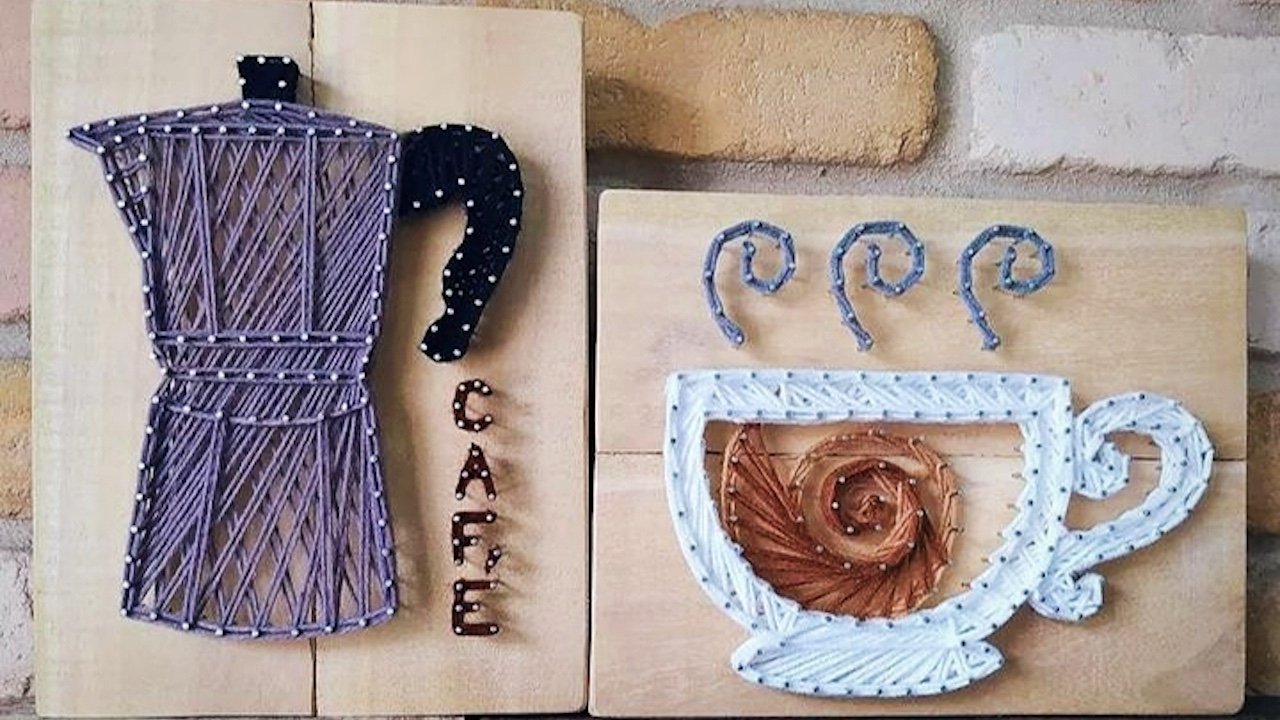
Maite Hernández failed to get a degree in economics at university. After graduating, she couldn’t stand the idea of sitting in an office staring at a computer screen for eight hours. Now she’s one of thousands of Cuban entrepreneurs trying to survive on an island that lacks infrastructure and support services and is plagued by inflation.
“I started at the beginning of 2021. I was in the process of decorating my own house after spending so much time at home during the pandemic. I saw some pictures of string art on Pinterest and fell in love with the detail of the handcrafted technique. I thought the result was amazing, so I decided to make a ‘Home’ sign. That was my first piece.”
Two months later, Maite began designing small string art pieces to sell on February 14th, and that’s how her business, Churerías, started in Matanzas.
“From there, it was a bittersweet journey. Getting ingredients was always stressful. There was nowhere I could buy what I needed. I couldn’t keep my Instagram account updated all the time, but it was worth the effort because I had fun doing it.”
For 34-year-old architect Lourdes Hernández, the opportunity to start her own business came during her student days. The essence of her work is making boxes, organizers and other items that clients request to decorate their homes.
“It started as a hobby, then I decided to start a business and sell it, but it was very small. When I had a baby, I had more time to think, expand production and focus on the business. Seeing the results, I chose to work from home so I could have time to raise my child,” Lourdes says about how she started Kjas.
“Woodworking is part of my family’s tradition,” she says of her devotion to this type of craftsmanship. “My father was a carpenter and he instilled in me an appreciation for woodworking in particular. I love using scrap and recycled materials. It’s rewarding to make something good out of what some people might consider trash.”
Entrepreneurship, disease or cure?
Despite the difficulties in finding suppliers and promoting one’s business in Cuba, freedom from working for the state, increased income and personal growth are the motivating factors for entrepreneurs.
“The best thing is that you can take on any level of work that you are capable of handling. The worst thing is that you have to be able to manage your time and money. Every day, more and more people choose to start a business because it can produce great results and there are a lot of opportunities out there if you find them. Many people choose to do something basic, but some look for areas where they are lacking and try to get the job done in a more professional way,” says Lourdes.
According to Maite, “More and more people are choosing to start their own businesses as they realise they can make a bit more money than working for the government. Many of those who start businesses are graduates with degrees in architecture, medicine, law etc.”
“For me, the good thing about being self-employed is that I can do something that I really love and am good at, and that I can generally make my own schedule and plan things. The bad thing is that I don’t have anywhere to go and buy the tools and materials I need,” adds the Chulerías founder.
The risks and difficulties have forced many business owners to close their businesses and return to civil service jobs to make ends meet, or to observe trends and adapt their businesses, while others have persevered and kept their projects going despite the adversity.
“The key is motivation. You may face many obstacles, but with imagination and perseverance you can find solutions. The most difficult part is remaining legal throughout the process,” says Lourdes Hernández.
Lack of training among entrepreneurs is a recurring factor affecting their performance: online courses offered by foreign institutions are not available to Cuban residents.
A few years ago, the first of the “Creation and Development of New Forms of Non-State Management” workshops was held in the Historic Center of Havana, aimed at promoting local entrepreneurship. The initiative was carried out in line with the Master Plan of the Department of History and the University of the capital.
In addition to this initiative, others have emerged, such as “Cuba Emprende”, a course aimed at equipping students with the skills and tools in entrepreneurship. Havana is a hub for workshops on such topics, while people in other provinces have limited options.
“It is three times harder to be an entrepreneur in Cuba than in other countries. There are many influences: lack of resources, slow connections to promote products, the impossibility of collaborating with other brands, social media restrictions, high inflation. Art becomes a luxury item. Money is spent on food, hygiene and medicine,” says Maite Hernández.
“The risk of being self-employed is that, on a financial level, it’s not as consistent as working for the country. I sell over the phone and take customized orders and I wouldn’t change that,” she added.
Lourdes believes that “it’s all risky. But I think it’s possible. The legal issues are complex. Those who advise you on how to organize your business legally may not know much or only know certain rigid structures. And the economics are crazy. Most of the materials are on the informal market, or legally through importers, which means that prices are much higher.”
Secrets to success
Lourdes emphasizes, “The key to success is persistence, maintaining the brand and reaching out to customers and making them happy with the product. Quality and creativity are very important.”
“If you don’t love what you do, you may not be motivated and motivation is temporary – it comes and goes. Consistency is just as important. Once you develop a habit, you will continue to improve. With discipline, you will become better at any aspect of life,” says Maite.
“The immigration issue hit us in 2024 and our production capacity has not recovered. I work alone and our production is well below customer demand, which has affected us a bit. Finding qualified staff and those willing to learn is also a challenge,” says Lourdes.
There are social media accounts run by university students who have decided to start illegal businesses to cover shopping and outing expenses and meet the basic needs of their families.
In the current Cuban context, a new business is a boon for both property owners and citizens, for the former in terms of the profits it generates and for the latter in terms of the possibilities it offers in terms of access to a variety of products that the country does not offer. Whether the business becomes a dream come true or a nightmare all depends on the entrepreneur, his resources, his resources and his luck.
