

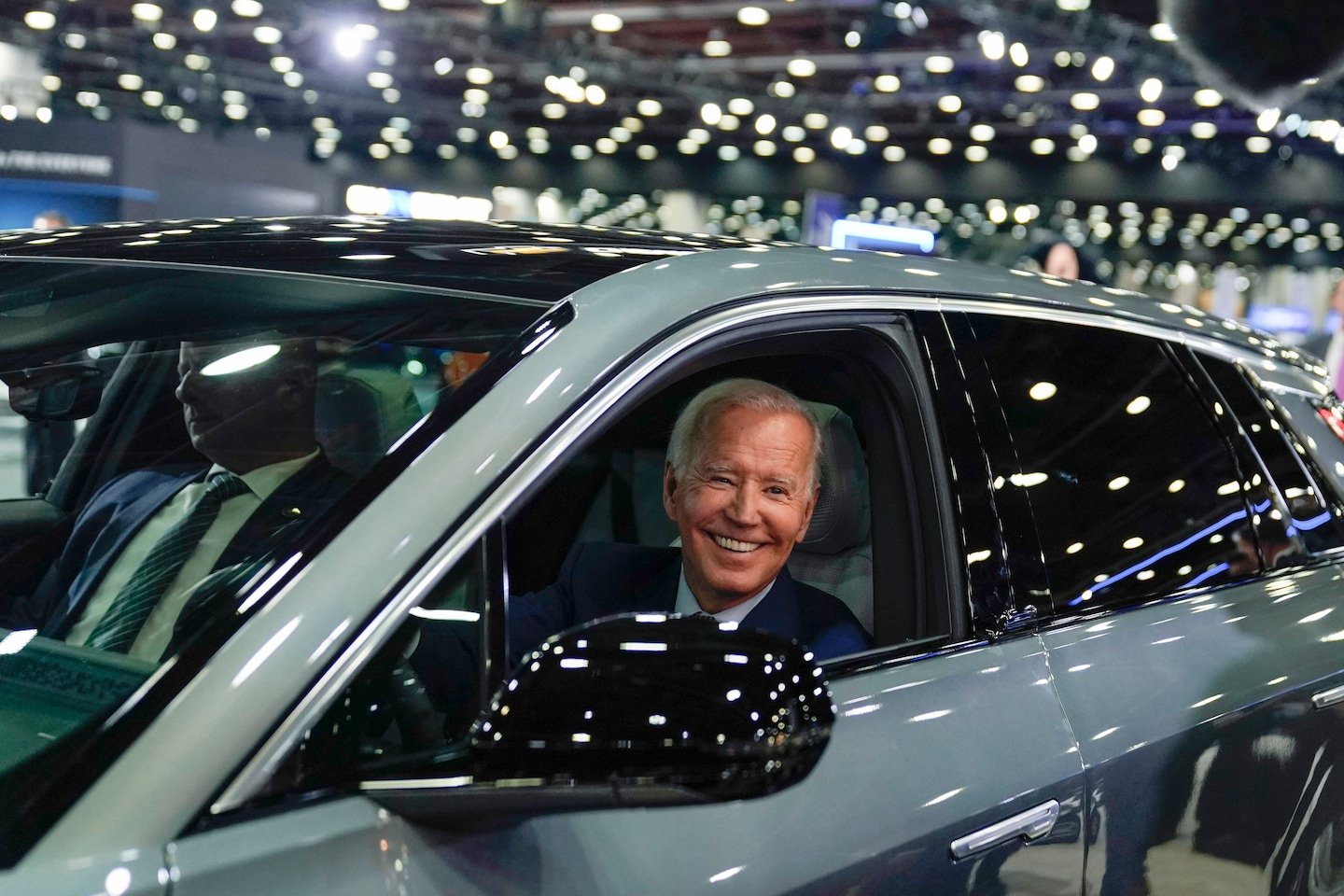
Republican presidential candidate Donald Trump has made criticism of EVs a central pillar of his campaign, turning them into a culture war weapon in an election year. Meanwhile, fossil fuel industry groups have Trump is spending millions of dollars on advertising in battleground states to tie Democratic senators to Biden’s push for electric vehicles.
Trump has vowed to reverse Biden’s electric vehicle policies, warning that “these cars won’t sell” if he becomes president.
Biden’s tough new emissions standards require automakers to boost sales of EVs while also sharply cutting carbon dioxide emissions from gasoline-powered vehicles, which account for about a fifth of the U.S. contribution to global warming. Automakers won’t have to significantly increase EV sales until after 2030, a concession to automakers that were wary of the earlier deadline Biden initially proposed.
The issue of electric vehicles (EVs) has several powerful political factors at play: China, class warfare, and what Republicans would probably call a congressional spending spree. Defenders of the policy point out that the transition to EVs is essential to slowing the worst effects of climate change, and that tens of millions of dollars in investments in U.S. EV factories would create high-paying manufacturing jobs.
That’s an easy line of attack for Trump. but, He recently met with oil industry executives and boldly asked them to raise $1 billion for his campaign, during which he called Biden’s regulations “ridiculous.”
At a rally in Las Vegas earlier this month, President Trump slammed electric boats, saying he didn’t know what to do if his boat sank in shark-filled waters. “If the boat sinks, and the batteries get water in and the boat sinks, will I get electrocuted? Will I stay on the boat and get electrocuted, or will I jump over the shark and not get electrocuted?” he asked.
“I don’t care if I get electrocuted every time,” he said. “I’m not going to go near a shark.”
According to Sen. Josh Hawley (R-Missouri), Trump privately told Senate Republicans last week that if elected president, he would “repeal” Biden’s “disastrous” EV policies.
Some Democrats, especially those in tough races, have distanced themselves from some of Biden’s policies, given the highly politicized issue and data showing that more Democrats than Republicans are buying electric vehicles.
Sen. Sherrod Brown (D-Ohio) introduced a bipartisan congressional review bill in May that would overturn the Biden administration’s decision to allow EV battery parts to be made in China, ending weeks of criticism of the Biden administration’s stance on EVs.
“The United States must immediately ban Chinese-made electric vehicles and stop the influx of Chinese government-subsidized vehicles that threaten Ohio’s auto jobs and our national and economic security,” Brown wrote to Biden in April.
In early May, the Biden administration announced steep new tariffs on Chinese-made electric vehicles.
Sen. Brown and Sen. Jon Tester (D-Mont.) both voted unsuccessfully to roll back Biden’s emissions standards, and also voted with Republicans to repeal Biden’s rule exempting EV charging stations from “Buy America” rules. Biden subsequently vetoed the charger bill.
“There are significant concerns about electric vehicles in Ohio, which is probably a negative for Sherrod Brown overall, but the upside is that it gives him an opportunity to draw a contrast with Joe Biden,” said Christopher Devine, a political science professor at the University of Dayton.
In Ohio, an auto-manufacturing state where cars are at the center of politics, Mr. Brown’s Republican rival, Bernie Moreno, has criticized the “crazy” move toward electric vehicles, saying they could destroy the auto industry. Mr. Brown’s supporters have pointed to Mr. Moreno’s past record of selling Chinese-made Buicks at his dealerships.
Ohio is home to a high concentration of auto manufacturing plants, including those owned by General Motors Co., and has embraced the Biden administration’s push for electric vehicles. Most of the auto industry is on board with the policy after the Environmental Protection Agency adjusted early emissions standards and slowed the pace of electrification in its latest regulations. The powerful United Auto Workers union has also endorsed Biden after the president eased concerns about his efforts to promote union jobs at EV-related factories.
Tester said he believes more research and development into electric vehicle batteries is needed to make electric vehicles attractive to more consumers. “I’m a combustion engine guy,” Tester said. “The reality is, to be competitive, we need to make batteries more affordable, last longer and work in colder climates.”
According to Tester’s memoir, published in 2020, he bought a used Prius to drive during his stay in Washington, DC.
But nuanced discussions are difficult during election season.
Both men are facing ads in their states funded by fuel industry groups that claim Biden will soon ban most gasoline-powered vehicles — a reference to the president’s tough new emissions standards but which experts say is misleading.
The $6.6 million ad, set to air this week, photoshops Tester into the back seat of a car with Biden. “President Biden is banning most new gas-powered vehicles,” a narrator croons in the background. “Freedom of choice is in the rearview mirror. And Sen. Jon Tester couldn’t stop him.” The ad urges voters to call Tester and tell him to keep trying to stop the “ban.” Similar ads featuring Brown and Sen. Jacky Rosen (D-Nevada) will air in their respective states, where both senators are facing tough reelection fights, as well as in six other states.
Chet Thompson, president and CEO of American Fuel & Petrochemical Manufacturers, said he is “indifferent” to who wins the Senate elections in battleground states where his group runs ads, but he believes the Biden administration’s EV policies will be “very unpopular” with voters.
Thompson defended the ad’s use of the word “ban,” which experts say is inaccurate because new emissions standards will force automakers to significantly increase electric vehicles and reduce gasoline-powered cars. You should follow suit, but the transition will be gradual.
According to the EPA, EVs will account for “approximately 30% to 56% of new light-duty vehicle sales” and about 20% to 32% of midsize vehicle sales in 2030. That’s below Biden’s original goal of having EVs account for half of new vehicle sales by 2030. And neither would be a ban.
“This is nothing more than Republican propaganda and fear-mongering,” said Sen. Gary Peters (D-Mich.), chairman of the Democratic Senatorial Campaign Committee.
But political challenges remain.
Much of the EV tax credit passed in the Stop Inflation Act went to buyers in California and on the coasts, making it harder to sell EVs in Republican-leaning states. Republicans and some Democrats have argued that the Biden administration has been too tolerant of Chinese-made EV battery components, but Republicans plan to argue that lawmakers haven’t been sufficiently accountable despite approving billions of dollars in spending in the bill. Significantly reduce inflation.
Some liberal groups say Democrats should do more to highlight the benefits of investing in EVs, such as building factories in Republican states, and work harder to explain the economic benefits to voters.
“The mistake Democrats are making is trying to run away from this bill and not acknowledge the real accomplishments of the Anti-Inflation Act,” said Stevie O’Hanlon, spokesman for the liberal climate group Sunrise Movement. He said Democratic candidates should also “go on the offensive” in Republican-leaning states to explain the investment and jobs the bill would bring there.
O’Hanlon said Republicans campaigned against the Green New Deal in 2019, arguing that liberals were trying to take away people’s hamburgers, but that didn’t translate into election-year success. “This is a classic Big Oil strategy,” he said.
Rep. Elissa Slotkin (D-Mich.), who is running for Michigan’s vacant Senate seat and has come under fire for her opposition to a bill in the House of Representatives in 2023 that would have blocked state efforts to restrict gasoline-powered cars, has taken a more aggressive stance. “I know Donald Trump has fashioned electric vehicles into the new ‘woke’ culture war,” she said in a statement after the vote. “Electric cars will be built, and I will always choose Team America over Team China building those damn cars.”
But Trump’s consistent demonization of EVs, including telling EV supporters to “rot in hell” in a Truth Social post last Christmas, has only made EVs more unpopular among Republicans.
And EV adoption isn’t high in Republican-leaning states: In Ohio, for example, only about 3.25% of new car purchases are electric, according to the Toledo Blade. Just 3,300 EVs will be registered in Montana in 2022, less than 0.5% of the total vehicle population.
Mike Murphy, a Republican strategist who is leading an effort to promote EV adoption among conservatives, said the gulf between Democrats and Republicans on EVs is startling: In a poll he commissioned, more than 61% of Democrats said they would think it was a “smart choice” if a friend bought an EV, while only 19% of Republicans said the same.
“They marketed EVs as environmentally friendly, as a way to portray themselves as good guys,” Murphy said, which alienated Republicans who tend to be skeptical of climate change.
Murphy sees an opportunity to change this trend by highlighting big investments in job-creating battleground states: Michigan, Georgia, Nevada and Arizona have all announced tens of millions of dollars in EV investments, including $31.5 million in Georgia.
Although the majority of EV purchases are made by Democratic consumers, EVs are increasingly being manufactured in battleground states.
“If Republicans want to declare war on the largest source of new manufacturing jobs in a crucial voting state, they do so at their own peril,” Murphy said.
Murphy fears that after 2024, progress on the issue could be rolled back if the perception that opposing EVs won him the election becomes embedded: “I don’t want Washington to decide that bashing EVs has worked.”
