

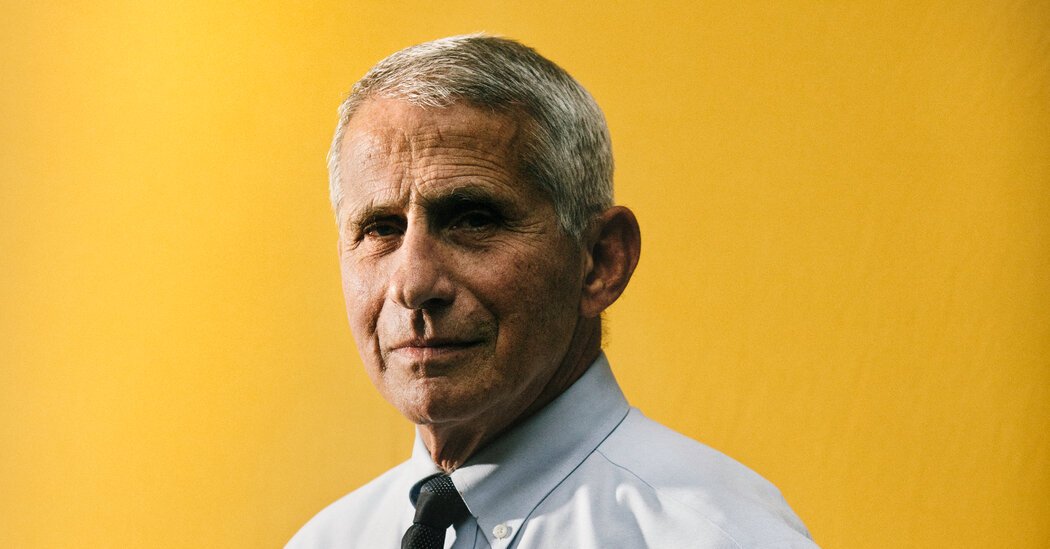
Three months into the coronavirus pandemic, Dr. Anthony S. Fauci answered his cellphone at his home in northwest Washington to be greeted by President Donald J. Trump yelling at him in an expletive-laced tirade after he suggested that a vaccine in development might not confer long-lasting immunity, drawing the president’s ire.
June 3, 2020, was “the first time I bore the brunt of the president’s wrath,” Dr. Fauci wrote in his upcoming autobiography.
Dr Fauci has long been careful about discussing his feelings towards Mr Trump, but in his book “On Call: A Doctor’s Journey as a Public Servant,” he writes candidly about a relationship he describes as “complicated.”
In a chapter titled “He Loves Me, He Doesn’t Love Me,” Dr. Fauci described how Trump repeatedly said “I love you” while at the same time launching into fierce diatribes peppered with four-letter words.
“The president was furious and said we can’t let this go on any longer,” Dr. Fauci wrote. “He said he loved me, but the country has a problem and I’m making it worse. He added that I’d cost the country ‘a trillion dollars’ because stocks only rose 600 points on Phase 1 vaccine good news when they should have risen 1,000 points” (the president added an expletive).
“I’m a pretty sensitive person,” Dr. Fauci added, “but being yelled at by the president of the United States, no matter how much he says he loves you, is not fun.”
The book, due for release on June 18, traces Dr. Fauci’s life from his childhood in Brooklyn as the son of first-generation Italian Americans (his father was a pharmacist and the family lived above “Fauci Pharmacy”) to his 54-year career at the National Institutes of Health, 38 of which he served as director of the National Institute of Allergy and Infectious Diseases.
In a 450-page book, Fauci devotes about 70 pages to the first year of the COVID-19 pandemic under President Trump. His criticism of Trump and the White House is sometimes blunt, sometimes roundabout, leaving readers to draw their own conclusions.
Dr Fauci served under seven presidents and steered the country through infectious disease threats including AIDS, swine flu, anthrax and Ebola, but the coronavirus pandemic has made him a controversial public figure and a target for Republicans, especially Mr Trump’s most ardent supporters.
During a tense hearing before the House Select Committee on COVID-19 this month, Dr. Fauci forcefully denied Republican allegations that he funded research that led to the pandemic or covered up the possibility that it started in a lab, calling the allegations “totally false and totally absurd.”
Fauci said the Trump White House was unlike any he had experienced before, especially because of its lack of connection to the truth: Trump “shocked me on his first day in office with his disregard for facts like the size of the inauguration crowd and his fierce disdain for the press.”
Those differences also extended to Trump’s relationship with Vice President Mike Pence, who serves as chairman of the White House Coronavirus Task Force.
“The Vice President is, for the most part, loyal to the President in public — that’s part of the job. But in my opinion, VP Pence has sometimes taken it too far. During task force meetings, he would often say things like, ‘There are a lot of smart people here, but we all know the smartest ones are at the top,'” Dr. Fauci wrote.
Dr Fauci then wrote, without specifying that Pence was referring to Trump, “Of course, he was referring to the man who sits behind the Resolute Desk in the Oval Office.”
Fauci also cast some of Trump’s advisers, including Chief of Staff Mark Meadows, chief economic adviser Peter Navarro and medical adviser Scott Atlas, as little use, saying Trump aides had provided journalists with negative information about the president in 2020.
“The growing hostility toward me from the White House over the spring and summer likely prompted, at least in part, the overt attacks against me by trolls in right-wing media and on social media platforms,” Fauci wrote. In August of that year, he opened a letter containing a “fine white powder” and “immediately feared it contained anthrax or something worse.” Hazardous teams were called to his office at the National Institutes of Health, and a few days later the FBI confirmed the powder was harmless.
Fauci first met President Trump before the COVID-19 pandemic began, at a White House ceremony where the president signed an executive order calling for improved manufacturing and distribution of the flu vaccine. After the ceremony, Trump told Fauci that he had never had a flu shot.
“I asked him why, and he replied, ‘Why would I need a flu shot if I’ve never had the flu?’ I had no answer,” Fauci wrote. The implication is clear: He was astonished at how little Trump knew about the purpose of vaccines.
According to Dr. Fauci’s account, on the morning of January 29, 2020, he received a call from his longtime acquaintance, conservative political commentator Lou Dobbs, who told him that Trump wanted to meet with him. A few hours later, Dr. Fauci was in the White House Situation Room briefing the president and his top advisers on the new virus spreading in China. For Dr. Fauci, a scientist from Brooklyn, it was immediately clear that he and President Trump, a native of Queens, could empathize in a way that only a New Yorker can.
“He had a New York swagger that I immediately recognized — a confident, shoulder-tapping charisma that reminded me of my days in New York,” Dr. Fauci wrote.
But the familiarity ended there. Dr. Fauci wrote that when Trump embraced the antimalarial drug hydroxychloroquine as a COVID-19 treatment based on anecdotal evidence, he realized “sooner or later I would have to publicly refute it.”
Trump portrayed the president as obsessed with TV ratings and the economy. After a March 2020 coronavirus press conference, Trump summoned Dr. Fauci to the Oval Office and called Fox News personality Sean Hannity. Dr. Fauci recalled: “‘Hey, Sean,’ he said on speakerphone, ‘Look at our ratings!'”
