

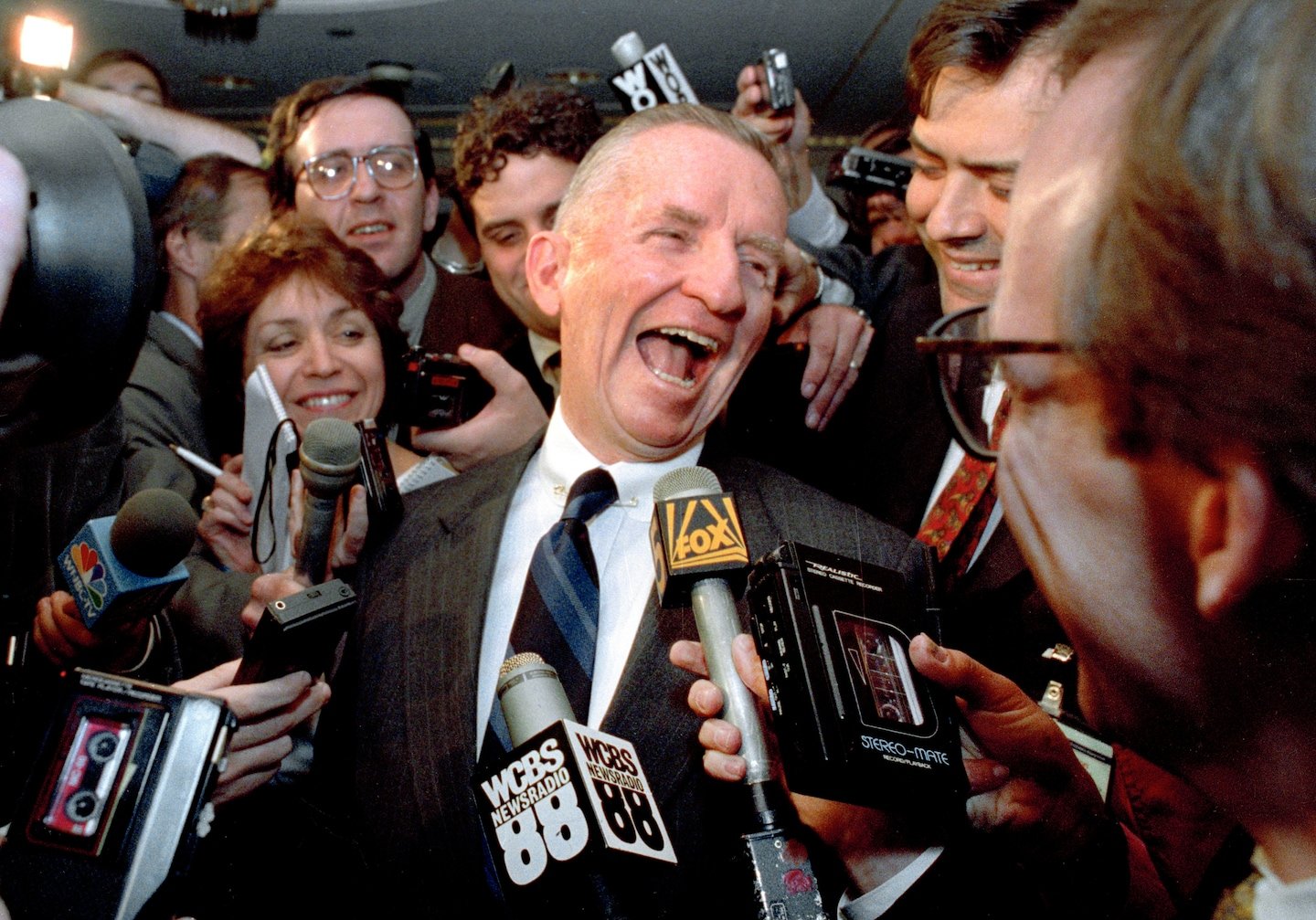
Unfortunately, the ’90s were not as tranquil as Fukuyama predicted. In his new end-of-history history, When the Clock Broke: Cheaters, Schemers, and the Collapse of America in the Early 1990s, journalist John Ganz shows how a country deprived of external enemies turned inward and consumed itself. Critics like to describe Donald Trump’s political career as “unprecedented,” but in fact he has ample precedent, as Ganz demonstrates in this wry and fascinating account of the former president’s twisted and bigoted predecessors:
“History, as the cliché goes, is written by the winners,” Ganz begins, “but this is the history of the losers.” The losers included such comical yet frightening figures as Ku Klux Klan leader David Duke, veiled white supremacist reactionary Pat Buchanan, and eccentric populist maverick Ross Perot, all of whom ran for president in 1992. The resulting election cycle was a circus, but also a warning that the establishment, if ignored, would be dangerous and, sooner or later, disastrous.
The self-proclaimed demagogues of this era were able to thrive because, for much of the country, history was not over. While the elite celebrated the victory of the Cold War and continued bureaucratic business as usual, the working class suffered. Eight years of Reaganomics produced devastating inequality. “Between 1980 and 1989, the median income of 80% of American families fell, while the top fifth of Americans saw it increase by nearly 50%,” Ganz writes. Meanwhile, the jobs that were the lifeline for many Americans were disappearing fast. Deindustrialization wiped out manufacturing jobs, and few white-collar management positions survived. Across Middle America, family farms struggled to compete with large-scale agriculture.
Those who rejected what President George H. W. Bush rather menacingly called the “New World Order” felt betrayed by their leaders. “Across the country,” Ganz wrote in 1992, “opinion polls showed dissatisfaction with all the primary choices”: the disappointingly weak incumbent Bush and the liberal Rhodes Scholar and Washington socialite Bill Clinton. Not surprisingly, Clinton’s victory did nothing to quell the growing resentment and discontent. Alienated from the centers of power and craving a scapegoat, working-class white Americans concocted conspiracy theories and railed against “multiculturalism” and “political correctness.” The demagoguery of chauvinism that followed, first in the run-up to Clinton’s presidency and for the decades that followed, was not surprising to anyone who had been paying attention. Unfortunately, there were fewer surprises among liberals.
Followers of Ganz’s combative writing on Substack may be surprised by the restraint he displays in his first book. When the Clock Broke is a narrative work of history with relatively little conflict or polemic. Instead of insulting his opponents (which he does well, and often rightly), Ganz turns to a character study that doubles as an exercise in deft political critique. In one characteristically sharp passage, he memorably describes the first president, Bush, as “bred to govern, not to lead.” “He was happiest leading the Central Intelligence Agency, the country’s top-secret club for privileged boys, but he took on the clichés and behavior of the bureaucrats.”
Ganz is also strangely silent on the issue of Trump. Even when the parallels between past and present are most obvious, Ganz lets the reader figure them out. And yet, despite its largely implicit assertions about current America, “When the Clock Broke” is far more insightful on the subject of Trump’s rise than most writings that claim to address the issue directly. Treated as part of a long-standing American tradition, the 45th president’s indignant patriotism is less disturbing, but no less alarming.
Of course, some of the stereotypes that dominated the country in the early ’90s, like fears of Japanese hegemony, seem almost quaint in retrospect. But other talking points remain uncomfortably familiar. Both Duke and Perot position themselves as victims of mainstream media bias against conservatives and freethinkers. “It’s as if the establishment has banded together to stop the rise of separatists,” Duke told a newspaper when asked why he was unpopular with the press. One pro-Duke flyer described him as “a modern-day David taking on the Goliaths of money, power, the media and political corruption.”
By far the most influential and most sinister of Gantz’s followers, Buchanan predicted the worst of the MAGA cult when he spoke of a “new nationalism” and proposed building a border wall. It was he who first popularized the term “culture war” (“culture war” was his exact term), and he was the loudest shouter of the old isolationist slogan, “America First!”
Perhaps the most striking, enduring and reprehensible was the bold determination to embrace a new style of politics, one that sought scandal and spectacle. Whereas Bush Sr. was a staunch technocrat, comfortable working behind the scenes, Gunz’s Flamboyant new populists thrived in the limelight: they were performers first and politicians second.
“He who wishes to govern a country must enjoy it,” Saul Bellow wrote at the beginning of his 2000 novel, “Ravelstein.” It was a principle that Duke, Buchanan and Perot held fast to. Like today’s MAGA Republicans, they were tolerated and fawned over by liberal journalists precisely because they were so outrageous. Those who think Trump is especially ridiculous forget Duke’s sex jokes and outbursts of nervous laughter, or Perot’s fervent supporters, who “sculpted an eight-foot plaster-of-Paris bust.”
These unlikely candidates may have been silly and buffoonish, but they were evil nonetheless. Bush and other respected members of the Republican Party had long toyed with “racial resentment and hostility,” Ganz writes, but they were finally realizing “that they couldn’t control it.” The Republican establishment miscalculated, unleashing dark forces that could no longer be contained. They feebly extolled civility and decency while the party’s fringes and center crept toward extremism.
There is a tendency among opponents of the far right to caricature it as a coalition of hapless fools incapable of marshaling ideas and therefore unworthy of serious consideration. Ganz knows not to take this condescending, intellectually dishonest approach. Instead, he deals with reactionary militancy with appropriate severity (and appropriate moral contempt). He understands that Trump zealots and their political forebears are part of other movements. Some of them are irresponsible opportunists, but some are thinkers with a consistent, if unpleasant, ideology that they have been openly preaching for decades.
In 1992, liberal economist Murray Rothbard made no attempt to hide his agenda when he shouted to a crowd at a conservative club, “With Pat Buchanan as our leader, we will beat the clock of social democracy. … We will abolish the twentieth century.” The work of white nationalist columnist Samuel Francis, a longtime contributor to far-right publications The Chronicles and The Washington Times, is another good example, and Ganz would be wise to read it carefully. As early as 1992, Francis suggested that the right needed “a political formula and a public mythology that would integrate the attention to material and economic benefits that the left offers with the defense of concrete cultural and national identities that the right offers.” It took a long time for Trump to succeed with just such a formula. All he had to do to predict the end of the end of history was to listen to the prophet.
Becca Rothfeld is the nonfiction book critic for The Washington Post and author of All Things Are Too Small: Essays in Praise of Excess.
Cheaters, conspiracy theorists, and the collapse of America in the early 1990s
Farrar, Strauss & Giroux. 420 pages. $30.
