

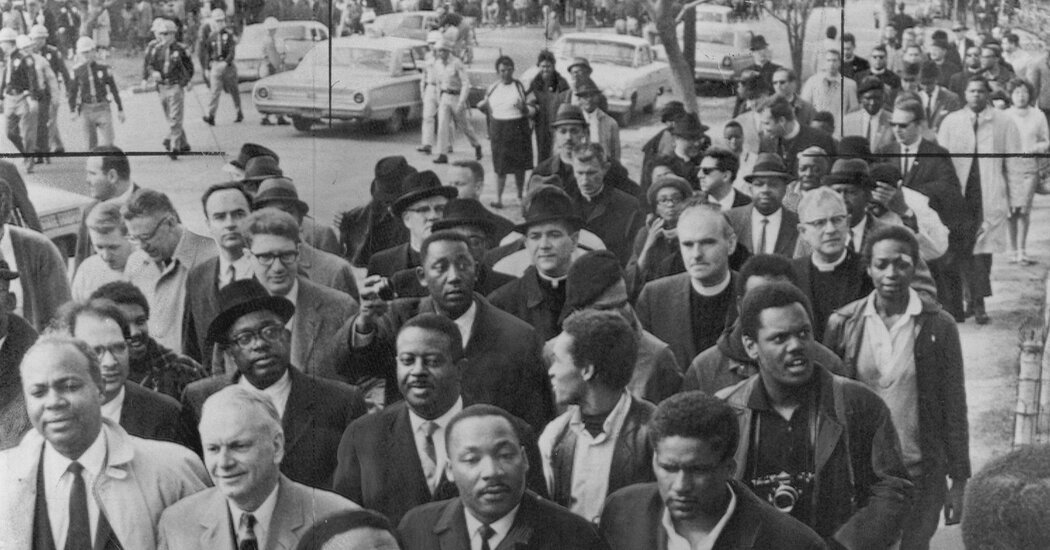
On March 9, 1965, standing at the foot of the Edmund Pettus Bridge in Selma, Alabama, the Rev. Martin Luther King Jr. selected two men from the hundreds of faithful men who had gathered that day to lead the prayer that would begin the March on Montgomery: the Rev. Ralph David Abernathy Sr., his best friend and closest associate during the American civil rights movement of the 1950s and 1960s, and the Rabbi Israel Dresner, one of King’s most trusted allies in the Jewish community.
Those men were our fathers.
“I believe that our lives have been enriched by your visit, and may the day come soon when we will all live as brothers in this great land, knowing no prejudice because of race, creed, color or former condition of servitude,” Abernathy wrote in 1965, praising Dresner, who had just preached from the church pulpit.
Abernathy passed away in 1990, and Dresdner in 2022. In the years since their passing, we have often been asked what they would say about issues and events. We believe they would be as appalled as we are by the outbursts of racism, anti-Semitism and Islamophobia that we have seen in our time. We know they would march against the rollback of civil rights and voting rights. Their dismay at the continuing erosion of Black-Jewish coalitions will be similarly painful.
We have never needed their counsel more than we have during these terrible months since October 7. Our hearts are broken by the hatred, violence and loss of life in Israel and Gaza.
We believe that the lessons learned from the lives and work of our forefathers – and most importantly, the way they bridged gaps between communities – can show us the way through times of division.
Abernathy and Dresner met in a segregated prison cell in Albany, Georgia, in August 1962. During their years working out together, our fathers became soul mates.
It was not the first time either man had been to prison; between them they had been arrested dozens of times. Both men received numerous death threats. Abernathy’s home and church were bombed, and Dresner found a bullet hole in the back window of his car parked in the driveway of his home.
Our forefathers, despite all the pain they experienced, fervently believed that it was always the right time to engage in dialogue in the pursuit of understanding and peace.
Our fathers have much in common. King, Abernathy, and their fellow black activists found inspiration in the story of the Exodus. King once told Dresner how much he admired the Jews for honoring the story of their ancestors who were slaves in Egypt. The rabbi reminded him that Jews, too, had been enslaved in European concentration and death camps less than 20 years earlier. Most of Dresner’s father’s family was killed in the Holocaust, and he and many Jewish activists saw the world’s silence in the face of the Holocaust as a lesson. They refused to remain silent amid the oppression of their African-American brothers and sisters.
King, on the other hand, believed that Israel rose from the ashes of the Holocaust, he was a supporter of the Jewish state, and he explicitly linked anti-Zionism with anti-Semitism.
Abernathy was a member of the Black Americans Supporting Israel Committee (BASIC), which formed in 1975 to educate the African-American community about Israel and Zionism and organize trips to Israel. “In the fight against discrimination, black Americans and American Jews share deep and enduring common interests that far transcend any differences between us,” the committee wrote in an ad in The Times.
Over the next few years, our communities grew apart and hostility grew. We have often seen the relationship between blacks and Jews portrayed negatively as that of patron and client, with the Jews as patrons and the African-Americans as clients, implying that the relationship was one-way. In fact, it has always been two-way, both in the fight to end segregation and dismantle racism in America and in support of Israel.
We have been committed to overcoming the divisions that have permeated Black and Jewish America and torn the two communities apart. This division began to fray with the assassination of Dr. King in 1968, and in the years since, we have witnessed our movement away from our common history of slavery and oppression and our shared biblical belief in a prophetic tradition of justice and equality. We continue the legacy of our forefathers by telling our common history and using it as a bridge to a better future.
We are reminded of a passage written jointly by 16 rabbis, including Dresner, after their arrest in St. Augustine, Florida, in 1964. “We could not pass up the opportunity to achieve a moral goal by moral means – a rare privilege in our time that was the glory of the nonviolent civil rights movement,” the rabbis wrote. “We must humbly confess that we did this as a fulfillment of our faith, a response to an inner need, and as a service to our black brothers and sisters.”
With this legacy in mind, after the initial shock and grief of October 7, and the retaliation against Gaza, we relied on each other.
In the hours after the attack, it seemed to us that bystanders quickly took a new, darker turn: an explosion of anti-Semitism, and rather than condemning the Hamas attack, celebrating it with specific protests, leading to communal divisions over the hierarchy of victims in the area.
We want to bring the message of love and unity our fathers wanted to convey to campuses in turmoil, and we want to bring together Zionist and pro-Palestinian protesters to find common ground.
We tried this spring, and unfortunately, the responses we received from the Black and Jewish professors and students we reached out to could be summed up as “there’s no one on the other side to talk to” and “this is the wrong time.”
We don’t think so, and this fall we want to take our message to schools and communities across the country.
Our forefathers taught us by their example how to create meaningful change, especially through meaningful dialogue with those who disagree with us. We want people to understand that Jews, wherever they live in the world, are not responsible for the violence in Israel or the atrocities that the current Israeli government is committing against the people of Gaza. We want people to understand that being Muslim does not mean that we support Hamas or hate Jews or Christians. We would like to teach all this and more, if people would stop speaking out and listen. And we promise to listen.
Abernathy and Dresner’s work is rooted in love for one another, love for humanity, love for justice, love for freedom, love for equality, love for America, and love for the world. They wanted the country we love to live up to the principles it was founded on and enshrined in its founding documents. We want the same for America, Israel, and Palestine. Like many protesters across this country, we want an end to the war in Israel and Gaza. We too want a Palestinian state alongside a Jewish state. Getting from here to there may seem difficult, but however we do it, as our fathers taught us, it must be through nonviolent action, not violence or violent rhetoric.
Such an idea may seem impossible, but who could have imagined that blacks and whites would ever sit side by side on the bus or in a restaurant until our fathers helped make it happen?
Donzalee Abernathy is an actress and author of “Partners To History: Martin Luther King, Ralph David Abernathy and the Civil Rights Movement.” Avi Dresner is an author, journalist and documentary filmmaker. He is executive producer of the documentary “The Rabbi & The Reverend,” currently in production.
The Times is committed to publishing Diverse characters To the Editor: Tell us what you think about this article or any other article. Tips. And here is our email: letters@nytimes.com.
Follow The New York Times Opinion section Facebook, Instagram, Tick tock, WhatsApp, X and thread.
