

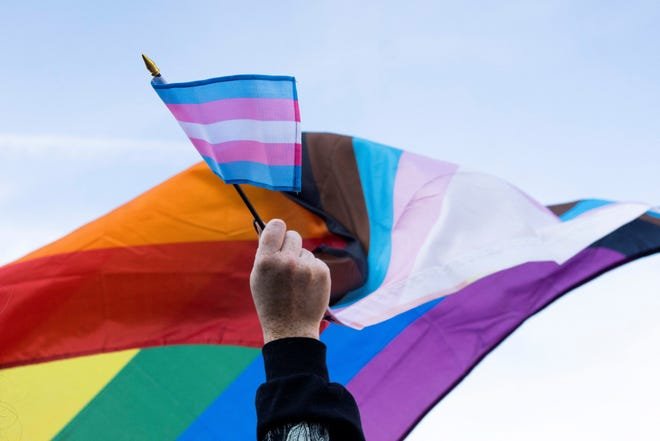
When you were born, someone probably told you whether you were a boy or a girl, and while your reproductive organs certainly revealed the sex you were born with, gender identity is by no means predetermined, says child and adolescent psychiatrist Jack Turban, M.D.
Turban, founding director of the Gender Psychiatry Program at the University of California, San Francisco, and a frequent speaker in the media about gender-affirming care, has a new book, “Free to Be,” out Tuesday.
“My big hope with this book is that it will broaden the nuance of how people think about gender,” Turban said during a recent Zoom call. “Younger generations are thinking about gender in a more nuanced way than older generations, and they’re thinking about different aspects and complexities of gender. As a psychiatrist, that’s really wonderful to see.”

The following interview has been edited and condensed for clarity.
People seem to love cherry-picking data points that fit their perspective (for or against gender affirming care). Do you think that’s where most of the misinformation comes from?
There’s also misrepresentation of the data. One of the most egregious misrepresentations is the idea that 80% of trans kids will change their mind and grow up, so we should just ignore their gender diversity, which is just not true. We talk about the studies. We also often make up stories that are not based on fact.
The bathroom controversy is a perfect example of how unfortunately people with very large platforms, like J.K. Rowling, for example, will claim that transgender-friendly spaces increase the risk of sexual assault, without providing any data, sometimes just anecdotes, when in fact there is research that shows that transgender-friendly spaces actually make transgender people safer, and don’t make things worse for cisgender people.
Transgender people So using a bathroom that doesn’t match your gender identity puts you at a higher risk of actually getting into trouble?
Absolutely. And the other thing I really wanted to take away from the book is to hear the actual stories of transgender people and transgender kids, because I think often these discussions become completely theoretical and so far removed from reality. And then it’s really easy to get carried away in the wrong direction. Again, bathrooms are a great example, because if you know a teenage transgender girl and you’ve had to actually see her being forced to use the boys’ bathroom, then you have that understanding. This is not safe for that child. This is embarrassing for that child. It’s cruel. But oftentimes transgender people aren’t part of the conversation. Kids are definitely not speaking up. So I wanted to highlight some of their voices a little bit more.

In case you missed it:Gender-affirming care saves lives, study says. Why is it so controversial?
Something that often gets overlooked when talking about this is that some kids take puberty suppressants. Some don’t. Some kids ultimately want surgery, some don’t. How do you think this nuance can become more mainstream?
I have a strong faith. Not everyone shares this faith. But from my perspective, I see a lot of that nuance disappearing among older generations, political debates, and powerful people in society. When you read Twitter or the news, it might feel like that’s mainstream. But the reality is, I’m with young people all day long, and they don’t think that way. They love their transgender friends. They’re really open and accepting of gender diversity.
It’s inevitable that things will get better over time.

What I understand is that kids are talking about transgender issues, but not in the same way that adults are. Do you think it’s fair to say that?
I think that’s fair. Different generations think differently, but they think it seriously. Adults are very political and binary. And the interesting thing is that kids don’t really think about these things. For example, they don’t care if their friends use the toilet.
Transphobia appears to be something learned, not innate.

When did gender-affirming care become such a politicized issue?
[Gender-affirming care]has been around for decades — doctors have practiced it, they’ve implemented it, families have benefited from it, we’ve had similarly nuanced conversations about it — but it’s only really been in the last five years or so that it’s become really politicized and everything has become a lot more difficult.
Read next:Busy Philipps speaks passionately about LGBTQ+ parenting, praises friend Sophia Bush for coming out
You’ve spoken about your optimism for the future, can you expand on that?
Part of the reason is the current state of gender. I’m by no means a political scientist. But I feel like we’re in a difficult political time, not just in this regard but in a broader sense, living in this world. There’s a lot of things happening in the political world that we didn’t expect. And it seems to be getting harder and harder to predict. If you’d told me five years ago that the world would be in this state, I would never have believed you. So I hesitate to necessarily predict how things will be in five years.
But I really think that trans people are becoming more visible. Younger people are thinking about this in a more nuanced way, and younger people are not as prejudiced about trans people. Trans people are not hidden, and they are not as hidden as they used to be. So I think we are making progress. There is so much anti-trans rhetoric and anti-trans laws now, and maybe a lot of people are being forced back into the closet and are scared to speak out. But I think it’s temporary, and things will continue to improve.
