

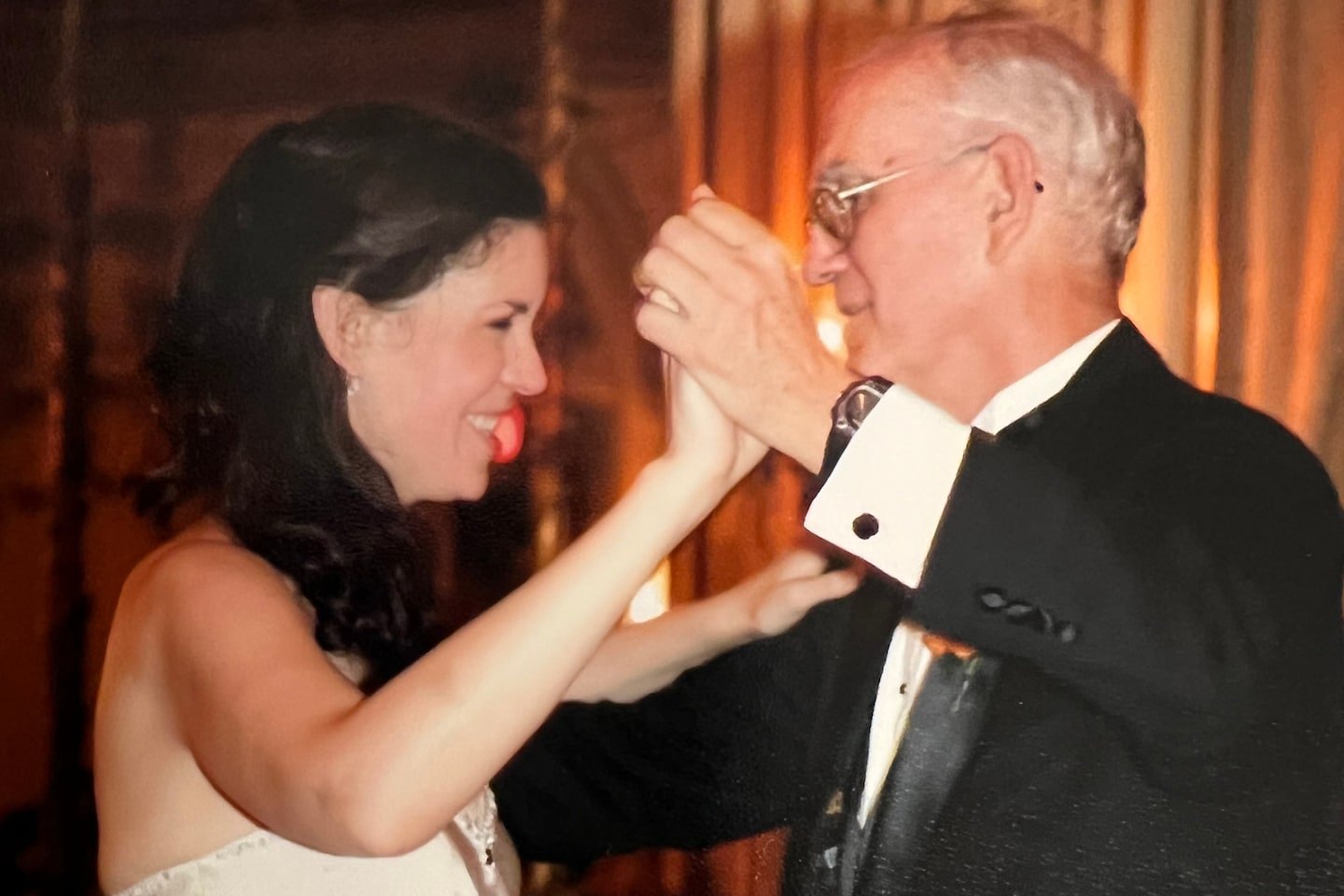
My sister and I learned about them when, digging through a pile of papers in my father’s home office near Boston, we found a folder marked “Atkinson, Nebraska.” We opened it and out popped a stack of letters written by children at West Holt Elementary School.
An hour of Googling revealed the full story: After 9/11, when he and I were working for a disaster recovery company at Ground Zero, he received some supplies that the Atkinson kids had collected for the rescue workers. Moved, he sent a check and continued to send more over the years, totaling $6,000. The money was used to fund things like new flagpoles for the elementary and middle schools.
“Please use the enclosed materials to remind your students that together we built a better America,” he wrote in a note to the school. He never said anything to his children, for he was a talkative man but also an introvert. He expressed his love through thoughts and actions, not through confessions or recollections of his frequent acts of impulsive generosity.
I grew up on fact-packed tours of New York City and Sunday political debates where he gently and amusedly shared his thoughts on a passionate, troubled teen’s world, and after I left home, during long phone calls, he taught me most of what I know about infrastructure, urban policy, and how government actually works.
You see, the great irony of my life as a libertarian columnist is that my father was a lobbyist. He worked for a decade at various levels of New York City government, eventually becoming head of the city’s Department of Environmental Protection. He then spent most of the next three decades running the trade association for the heavy equipment construction contractors who built most of the infrastructure in the tri-state area. Whenever I wrote something particularly scathing about lobbyists, it was met with a humorous comment: “You know how I paid for college, right? With love, Mee.”
He wasn’t cynical about his profession because, as the memo said, he believed his members were building a better America. We drove around cities he knew well — New York, Boston, Washington, DC — and he told us their history through their roads, bridges, famous buildings, water plants, sewers, and more. Of course, we talked about many other things, too, because his interests were wide-ranging and his head, like his office, was full of information, neatly labeled and organized.
I remember when, as a college student, I had just begun learning T.S. Eliot’s The Love Song of J. Alfred Prufrock, opening my front door and saying, “Come on, let’s go out, you and I…”
Without a moment’s hesitation, my father continued:
“When evening spreads across the sky
Like a patient etherised on a table;
Walk the half-empty streets
I spent a sleepless night in a cheap hotel.”
I don’t know why I was surprised: he loved wordplay and puns, and he loved the poetry of the period, including his favorite poet, William Butler Yeats, and he remembered the things he liked.
Everyone who mourned my father’s death said the same thing: “My father was a great man. I learned so much from him.” As a child, I had a habit of treating my father like a walking encyclopedia, and I still remember the shock I felt the first time he didn’t know the answer to a question I asked him. I don’t remember what I asked, but I do remember I was in my 20s.
Luckily, I had a dad who was endlessly patient with my questions, because more than anything, he loved questions and he loved answering them. He was also a girl dad before the term was even used, and he was unashamedly supportive of everything my sister and I did. He came to many of my basketball games, even though my parents usually didn’t in the 1980s (and even though I was, frankly, terrible at everything except being “tall”). When I went to camp or college, I was given a card each day with some tidbit of news from home, and on the back of the card was the immortal signature of a stick figure in a top hat that read, “With love, me.”
I wish I had kept that card, but at the time I didn’t understand its true message: that wherever I went, he was right behind me, thinking about me, watching over me, cheering me on. He pretended to be enthusiastic about my wildest plans, like using my ruinously expensive MBA to land a journalism job with a tiny salary, but in that last case, he couldn’t hide the fear in his eyes.
(See, Dad? I told you it would work.)
It’s still hard to believe that there will be no more cards, no more phone calls, no more impromptu tours of the city’s bones, but it’s heartwarming to think of how the world is enriched by what he left behind, the people he loved and the infrastructure he helped build, including two flagpoles in Atkinson, Nebraska.
