

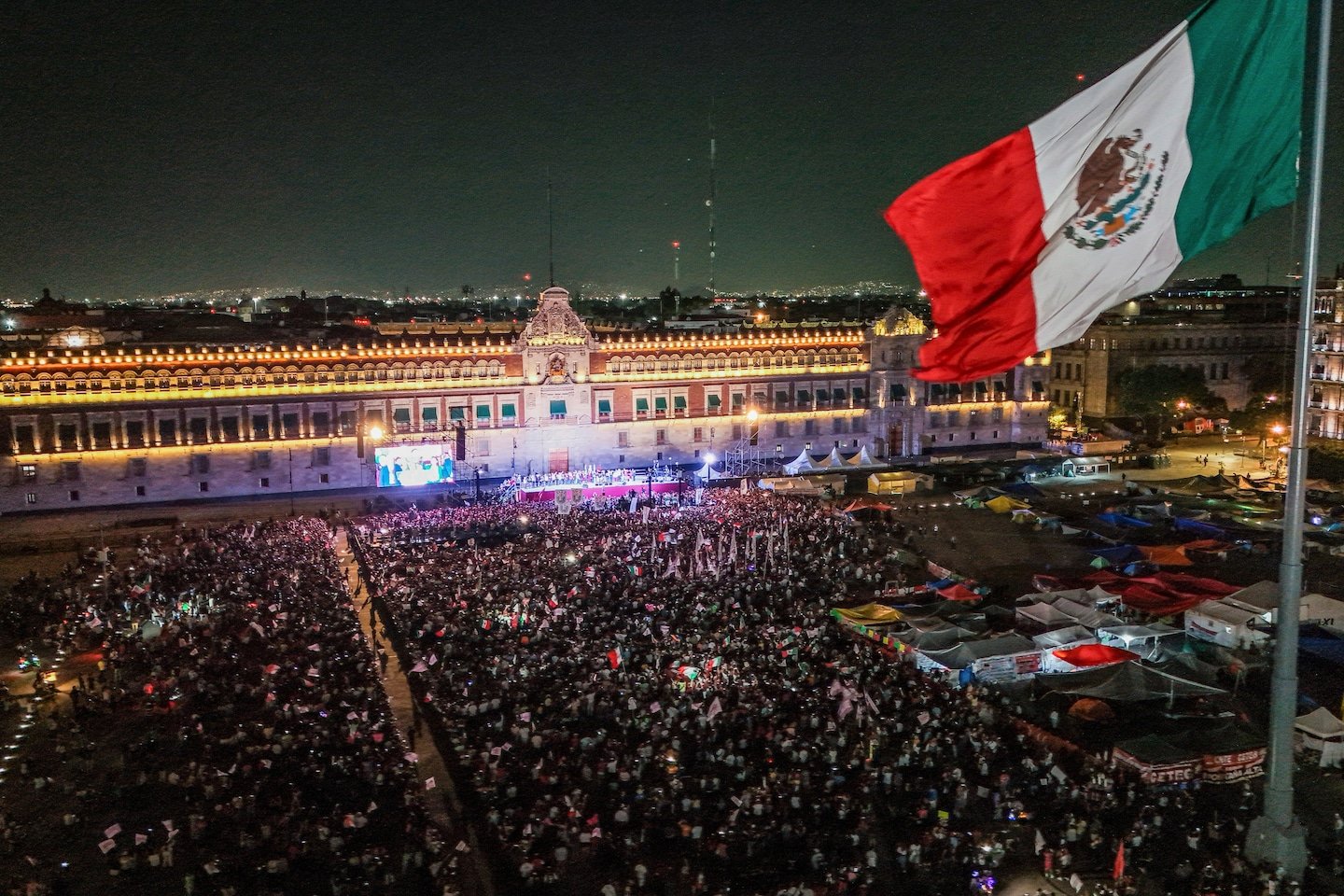
Morena’s coalition held Mexico City, won six of the eight contested states, and recaptured Yucatan, a state formerly held by the opposition National Action Party. It also won a landslide victory in Congress, winning a two-thirds majority in the lower house and potentially a two-thirds majority in the upper house once the final official results are announced, which would give the president the power to amend the country’s constitution.
And it’s raising legitimate concerns about Mexico’s future. The party that won a landslide victory on Sunday appears intent on using its enormous power to dismantle the institutions that underpin Mexico’s democracy and re-establish the one-party system that existed for 70 years before the country turned to democracy 24 years ago.
One reason for concern is that Lopez Obrador is a product of the old regime, having cut his teeth with the ruling Institutional Revolutionary Party (PRI) at a time when its candidates won presidential elections with 74.3 percent (1982), 86 percent (1970), and even more than 90 percent (1976) and no credible opposition.
Lopez Obrador is well versed in the PRI’s old tricks, buying electoral favor by inflating the 2024 budget deficit to 5.9% of gross domestic product, the highest in 36 years, and he has mostly railed against what he calls Mexico’s “neoliberal” era, which includes the country’s entire experience of democracy, but has little criticism of the previous decades of one-party rule.
The concerns are primarily due to the president’s own rhetoric: AMLO, as he is known, has openly said he wants to undermine institutions designed to limit presidential power.
The effort even has a name: Plan C, after failed reform attempts stymied by constitutional fine print. If Molina wins two-thirds of the Senate, he could introduce the bill in September. By then, the new Congress will be in session, but Scheinbaum hasn’t yet been sworn in. And no one — not the opposition, not the Supreme Court, not the Constitution — can stop the bill from becoming law.
The plan also includes dismantling the independent electoral watchdog that was established in the mid-1990s as a key step towards the country’s first democratic elections in 2000. The Freedom of Information Authority will also be abolished. The National Guard, which Lopez Obrador created to replace the federal police, will remain under military rule without civilian oversight.
Most importantly, judges, including Supreme Court justices, would be elected by popular vote, aligning the third branch of government more closely with the aims of the political giant of the time, Morena.
It’s unclear what the president-elect can do about this. Sheinbaum has publicly stated her support for Lopez Obrador’s judicial reform plan. She may have little say. There may be a Plan C in place before she takes office. Still, for the sake of her own government as well as Mexico’s democracy, she should try to convince her patron and predecessor, AMLO, to get out of this situation.
Sheinbaum must understand that by immersing himself in Lopez Obrador’s campaign against independent institutions, he is narrowing his own space to govern. Addressing Mexico’s many problems – violence, corruption, inequality, stagnation – requires a society-wide dialogue. This will not happen if the usual democratic checks and balances disappear and one must always bend to the will of one’s patrons.
Indeed, financial markets on Monday already sent a scare through Mexico, with the peso plummeting against the US dollar.
President Lopez Obrador wants Mexicans to believe that checks and balances are a right-wing plot to sabotage efforts to promote social justice. It’s not. Sheinbaum’s job is to convince the president that the return of unbridled power for the PRI would not end well for Mexico.
