

If only real life worked like the movies. Freedom House reports that global freedom has been declining for 18 years, and recent events have only intensified that ominous trend. Russian troops have invaded Ukraine, Iran has crushed pro-democracy protests, and Georgia has passed a Russian-style law allowing it to prosecute civil society organizations as “foreign agents.”
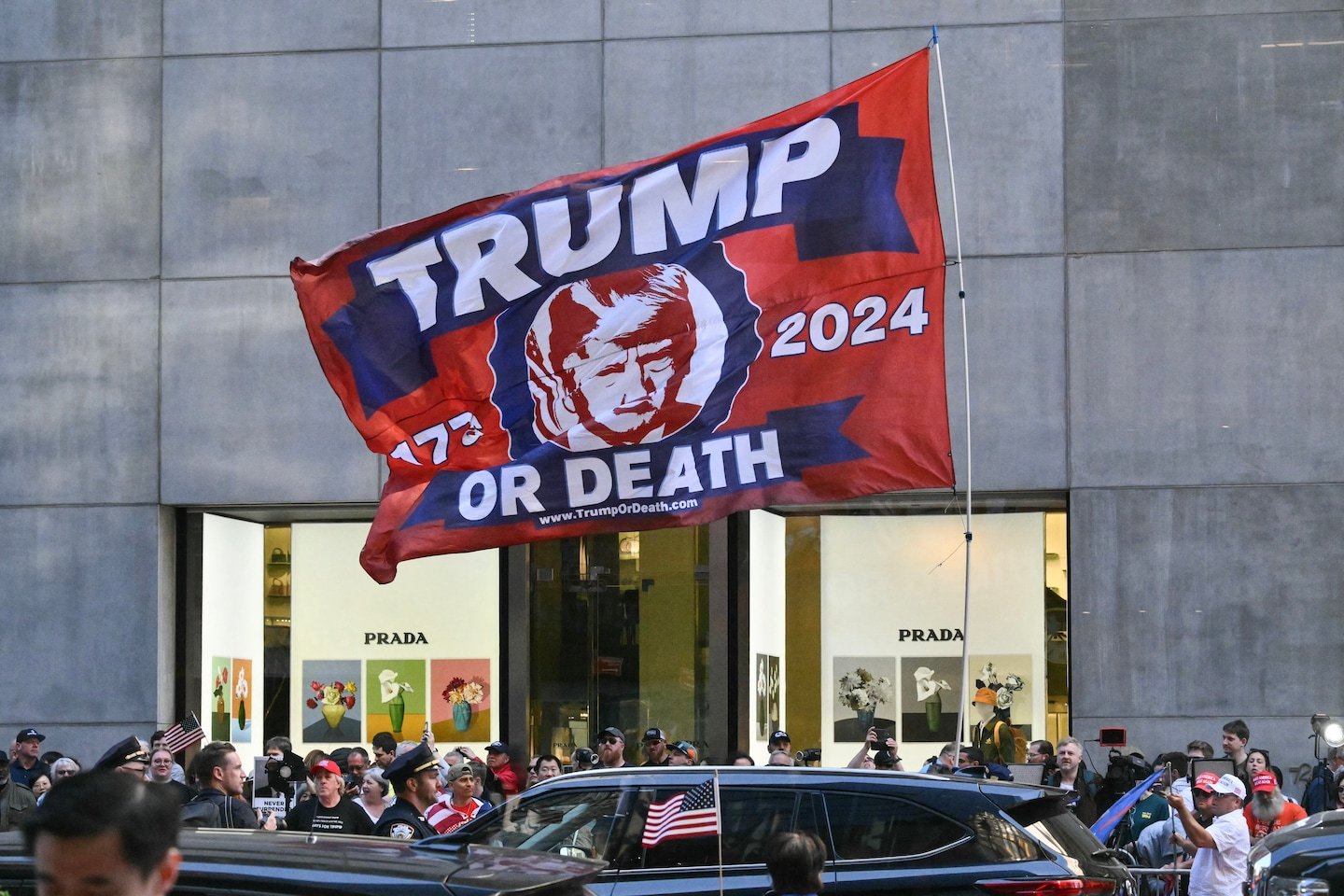
The strength of Donald Trump’s incendiary presidential campaign is another sign of how easily illiberalism can thrive. His continued popularity will be another indicator, despite his conviction on 34 felony counts in a hush money trial in New York last week.
“I believe the American people will choose good over evil,” First Lady Jill Biden said last week about the presidential election. I hope she’s right, but we must take seriously the possibility that she’s wrong. To naively pretend otherwise could create harmful passivity and counterproductive inertia that makes the victory of evil more certain.
While America’s sense of invincibility has been shaken in the past, such as by the Japanese attack on Pearl Harbor in 1941 and the terrorist attacks of September 11, 2001, the overall optimistic sense of security remains strong. And despite defeats from the Vietnam War to the Afghanistan War, Americans’ confidence in the U.S. military remains high, though not as strong as it once was. A Chicago Council on Global Affairs survey released in January found that only 19% of Americans said they were more concerned about overseas threats than domestic security threats.
Underlying much of the American national discourse is the belief that America is on the right side of history, that no matter what policies we pursue, “our” side will eventually triumph over the forces of tyranny. It’s just a matter of time. History is seen by many as a story of progress from a dark past to an enlightened present. This is known as the “Whig interpretation of history,” and although it has long been discredited by historians, it is still widely accepted.
In the real world, unfortunately, it’s quite possible for the bad guys to win. And even the victories of the good guys are often not as complete as they seem in retrospect. Take World War II, the epitome of a “good war.” Americans tend to focus on the defeat of Nazism and overlook the victory of the Soviet dictatorship in Eastern Europe. The end of World War II contained the seeds of the Cold War, leading to costly conflicts in Korea and Vietnam.
The end of the Cold War gave new impetus to the dream of liberal democracies reigning unchallenged, as suggested by Francis Fukuyama’s influential essays and books predicting “the end of history.” But recent years have seen democratic backsliding in countries such as Hungary and Georgia that were once held up as models of post-communist republics. Russia itself has ended its brief experiment with democracy and returned to levels of autocracy not seen since the Stalin era.
The war, pitting innocent Ukrainians against brutal Russian invaders, is the purest expression of good and evil imaginable. If this were a movie, the Russian bad guys would have been driven back to Moscow long ago. But in the real world, war criminals have shown disturbing staying power. Vladimir Putin remains entrenched in the Kremlin (he just gave himself another term in a farcical “election”) and has put the Russian economy on a war footing, while Europe and the United States fall behind in supporting Ukraine.
While Putin presses ahead with his invasion, Western leaders are balking, delaying Ukraine’s needed aid. In the past, Western countries have struggled to decide whether to send tanks, long-range missiles, or F-16s (which have yet to arrive). Now there is endless agonizing over whether to provide Ukraine with some $300 billion in frozen Russian assets, send military trainers to Ukraine, or allow Ukraine to use Western weapons systems to attack Russian military targets. Last week, President Biden finally allowed Ukraine to use U.S. weapons against Russian forces massing across the border, but only near Kharkov. So what about elsewhere?
Some Western leaders seem to think that Ukraine will win anyway, so there is no need to risk a more direct confrontation with Russia. However, Ukraine’s recent setbacks show that this is not the case. War is on the brink, and Ukraine could lose if the West does not work harder for it. Of course, Ukraine also needs to work harder for itself, mobilizing more soldiers, building more fortifications, etc.
In other parts of the world, dictators are on the rise – at least for now. We have Bashar al-Assad in Syria, Nicolas Maduro in Venezuela, Xi Jinping in China, Kim Jong-un in North Korea, Ali Khamenei in Iran. The list goes on. In most of these countries, protest movements have been brutally suppressed in recent years. The dictators are even banding together, with China, North Korea and Iran backing Russia’s brutal war in Ukraine.
Many Americans seem baffled by the staying power of dictators because we tend to imagine that everyone in the world wants to live like the rest of us. Perhaps so. But as the failed revolutions of the Arab Spring showed, attempts to realize the democratic dream often fizzle. Tunisia, the only success story to emerge from the Arab Spring, has since reverted to dictatorship.
And now, even in the United States, liberal democracy is under threat. Trump, who has incited insurrection and vowed revenge on his enemies, is leading Biden in most battleground states. Like many Americans, I never imagined that a disgraced, twice-impeached and now-convicted felon would ever return to office. But it’s entirely possible.
Trump is far from being on an equal footing with the dictators who often inspire his admiration, but this aspiring authoritarian has promised great harm to the most vulnerable among us, including the millions of illegal immigrants he vows to detain and deport. Some of his supporters are even more frightening than Trump himself. The fascist tendencies of the Trump camp are inescapable.
But many Americans seem too apolitical to see the stark differences between Biden and Trump. In 2020, 80 million Americans (about a third of the electorate) did not vote in the presidential election. This year, turnout is likely to be roughly the same. Perhaps that’s because only 18% of Americans, according to a YouGov poll, fear their country could become a dictatorship in their lifetime. This may be a fatal failure of imagination.
Don’t get me wrong. I’m not saying that the triumph of evil is inevitable, either in the United States or in the world. But the triumph of good is also inevitable. History does not have a predetermined ending, good or bad. The outcome is in our own hands. Unlike in the movies, superheroes don’t come to the rescue. We have to save ourselves.
