

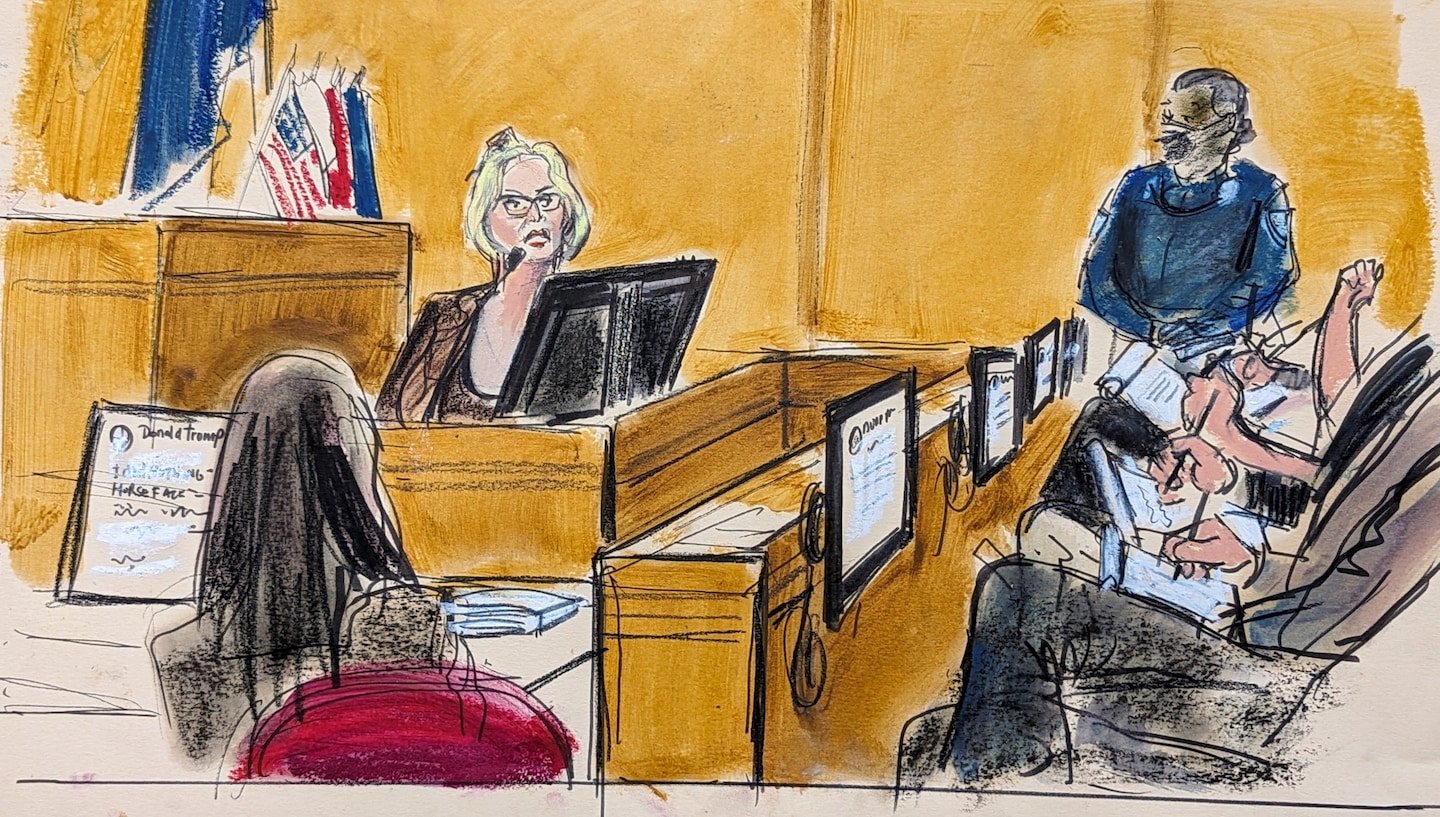
For the first time, jurors will be allowed to discuss the case — not just the witnesses they’ve seen, but also the evidence those witnesses have given. (It’s likely that some of the witnesses will have been discussed in the abstract; one witness in the Astor trial was wearing a cheetah-print outfit, which was a topic of discussion in the jury room after the trial.) And for the first time, jurors will realize that the hardest part of their work is only just beginning.
Throughout the nearly month-old Trump trial, I’ve written intermittently about my experience serving on a Manhattan jury 15 years ago over the trial of Anthony Marshall, the son of New York billionaire socialite Brooke Astor, and allegations that Marshall took advantage of his mother’s declining mental capacity due to aging to change her will.
Like the Trump jurors, we were selected and seated in the spring. Unlike the Trump lawyers, the prosecution and defense in what was then called the Astor trial didn’t wrap up until the fall. We spent six months together, hours listening attentively in the jury box and at least as much time chatting and gossiping behind closed doors in the jury room. At least, until the door clicked and we were suddenly down to work.
No one knows exactly what Trump jurors will do once deliberations begin, or how long they will take. I tried to emphasize this point last week: even the jurors who walk into the room will probably be wrong about how deliberations will unfold. Each of us has assessments of the world around us that we believe to be valid and accurate. But once we begin to exchange views, we quickly see how subjective our perceptions can be. And given that the issue at hand may involve personal freedom, jurors—at least those who take their duties seriously—must carefully consider how to blend those subjective experiences into a common verdict, as I, and the system, assume as a default.
On Wednesday morning, as the judge was preparing to give final instructions to the Trump jury, I read a commentary that suggested the jurors were eager to get things done, given their willingness to work late into Tuesday night. I think that’s wrong. Perhaps the jurors were instead eager to get on with the task for which they were selected.
The 12 people chosen to decide whether Trump is guilty are acutely aware of the weight of their decision, and by now they know each other well and how they see their role. They have endured weeks of briefings and arguments from lawyers and judges. They have watched as lawyers, audiences, and perhaps the defendant scrutinized their reactions to the evidence like stray cats lured by bait. And now, finally, they are in the driver’s seat.
What we did (if I remember correctly, 15 years later) was to begin by investigating the various charges and then hold a trial vote on the guilt of the defendants. (Marshall was prosecuting with his attorney, Francis Marshall.) We quickly realized that the deliberations were not going to end anytime soon.
It is important to remember that the task before the jury is not simply to answer the question, “Did the defendant do it?” but the more specific question, “Does the evidence presented dispel a reasonable doubt that the defendant violated the law?” In the jury box, you will primarily think about the first question. In the jury box, after the door clicks, you will consider the second question. This is the essence of the judge’s instructions.
Our case is different than the one Trump’s jury is considering because our case included a broader set of charges. Of course, I don’t discount what they have to consider, but the 34 charges Trump faces are all charges of “falsifying business records in the first degree.” The evidence must be compared in each of the 34 cases only against that particular statute. Perhaps all 34 charges will be decided the same way, and the jury will quickly agree on whether each was proven beyond a reasonable doubt. Or, perhaps, and perhaps more likely, they will disagree on some charges for specific reasons and will have to figure out how to resolve their differences.
What jurors cannot and should not do is consider what the consequences of a sentence would be. They are not being asked to punish Trump, but to assess his guilt based on the evidence available to them. That’s why the judge on Tuesday grew frustrated with Trump’s lawyer, Todd Blanche, who said Trump could face prison time and linked the sentence to the penalty in a way that could affect how jurors vote on the charges.
Here’s an example: After deliberating for 11 days in the Astor trial, we reached various verdicts on two defendants. Only afterwards did we find out that the one charge we found guilty of carried a mandatory prison sentence, meaning the 85-year-old defendant would have to serve it. This was one of the charges we spent the most time on because several of us, myself included, doubted whether the letter of the law had been followed. So we calculated the amount of money Marshall had misappropriated from his mother’s estate and determined that it exceeded the statutory requirements. It did exceed the statutory requirements, but not by much. Guilty beyond a reasonable doubt.
Had we known that Marshall would have to go to prison if convicted of this charge, that might have influenced our decision, but we didn’t know that, and we didn’t need to know that.
Deliberations are hard. Sitting down with 11 strangers and coming to unanimous agreement on a complex issue is tough. Tempers will flare up, as they will with jurors. But there’s no need to rush. After a month of evidence and courtroom maneuvering, the court, the lawyers, and the defendant will have to follow the jury instructions. Jurors may send questions for clarification (and wait hours for the lawyers to debate how to answer them with the judge). Jurors may ask to see evidence that was presented in court. (I vividly remember sitting in a jury room on the 15th floor of the Criminal Court Building in Lower Manhattan, holding and considering Brooke Astor’s will.) The court and everyone else will just have to wait until they reach an agreement, or decide they can’t.
I have a photo of the Astor verdict saved on my phone, one of the few I took sneakily while serving on the jury (which I’ll admit was against the rules). It shows me and the other two jurors sitting at a large table in the center of a relatively small jury room, likely the same room where Trump’s jury is seated. In the corner is a chalkboard with the charges and the votes we wrote on them. The date on the photo indicates it was taken the morning we delivered the verdict.
After making sure we and each other were confident in our decision (and after another free, state-paid lunch), we told the court that our decision was done. We were called back into the courtroom one last time, and the verdict was read out. Then each of us was asked to vote. Did we agree with the verdict that was presented? We all did.
And then, in the blink of an eye, we were all out of work. Our jobs were done. We were back to being ordinary New Yorkers, and in the generous eyes of the American justice system, no more than Brooke Astor or Donald Trump.
