

With slim majorities in both houses of Congress, the party is in a must-win situation in almost all of the lower-level elections in November, putting its majority control at risk.
Early projections have Florida, a resurgent battleground state with a decade’s worth of reliably Republican behavior at the ballot box, classified as “likely Republican.” Make no mistake, a statewide Democratic victory in the Sunshine State would be significant, and the 2024 Senate race will hinge in part on name recognition that tests voter memory.
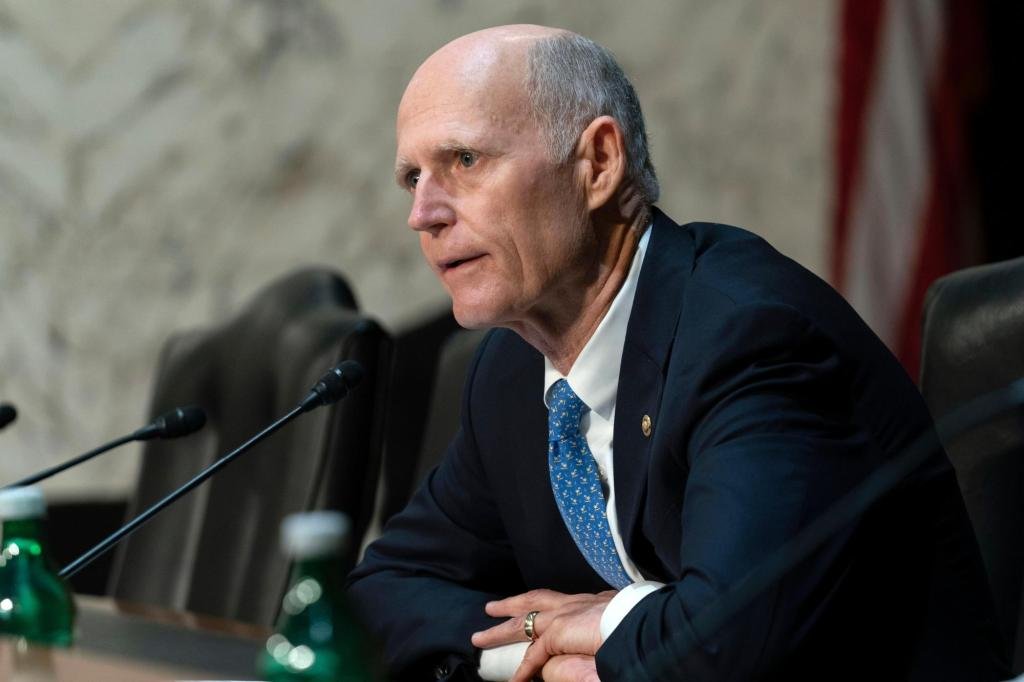
The candidate is incumbent Florida Rep. Rick Scott, now a fixture in Florida politics, who won Bill Nelson’s Senate seat in 2018 after serving two terms as governor from 2011 to 2019. Before running in 2010, Scott led Columbia/HCA, then the nation’s largest for-profit hospital chain.

Under Scott’s direction, Columbia/HCA was accused of massive Medicare and Medicaid fraud; in 2000 and 2002 the company pleaded guilty to 14 felony counts and agreed to pay more than $1.7 billion in fines. Scott was never formally questioned in the federal investigation, but in a separate civil lawsuit in 2000, he invoked the Fifth Amendment 75 times and refused to disclose whether he was even employed by Columbia/HCA. The company fired Scott, but a platinum parachute of $300 million in stock, $5.1 million in severance pay and a five-year consulting contract at $950,000 per year gave him a comfortable landing.
As governor, Scott continued to receive bad press as he racked up a string of firsts. He became the first Florida governor to win a lawsuit for violating the state’s Sunshine Law. As part of the settlement, Scott was fined $700,000, paid shamelessly with Floridians’ hard-earned tax money.
In 2011, Governor Scott signed harmful reforms to the Florida Retirement System, dealing a blow to public employees. Governor Scott eliminated cost-of-living adjustments going forward, required employee contributions, and raised the mandatory retirement age for employees. With rising inflationary pressures, these reforms will leave retirees on fixed incomes feeling stifled. Indeed, Governor Scott left public employees, including firefighters, teachers, police officers, and cafeteria workers, feeling uneasy long after he left the Governor’s Mansion.
Scott is attracting a formidable challenger in Democratic front-runner Debbie Mucarsel-Powell, a former congresswoman from Miami-Dade County with deep ties to university administration and nonprofits. Mucarsel-Powell has built a reputation for working with anyone to get results; she brought $200 million in Everglades funding to Florida, $100 million to South Florida transportation, and authored the Medicare expansion bill. Early political speculation has questioned whether Mucarsel-Powell’s name recognition will be enough to really challenge the politically entrenched incumbent Scott, but it may be Scott who should be concerned about name recognition.
Rick Scott is hoping voters will suffer from electoral amnesia this November and forget how much his policies have hurt working-class Floridians. After slashing working-class retirement savings and embezzling public funds to pay personal fines, Scott has been rewarded again, this time with a promotion to the U.S. Senate. Now it is up to Florida voters to give Scott long-overdue accountability at the ballot box.
John O’Brien of Miami is president of the South Florida Council of Firefighters.
