

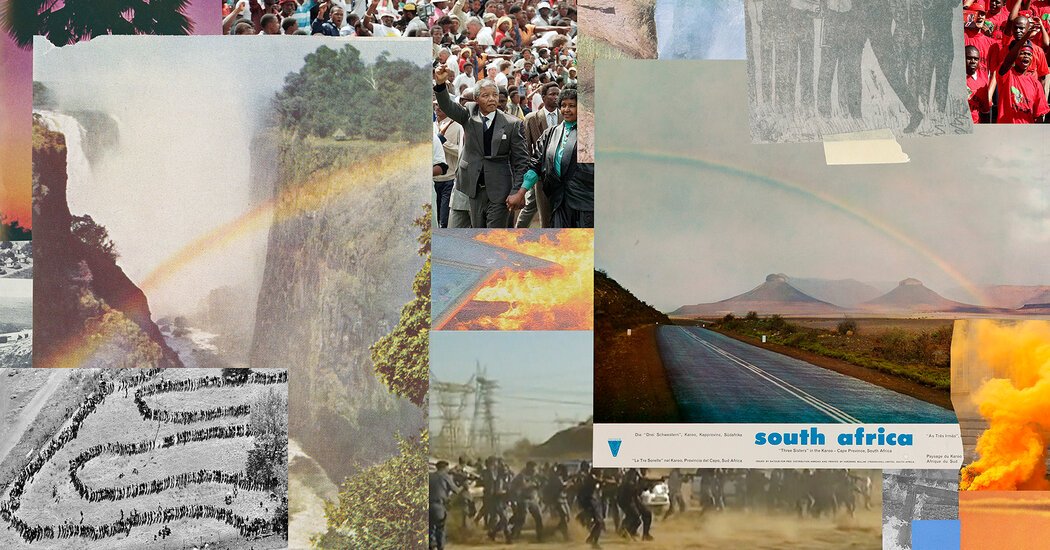
The ceremony drew little attention. On a cloudy April day in Pretoria, South Africa’s administrative capital, President Cyril Ramaphosa delivered a lackluster speech marking the end of white-minority rule in South Africa. When Nelson Mandela was sworn in as the country’s first black president, the skies had cleared with hope. Three decades later, Mr. Ramaphosa’s emaciated figure against a dark backdrop was a symbol of decline. Mr. Ramaphosa’s party, the African National Congress, has dominated politically since the country’s first democratic elections in 1994. Wednesday’s general election could see the party lose its parliamentary majority for the first time.
This is uncharted territory. Former South African president Jacob Zuma has declared on multiple occasions that the ANC will rule “until Jesus returns.” Zuma is now trying to unseat the party that enabled his notorious corruption. Founded last December, Umkhonto weSizwe (MK) is named after the former military wing of the ANC and features Zuma as its face. Although he has been disqualified by the Supreme Court from standing in elections, the party has rallied thousands of Zuma’s supporters behind its populist policies. If it can overcome its internal factionalism and legal troubles, it could pose the biggest risk to the ANC’s vote share and force a coalition government.
The emergence of this party is one of many ills in South Africa today. The ANC has lost its purpose and is a shadow of its former self. And the country it ruled for so many years is plagued by crumbling infrastructure, systemic corruption, fading central power, and violent crime. Thirty years after the end of apartheid, South Africa is once again in the midst of complex change. What happens next is unclear, but given the country’s divisions, it’s unlikely to be for the better.
How did it get to this point? In his February State of the Nation address, President Ramaphosa allegorically depicted the trajectory of post-apartheid South Africa through a fictional character named Tintswalo, born in 1994. Tintswalo is a woman who stands to benefit from the expansion of social services such as education, housing, electricity and health care that resulted from the abolition of racial discrimination. As many have pointed out, these benefits of democracy lasted at least for the first 15 years of South Africa’s post-apartheid history, when economic growth was robust, international market conditions were favorable and state management was competent.
The turning point came in 2009, the year Zuma came to power and the year after the global financial crisis. After that, life chances, political expectations and economic prospects all suffered a setback. The ANC’s hegemony was shattered by a series of consensus-shaking events: the Marikana massacre in 2012, when 34 miners were killed by police; in 2013, former ANC youth leaders formed the Economic Freedom Fighters; the National Metalworkers’ Union was expelled from the country’s largest trade union federation, which is formally allied with the ANC; and, in 2015 and 2016, widespread student protests.
All these developments called into question the conceptual foundations of post-apartheid reconciliation, particularly Rainbow Doctrine, the founding myth of a young nation of a non-racial, cooperative democracy embarking on a path of progress aimed at healing the legacies of apartheid and colonialism. This universalist vision, encapsulated in the 1955 ANC Freedom Charter’s assertion that “South Africa belongs to all who live in it”, was gradually weakened by persistent inequality and a corrupt state, leaving a vacuum in its place.
The ANC has lost support, but no political force has yet emerged to fill the void. Led by the combative Julius Malema, the Economic Freedom Fighters were once one of the most exciting new forces in the electoral contest. But their national profile has fizzled, and they have had a less-than-inspiring record in places where they have held power, such as in coalitions with the ANC in Johannesburg and Durban. That makes it hard for the party to stand out, even as it claims to be more prepared to implement the ANC’s national liberation agenda and properly confront what it calls “white monopoly capital.” This may not be a problem, but there is speculation that they may be seeking a place in government as a junior partner in a coalition.
The other main opposition party, the Democratic Alliance, has taken a different path. While the Economic Freedom Fighters’ underlying complaint is that post-apartheid democracy has done little to restore political and economic control to black South Africans, the Democratic Alliance has emphasized white insistence on a black-majority government. Having long abandoned a strategy of cultivating black leadership within the party, its campaign has consisted primarily of cautious warnings against continued ANC dominance (what allies call Zimbabweanization) while stoking separatist sentiment in the Western Cape.
South African political life once proceeded on the premise of a common citizenship. Politicians did not agree on questions of governance or distribution, but they shared, sometimes unwillingly, a commitment to the democratic process and a belief that every South African was a part of the political system. Now, the so-called national question dominates politics. The question of who we are has been replaced by the more programmatic question of what kind of society South Africans want to live in.
In this climate of political imagination deficiency, identity has become a social watershed. There are more overtly xenophobic elements on the right of the major parties. Parties such as ActionSA, led by a former Johannesburg mayor, combine a pro-law and order denunciation with an anti-immigration platform. This stance is also shared by the Patriotic Union, led by a former gangster, which has consolidated its base of support (mainly multi-ethnic South African voters known as Coloureds) through a resurgent Coloured nationalism. Rise Mzansi, led by a former business journalist who identifies with French President Emmanuel Macron, differs from this storyline. But its appeal to sophisticated experts is limited and will do little to assuage the growing sense that the country’s divisions are insurmountable.
South Africa is not the only country where revanchist is transforming the political landscape amid growing global dissatisfaction with liberal democracy. The public response has generally been one of resignation. In 1994, with a voter turnout of 86%, more than 12 million South Africans voted for Mandela’s government. After centuries of oppression, exploitation and struggle, the people were filled with hope that democracy would bring a better life. The last national election in 2019 saw a 20% drop in voter turnout, with more than 2 million ANC voters turning out. Fed up with the government’s failure to improve people’s lives, many have given up on politics.
This process of disengagement, manifested in declining participation in trade unions, civil society organisations and political parties, is hard to square with the image of anti-apartheid activism across race, ethnicity and class that convinced the world that South Africans were a special people endowed with social consciousness and goodwill. As the national narrative loses coherence, the country is being reborn. Like Tintswalo, the new South Africa is maturing and morphing into something different. For now, we don’t know what that might be.
William Shoki is editor of the independent online publication Africa Is a Country.
Source images are provided by Getty Images, Associated Press, Reuters, Satur, SABC News, News24 and artists’ collections.
The Times is committed to publishing Diverse characters To the Editor: Tell us what you think about this article or any other article. Tips. And here is our email: letters@nytimes.com.
Follow The New York Times Opinion section Facebook, Instagram, Tick tock, WhatsApp, X and thread.
