

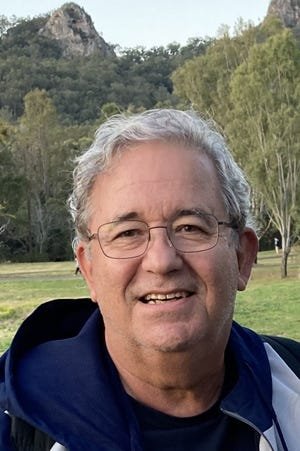
“I know poverty, I know fear,” he said, before sharing his own story of pursuing the American dream.
“The fear I know is lying under a bush in the desert at night, motionless, hiding, praying as police lights flash in the distance, waiting for a ‘coyote’ to give the signal to proceed. And the poverty I know is crawling, running and sweating in the desert for 15 days in the same pants, underwear, socks, shoes and shirt.”
His name was Jose, born in Veracruz, Mexico, the third of six children whose mother sold snacks on the street to make a living, and her name was Laura, also born in Veracruz, the youngest of 12 children to a single mother who worked on a coffee plantation.
Jose and Laura met at school and started dating when she was 14. Four years later, they were married; she was 18 and Jose was 20. They married as school sweethearts.
Jobs were very scarce in Veracruz, and the money coming in was just enough to eat. The future looked bleak. Around that time, José learned that many of his friends were going to the United States. Some worked in circuses or fairs, others to work on farms. He heard that someone in Monterrey, Mexico, was looking for someone to work on a tobacco farm. The job came with a permit to work in the United States for six months. He got the permit, left Laura and their two children in Veracruz, hopped in the back of a crowded truck, crossed the border, and worked on tobacco farms in the United States for two years.
He overstayed his work visa by six months and continued working to save up money to bring Lola over. He paid the coyotes about $1,000 to do so (today coyotes charge up to $14,000). Lola crossed the border and left her children with Jose’s family. Lola didn’t have much trouble crossing the border; she just had to walk. In fact, crossing into the U.S. on foot was effortless. Lola was lucky to have a knowledgeable, honest coyote with years of experience to help her. But not everyone is so lucky.
Two years later, José returned to Veracruz to pick up his children and cross the border on foot through Ciudad Juarez with them in tow. He was with a group of about 15 people, led by a wise coyote. He quickly learned that no amount of preparation was enough to comfort two 10- and 11-year-olds who were very scared, hungry and tired as they walked through the desert at night. The first paragraph of this story well captures the anguish José felt as he crossed the border with his children. But they made it.
Laura and Jose have lived in Asheville for about 20 years. When they first arrived, Jose washed dishes in restaurants, shoveled snow, blew leaves, and worked in a factory where he and many other undocumented immigrants worked 12 hours a day, seven days a week. Laura worked in a tienda, a Latino grocery store.
Like many Hispanic immigrants today, they live in a trailer park. After working hard over the past decade to clean up their house, they were able to buy a trailer, but not the land. In trailer parks, landlords own the land, and most Hispanic immigrants are renters. Like many others, they live in constant fear of eviction.
“Was it worth it?” I asked. “Yes,” Laura replied with a smile. “Our kids are good kids. They’re both grown, in school, with good jobs. They’re married and live nearby. They’re both recipients of the Deferred Action for Childhood Arrivals (DACA) program. We’ve prayed for DACA for 10 years. We pray every day.”
José and Laura live by the most important advice they received from their mother: “Never take anything that does not belong to you, not even a needle.” Honesty and integrity are gifts they inherited from their mother, gifts that have guided them throughout their lives and gifts that they hold dear.
more:Opinion: U.S. should step up to help Latin American neighbors live better lives
more:Opinion: America needs immigrants as a powerful engine of economic growth

Carlos Linares is an international development and environmental professional with 45 years of experience. He serves as chairman of the Buncombe County Democratic Party Hispanic Outreach Committee, secretary of the Lake Commission for Biltmore Lake, and a member of the Community Advisory Board for Blue Ridge Public Radio/NPR.
