

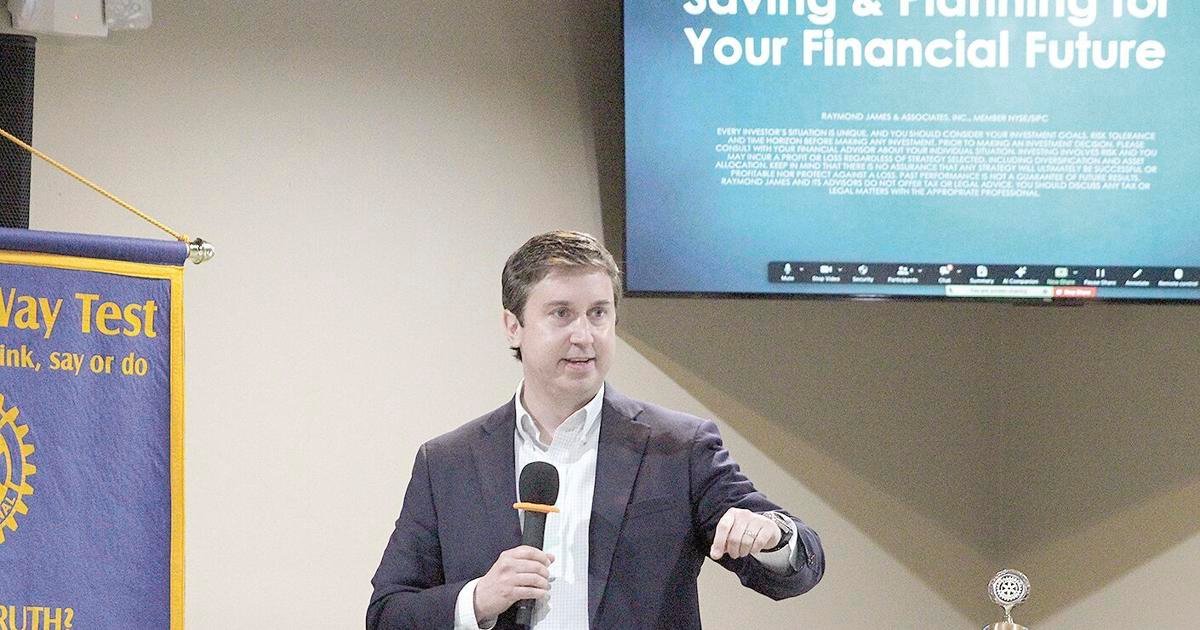
When asked when is the best time to invest money, Brad Perkins, a financial advisor with Raymond James Cooper & Cooper Investment Advisors, said he likes to answer with a story.
“When is the best time to plant a tree?” a man asked an arborist.
The arborist replied: “Oh, that’s an easy question. It was 20 or 30 years ago.”
The man then asked, “When is the second best time to plant a tree?”
“Today,” the arborist replied.
Like trees planted 20 or 30 years ago, past investments have time to mature, and Perkins says, “over the long term, markets tend to be pretty predictable. In the short term, they’re pretty unpredictable.”
That’s the financial insight Perkins offered members of his Bradley-Sunrise Rotary Club at their Thursday, May 23, meeting.
Perkins joked that he has no plans to hand out cryptocurrency or give financial advice like who to vote for in the 2024 presidential election, instead talking about the importance of investing overall.
He began by talking about what attracted him to a career as a financial advisor, sharing that during his senior year at Lee University, he began to pivot from his field of study, history, to focus on investing.
“I went to the Cleveland Bradley County Library and read all kinds of books about investing, the stock market, real estate, everything,” Perkins recalled. “That’s where my interest in money and personal finance really started to grow and blossom.”
Still, Perkins wanted to look back at his own personal history to answer a bigger question: Am I a spender or a saver?
“We can understand why we are savers or spenders by going back to our early years,” Perkins told the Rotarians.
For Perkins, growing up with a father who couldn’t work due to a neurological disorder had a major impact on his desire to save. “I realized from an early age that unexpected things happen in life, so it’s better to plan for the unexpected things in life,” Perkins says.
He also recalled a shocking moment in elementary school when he found his mother’s checkbook and wondered, “Is this all the money our family has?”
She said she was scared as a child, but that fear was due to not knowing about other options for how to spend money, such as savings accounts, fixed deposits or investing with a financial advisor.
From that moment on, he began to understand the importance of saving for the future, which he believes set him on the path to becoming a lifelong investor.
Perkins went on to quote Berkshire Hathaway Chairman and CEO Warren Buffett, who said, “If you don’t find a way to make money while you sleep, you’ll probably be working your whole life away.”
The average retirement age for the people Perkins works with as a financial adviser is 64, he said. The average retirement age is 62, he added.
“For people who are retiring three to five years earlier than planned, this situation can really throw off their financial projections,” Perkins said.
Speaking about Social Security, he said the system is only intended to replace 40 percent of income and asked Rotarians, “Can you survive a 60 percent cut in your pay? That would be pretty tough.”
Perkins pointed out that three investment areas could be key for saving for the future: real estate, banking and the stock market.
“If you put your money in a bank, you might not get as much return as you do now,” he said, noting that interest rates on savings and term deposits are currently around 5%. “There are risks and rewards when you invest in the stock market. These are things we know and we’re especially prepared for, so it’s not really a surprise.”
“On average, the market has gone up 10% a year,” Perkins said of the S&P 500 index.
More specifically, the S&P 500 is up 11% so far this year, while the market gained 24% last year, but is down 20% in 2022.
“A 20% drop hurts, but statistically it’s expected to happen about once every six and a half years,” Perkins said. “The good thing about the stock market is that it goes up more often than it goes down.”
He used the COVID-19 outbreak in March 2020 as a case study, saying the stock market fell 20% but ended the year in the positive, up 16%.
“One thing I’ve learned is that once you invest, it’s extremely important to stay invested,” he said. “Markets can go up and they can go down, but the real key to investing is the time you’re in the market. It’s not about trying to time the market.”
Perkins told Rotarians that in a hypothetical investment scenario, someone who invested $10,000 in the S&P 500 in January 2003 would have $64,000 by December 2022 if they continued to invest.
He said that if he had missed the market’s strongest 10-day period in the last 20 years, the increase in his investment would have been just $29,000.
If you invest in the stock market today, will you make money tomorrow? Perkins says the chances are closer to 50/50. But if you hold your investment in the market for a month, your chances of making money increase to 62%. After a year, your investment has a 75% chance of making money.
“If you invest for 15 years, you have a 99.8% chance of making a profit,” he said.
Perkins reminded Rotarians that for people who “can’t stand the ups and downs” of the stock market, investing in profitable savings accounts or certificates of deposit is a strong option.
He ended his speech by urging people not to make all their investment decisions based on what they read on the internet, saying “it’s not a good strategy.”
Perkins also said it’s unwise to spread the word about a particular stock investment opportunity.
“Seek investment advice you can trust — people you know and people with years of experience who can give you serious advice, not conspiracy theories or gossip,” Perkins said.
