

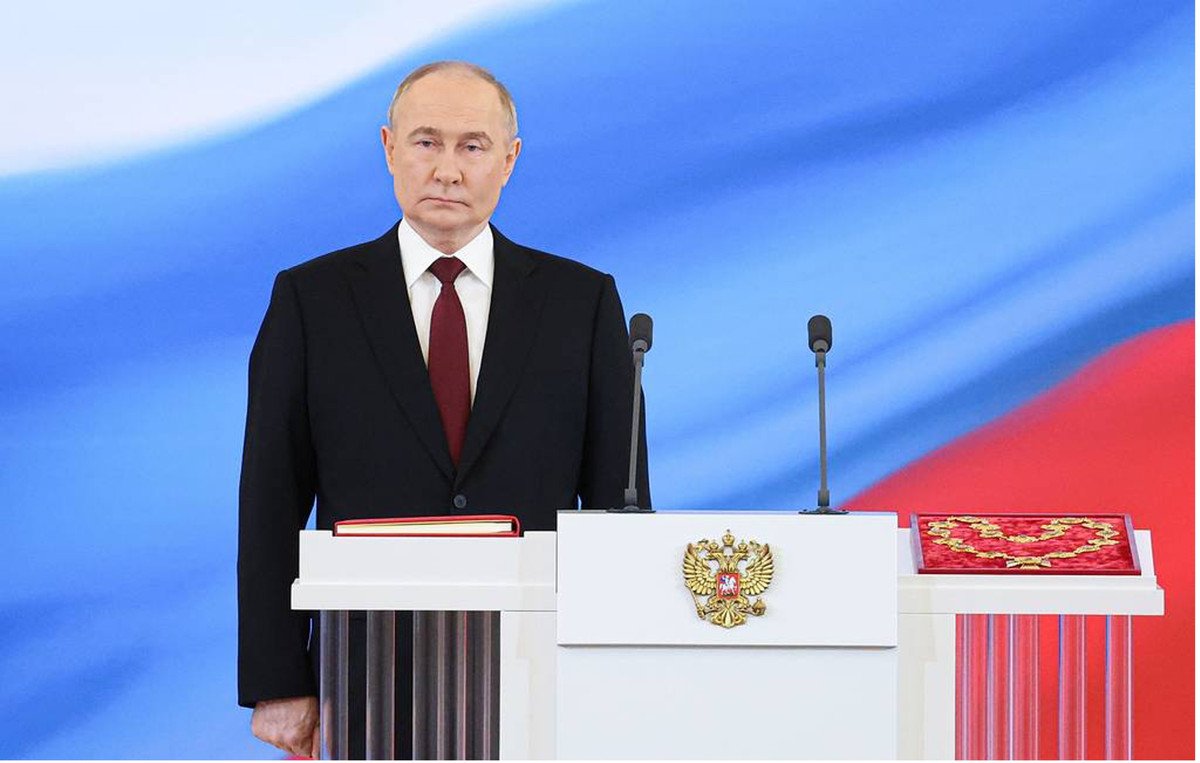
Unlike Western countries, where politicians tend to make their objectives public in manifestos before elections, Putin’s Russia makes them public after elections through executive orders and decrees. The title of this year’s proposal is “On the long-term national development goals of the Russian Federation until 2030 and 2036.” It replaces the 2020 version and consists of 11 paragraphs and a number of subparagraphs setting out the President’s specific goals and objectives, effective on the date of signing.
But don’t worry. I’m not going to explain it line by line, but just highlight a few important points and comment on their veracity. If you’re really interested, you can find the full text in the original Russian here or the (Google) translation here.
paragraph 1
It consists of seven subparagraphs summarizing the content of the document, setting out the national goals of the Russian Federation until 2030 and future goals until 2036.
Section 2
This shows how Russia will work to “maintain the population, strengthen health, improve people’s welfare and support families.” It aims to increase the country’s birth rate, encourage families to have three or more children, and increase life expectancy from the current 73.4 years to 78 years by 2030 and 81 years by 2036. It has established.
comment: Bloomberg reported that independent demographer Alexei Raksha said Putin’s goals are “unrealistic without ending wars, significantly tightening regulations on hard alcohol and tobacco, and doubling health care costs.” He said that he had pointed out that.
Other interesting topics
‘Heavy fighting’ is occurring along ‘the entire front’: Zelenskiy
Fierce fighting continues as Russian forces attempt an offensive on the Eastern Front. Washington announced a new $400 million military aid package for Kiev hours after the attack began.
The Decree also increases the number of elderly and disabled citizens receiving social assistance, improves medical and rehabilitation support for participants in “special military operations”, reduces poverty levels and increases the salaries of civil servants. He also said he would raise the wage and introduce a new minimum wage. .
Section 3
It outlines how to “educate everyone to realize their potential, develop their talents, and produce patriotic and socially responsible individuals.” Again, it sets numerical and percentage targets for its many “initiatives” but does not provide details on how they will be achieved or evaluated.
Section 4
This defines what President Putin calls Russia’s goals: to provide all citizens with a “comfortable and safe living environment,” including updating housing stock, infrastructure, transportation, public and historic amenities; The aim is to provide each individual with 33 square meters of living space by 2030. By 2036 he will have 38 square meters.

A cartoon satirizing the announcement of 33 square meters.
comment: Independent news site Insider says that under current law, the legal right for individuals is already 33 square meters, but this will be reduced to 42 square meters for married couples, with each family being given an additional 18 square meters. . The report points out that in some regions of Russia the allocation for individuals is currently just 18 square meters, plus an additional 6 square meters per family member, and asks where the additional space will come from. .
This paragraph contains another restatement of Putin’s previous aviation statement that by 2030 at least half of civil airlines’ aircraft should be provided with domestic production, which will This means that more than 600 aircraft will need to be manufactured each year.
comment: In the first half of 2023, each factory completed the production of just two commercial aircraft for customers, which were delivered several months behind schedule. Shortages of key parts due to sanctions have hampered production of key items, particularly affecting deliveries of new engines that were unable to pass flight acceptance tests.
Section 5
It stipulates how Russia will ensure its future “environmental health”, including waste reduction, separation and recycling, reduction of industrial emissions, hazardous waste, water pollution and nature protection. targets and percentages have been set.
Section 6
It enumerates the requirements for establishing a “sustainable and dynamic economy,” including improving GDP, reducing imports, increasing investment, improving salaries and pensions, “robotization,” vocational training, and tourism. Contains ambitious goals.
Section 7
How will President Putin become one of the world’s top 10 superpowers in terms of “technological leadership” through investments in scientific fields such as automation, space and nuclear technology, the bioeconomy, and the chemical industry, as well as the expansion of research and development in all fields? Explain how you would like to rise to the top.
Section 8
Setting goals for “digital transformation of state and local government, economic, and social areas,” including healthcare, education, machine learning, and artificial intelligence. He also believes that it is necessary to improve high-speed broadband access, access to the Internet, satellite and mobile communications, and replace his 80% of externally created software with domestic versions.
comment: The last wish was effectively imposed on Russia, as major software providers such as Microsoft withdrew in parallel with the imposition of sanctions.
Paragraphs 9-11
These primarily include the legal and procedural elements of issuing and implementing executive orders.
Many of the goals in the 2024 Ordinance are similar to those in the 2018 version, and in many cases are almost exactly the same. Needless to say, most of them were close to being achieved, and many of them were pushed aside by the invasion of Ukraine in 2022. There is little to suggest that we will see any improvement in the next six or 12 years.
The views expressed in this opinion article are those of the author and not necessarily those of the Kyiv Post.
