

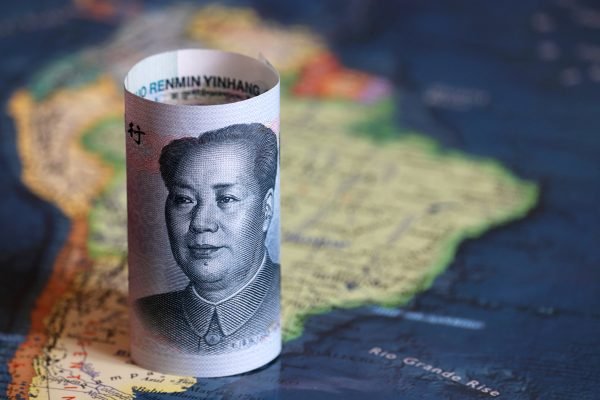
Due to the growing presence of China in the field of trade and investment in Latin America, attracted attention Opinions from U.S. policymakers and businesses. The United States and its traditional allies, accustomed to their position as the region’s leading powers, now face competition from China.
This trend started 20 years ago. China’s growing economic involvement in Latin America began after it joined the World Trade Organization (WTO) and launched its Going Global strategy in 2001. Trade between Latin America and China It grew from $12 billion in 2000 to more than $445 billion in 2021.
With increasing foreign direct investment (FDI), diplomatic efforts, and increased trade complementarity, China’s involvement is only increasing year by year. Chinese FDI was initially aimed at ensuring food and energy security through mergers and acquisitions with local and foreign companies in Latin America’s agriculture, oil and gas sectors. The first white paper outlining the Chinese government’s vision for engagement in the region was released in 2008, at a time when Chinese companies were still gaining knowledge, assessing strategic objectives, and understanding each country’s political economy, regulations, and institutions. I was learning how to navigate my environment.
After 2013, during Xi Jinping’s first mandate and the launch of the Belt and Road Initiative (BRI), the vision changed. The focus of Chinese investment has been large-scale infrastructure projects, mainly focused on the energy sector. In 2016, China released a second, more detailed white paper outlining its Latin American policy, focusing on cooperation for development, energy and sustainability in a South-South framework.
Between 2005 and 2012, it is estimated that: China’s total FDI in South America and Mexico The total amount reached approximately $63 billion, and between 2005 and 2023, the total FDI of Chinese companies in the same country reached $212 billion. Brazil accounts for just over a third of the total, Chinese investment worth $71.6 billion in 235 projects.
Chinese FDI in Latin America continued to grow steadily until it was interrupted by the social and economic challenges of the pandemic, further exacerbated by China’s strict lockdowns and zero-corona policy. In 2020 and 2021, total Chinese investment in Latin America decreased in the region.
However, investment flows increased in 2022 and 2023. Only this time, funds were directed to new sectors such as: Solar power, wind power, hydropower, electric vehicles (EV), etc.mining in strategic supplies Other priorities include lithium and rare earth minerals, which are important feeders into the value chain of many of the advanced technologies involved in decarbonisation. Many of the Chinese companies operating in these new subsectors are privately owned, such as BYD and Great Wall Motors.
Due to rising geopolitical tensions, importance arose An overview of industrial and technology policy in governments in the developed North and the global South. CHIPS and the Science and Inflation Control Act in the United States are examples of this trend, as is China. Focus on indigenous innovation and indigenous technology For example, it is encapsulated in the 14th Five-Year Plan (2021-2025) and the Made in China 2025 Strategy.Analysts point out this term “New infrastructure” It has appeared in Chinese media and policy documents as a glossary designating areas that China hopes to develop domestically while becoming a competitive global player.
Information technology related to data centres, semiconductors and artificial intelligence is a key focus for policymakers in Beijing, but so are renewable energy generation and electric vehicles. Technology is a key aspect of China’s efforts to rebuild its domestic economy and compete with the United States.
The general trend of Chinese investment in Latin America in 2022-2023 is an increase in the number of small-scale projects. This represents a shift from previous trends in large-scale infrastructure projects. Belt and Road Initiative (BRI), multi-billion investments in Brazil and Argentina by State Grid and China Three Gorges, etc.For example, towards more agile and numerous technology-intensive projects. Although small in scale, these new projects are aimed at strategic areas.
Changes in foreign investment policy reflect changes in the priorities and characteristics of China’s economy. Concepts such as new “high-quality productivity,” “small but beautiful,” “inherent innovation,” and self-reliance are emerging as priorities for the Chinese nation. The government is facing challenges and slowdowns caused by an aging population, high youth unemployment, a real estate crisis in the real estate sector, and a post-COVID-19 consumption recovery that has not been as strong as the Chinese government had hoped. , trying to reignite economic growth. All of this reflects Chinese companies investing overseas, with Chinese companies focusing on technology and innovation and trying to find new markets and trading partners, while overcapacity increases. Exported to industry. Domestic demand is decreasingthe same as for EV.
In 2022, two FDI acquisitions took place in Argentina’s lithium sector. Ganfeng Lithium and Zijin Mining Group, totaling $1.7 billion. A greenfield investment in a battery factory and mine by Chinese automaker Chery Automobile and a greenfield investment in a lithium carbonate plant by Liex, a subsidiary of Zijin Mining Group, were both announced in Argentina in 2023. In Chile, Chinese EV maker BYD announced a $290 million investment. Use lithium.
In addition, automaker Geely Automobile has formed a joint venture with Renault and acquired seven factories around the world, including one in Cordoba, Argentina. These factories manufacture aluminum parts for gearboxes, which are used by the subsidiary Hose. The company produces gearboxes at other plants in Chile and Brazil, supplying companies such as Renault, Dacia, Nissan and Mitsubishi.
Investments continued in Brazil. great wall motors, acquired the Mercedes-Benz factory in São Paulo state in 2021 for the purpose of producing electric cars and batteries. The company continues to build production capacity with an investment plan of BRL 4 billion ($776 million) from 2022 to 2025. In addition to developing research and development projects, the automaker plans to produce electric and hybrid vehicles.
Volvo, the Swedish automaker whose largest shareholder is China’s Geely, has invested 881 million reais in a factory in Paraná, Brazil. These funds will be used to develop products and services focused on electromobility and decarbonization, and will be part of a larger investment cycle expected to reach RMB 1.5 billion between 2022 and 2025. .
BYD is Invested 1.1 billion reais The company will produce electric bus and truck chassis in the Brazilian state of Bahia, manufacture electric passenger cars and hybrid passenger cars (with an initial estimated production capacity of 150,000 units per year), as well as process lithium phosphate and iron phosphate in Brazil. It will be exported to Brazil later. worldwide market. The project was approved in July 2023. BYD will take over three factories formerly owned by U.S.-based Ford Motors in Bahia, which it exited in 2021 after more than 40 years of operations in Brazil. BYD plans to start production in Brazil in late 2024 and has already partnered with local energy companies Raizen to build charging network stations in eight major cities in the country.
In summary, Chinese state-owned enterprises were the first to enter Latin America, laying the foundations for power and other capital-intensive sectors. But over the past decade, private companies have been investing in sectors that offer greater returns and are more technology-intensive. Although it may be too early to say for sure, the evidence points to a clearing up of regional value chains in green technologies led by Chinese companies, with Chile and Argentina producing strategic minerals and batteries, for example. On the other hand, there is still manufacturing capacity for EVs and solar panels. Located in Brazil, it has the potential to become an export hub for the entire region.
If this configuration itself is confirmed, it could be due to geo-economic influences or economic policy – Concepts associated with the use of economic resources by states to achieve objectives related to national interests or global influence. Latin American countries need to develop their own plans and strategies for the creation of higher value-added products, production innovations, and industrialization to leverage Chinese capital in their development processes.
Finally, this means that geopolitical tensions and competition with the United States will intensify, even in areas that were previously under the United States’ irrefutable influence. Reality changes rapidly and changes further through the power and influence conferred by capital, finance, and employment. of new technology.
